Get Full Government Meeting Transcripts, Videos, & Alerts Forever!
Get email alerts on the State Public Defender topic
No spam. Unsubscribe anytime.
New State Public Defender office seeks millions to staff operations, cover transcripts and onboard counties
Summary
Legislative analysts and the State Public Defender told JFAC the newly created statewide public defender agency needs supplemental and ongoing appropriations to utilize a $39 million cash transfer, pay transcript costs after a recent Idaho Supreme Court ruling and recruit staff for new institutional offices.
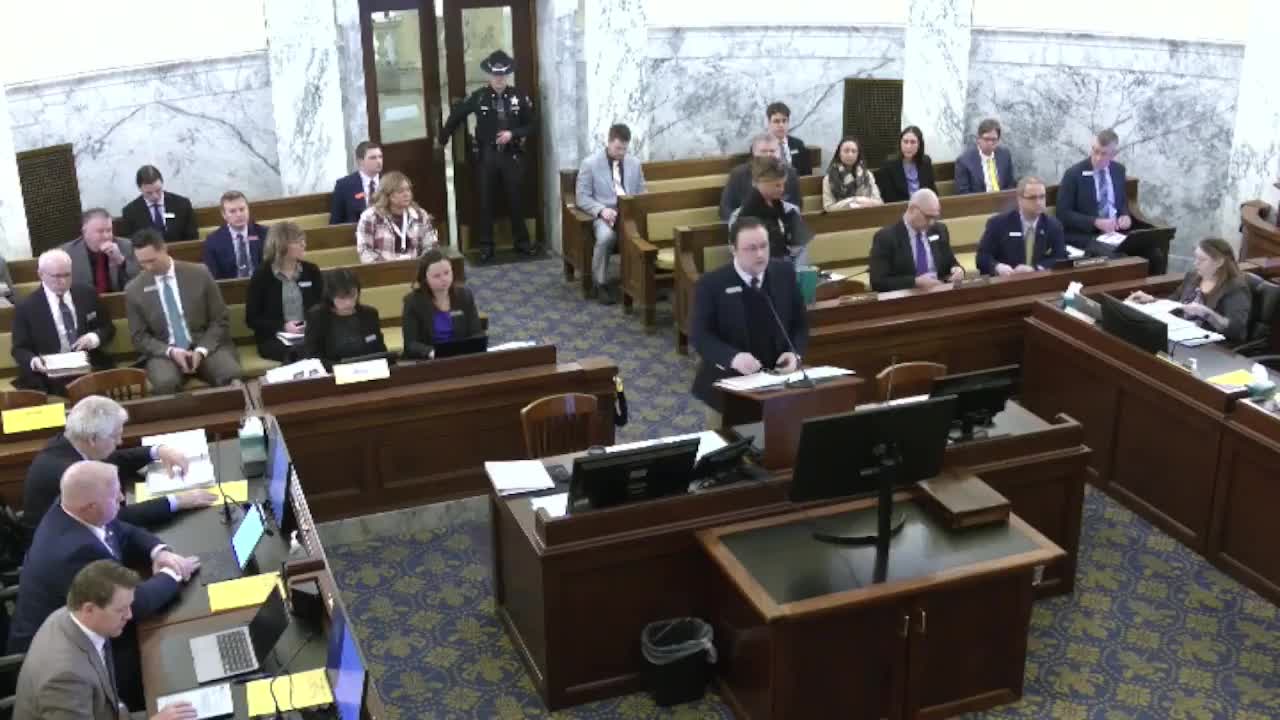
At a Joint Finance-Appropriations Committee hearing, Legislative Services Office analyst Christopher Lahoset and State Public Defender Eric Fredericksen outlined the budget and staffing needs of the newly created State Public Defender office.
Why it matters: The office was created by statute and funded, in part, with a $39 million transfer from the tax relief fund into a dedicated State Public Defense Fund. The agency says statutory cash transfers require matching legislative appropriation before funds can be spent; the agency and the governor recommended a combination of one-time and ongoing appropriations to fully use the enacted cash transfer and to cover unanticipated costs that became clear after the office began operations on Oct. 1.
Lahoset said the State Public Defender was created by statute (Title 19, Chapter 60, Section 3 of the Idaho Code). He presented the agency’s budget structure, noting the office had 29 vacant positions in the budget plan and a personnel budget of about $37.7 million. The analyst said the agency’s base appropriation after initial enhancements is just under $49 million and the current fiscal-year total authorized appropriation is about $52,000,015.30.
Lahoset walked the committee through several funding requests. For the current fiscal year the agency requested a one-time supplemental of $2,500,000 to allow the office to fully use the $39,000,000 cash transfer. He explained agencies need both cash and legislative appropriation to spend transferred funds; the appropriation for the transfer had been omitted in the previous budget formulation. The governor recommended a supplemental $390,200 for transcript costs after the Idaho Supreme Court ruled on Dec. 5, 2024, in State v. Blasick that the state is responsible for transcripts that counties had previously paid.
For FY2026 the agency requested $2,500,000 ongoing to fully utilize the $39,000,000 cash transfer, plus $16,000,380 (and an additional $80,800 noted in the budget book) from the General Fund to increase public-defense operating funds for contract attorneys, investigators, experts, capital litigation, training and transcripts. The agency also requested authorization for 17.96 additional full-time positions and $226,700 ongoing to stand up four new institutional offices (Benewah, Elmore, Jerome and Shoshone counties) as counties transition into state management.
Eric Fredericksen, the State Public Defender, described the agency’s rapid transition after Oct. 1 and the operational challenges it revealed. Fredericksen said the statewide reorganization followed long-standing studies and interim legislative work dating back to 2012, and that COVID-era case patterns initially informed funding plans. "We walked into 1,300 withdrawals and cases," Fredericksen said, describing a sudden workload that required district defenders and leadership to handle active litigation during the early transition. He said many flat‑fee county contracts were unsustainable and that the unified system required higher, uniform payment rates to recruit and retain attorneys in rural districts.
Fredericksen and committee members discussed costs categorized as "miscellaneous" in the agency request, which include expert fees and certain psychosexual evaluations (Fredericksen cited roughly $2,500 per evaluation). He also told the committee that while the agency was appropriated cash for representation of parents and children under the Child Protective Act, it had not received the necessary appropriation to spend those monies and therefore sought supplemental authority.
Committee members raised several operational questions: how counties will transition facilities (current statute requires counties to provide facilities until 2029), the pace of onboarding counties into the statewide system, whether the changes have produced savings, and the duration and use of reappropriated one-time funds. Fredericksen said some counties will still require contract attorneys and that the state will not absorb every county into institutional offices.
Lahoset noted a fund-flow detail: online retailer sales tax revenue is deposited to the tax relief fund and, under Idaho Code §57-8207, the state controller is directed to transfer $39,000,000 to the State Public Defense Fund. He presented the governor’s recommended fund shift that would place some appropriation authority on the dedicated fund, contingent on legislation amending the cash transfer.
No committee vote occurred at the hearing. Fredericksen concluded by saying the office is five months into statewide operation and is continuing to adapt its staffing, contracting and case‑management tools to provide uniform indigent defense across Idaho.