Get Full Government Meeting Transcripts, Videos, & Alerts Forever!
Get email alerts on the Nutrition And Food Policy topic
No spam. Unsubscribe anytime.
American Falls FFA students present pro and con perspectives on processed foods to committee
Summary
American Falls FFA students presented contrasting views on processed foods and whole-food diets before the Senate Health and Welfare Committee, citing sources and statistics; presentation comprised student role-play and discussion, and generated committee praise.
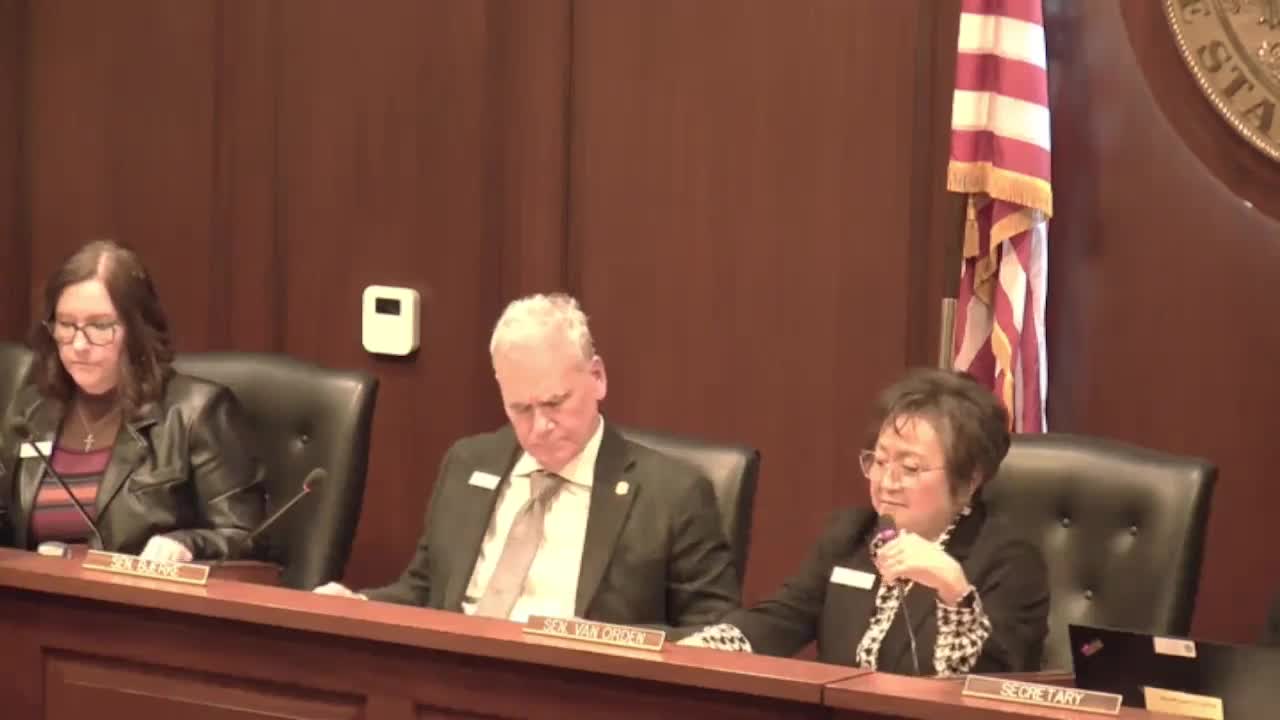
A team from the American Falls FFA presented to the Idaho Senate Health and Welfare Committee a student-led panel exploring arguments for and against processed foods.
Noah Cummins introduced the panel and said he organized the discussion to help parents decide between processed ready-to-eat foods and whole foods. Panel members identified themselves and their assigned roles: Sadie Porth presented material as a representative of the Food and Drug Administration; Ava (also shown as Eva in the record) Cardona spoke representing Kellogg’s; Joaquin Morales spoke as a consumer representative; Anna Hernandez identified herself as an extension home economist; Excel Fonseca spoke as a medical professor representative; and Leslie Hernandez identified herself as a nutritionist.
Panelists presented competing claims, frequently prefacing assertions with citations to agencies or studies. Points made by presenters included:
- Pro-processed-food assertions (attributed to student presenters): processed foods contribute sizable shares of U.S. diets, offer affordability and shelf life, and support food-manufacturing jobs and supply chains; the presenters cited the Centers for Disease Control, the U.S. food-manufacturing sector and AgEcon statistics during their remarks.
- Pro-whole-food assertions (attributed to student presenters): processed foods can contain additives and high sugar or fat levels linked to chronic disease; marketing and labeling gaps can mislead consumers; agricultural monocultures driven by processing demand can reduce agrobiodiversity and harm the environment; presenters cited the National Institutes of Health, the United Nations, Columbia University and other sources during their remarks.
The students framed many numeric claims as coming from third-party sources; the committee did not independently verify those figures during the session. The presentation included references to specific statistics (for example, presenters cited percentages of daily calories from processed foods and large employment and economic figures). Some numbers stated in the presentation appear inconsistent or unusually large when viewed alongside standard published figures (for example, employment numbers and industry valuations presented without a clear citation in the record). The transcript records those figures as presented by students; the committee did not adopt or endorse the specific numeric claims.
Committee members praised the students’ preparation and balanced approach. Senator Wintrow said, “I thought that was really well done, very informative,” and Senator Shippey commended the students for public-speaking skills. No committee action followed the presentation; the panel answered senators’ questions and summarized positions before departing.
The presentation was educational and framed as a student exercise: the panelists were representing assigned roles rather than testifying as subject-matter experts. The committee did not receive supporting materials or studies in the meeting record; any cited studies or statistics should be checked against the primary sources before being used as factual support in reporting or policymaking.