Get Full Government Meeting Transcripts, Videos, & Alerts Forever!
Get email alerts on the Bsu Budget Lawsuit Values topic
No spam. Unsubscribe anytime.
Boise State presents FY2026 requests; president highlights LAUNCH enrollment, Institute for Advancing American Values, semiconductor workforce plans and says $1
Summary
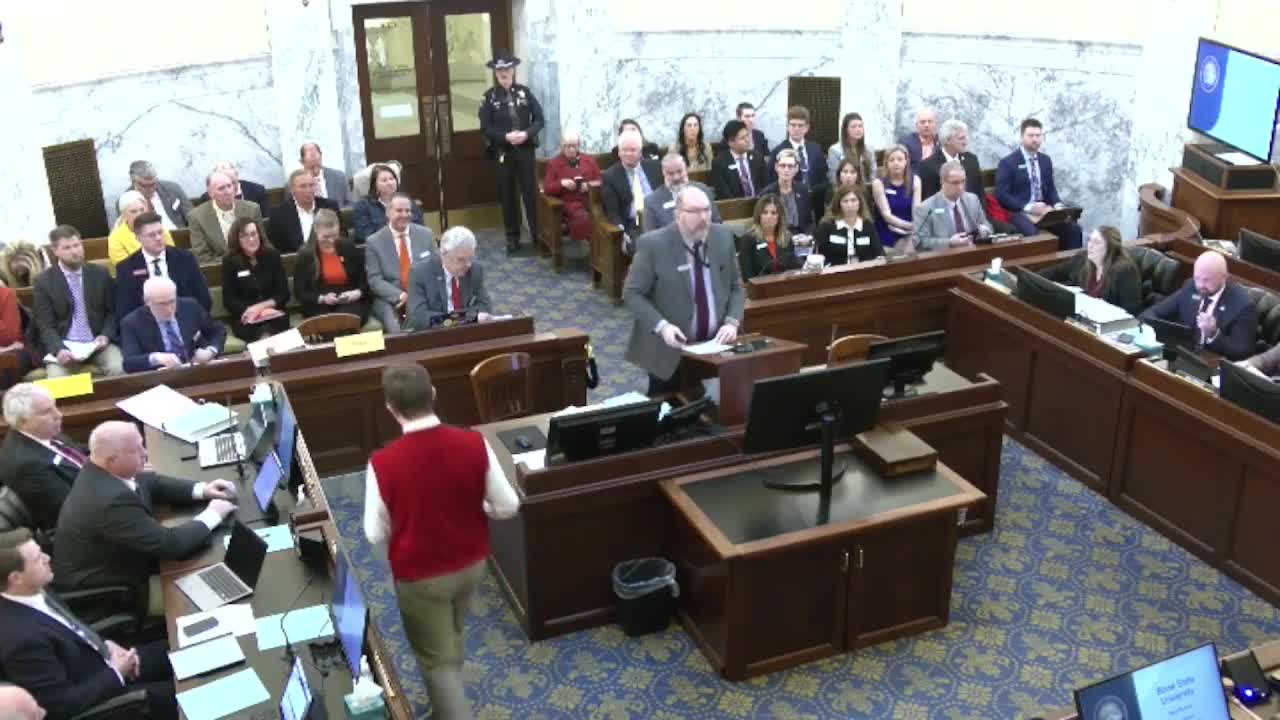
At the Jan. 29 JFAC presentation Boise State University President Marlene Tromp outlined FY2026 funding priorities, cited LAUNCH enrollment and graduation‑rate gains, described restructuring of campus equity centers, and said the university spent about $1.5 million from non‑tax funds to defend a lawsuit related to a campus vendor.
Boise State University officials presented their FY2026 budget overview to the Joint Finance‑Appropriations Committee on Jan. 29, and President Marlene Tromp described priorities that include expanding nursing and engineering capacity tied to semiconductor industry growth, continuing LAUNCH‑program enrollments and transforming some student‑support functions.
Kevin Campbell, the Legislative Services Office analyst, said the packet shows Boise State enrollment of more than 27,000 students and noted the university’s operating‑budget slides. Campbell and university staff explained that personnel costs represent the largest share of expenditures and reviewed recent general‑fund reductions and operational‑capacity enhancements (OCE) in prior fiscal years.
President Tromp told the committee Boise State has about 1,300 students enrolled in the state LAUNCH program and said LAUNCH provides access for students in fields that align with workforce needs, including nursing, computer science and engineering. She credited a five‑year drive on student success with substantial graduation‑rate gains and told the committee Boise State now has a balanced budget and a comparatively low administrative cost per student.
Tromp described steps the university has taken to restructure centers and staff previously focused on diversity‑related programs. She said Boise State reduced staff involved in those centers (from a prior total of eight staff) and reoriented resources toward student‑success work that serves broader student populations. Tromp said BUILD’s DEI certificate was closed in October 2024 and that some student‑support functions formerly delivered by discrete centers have been reconfigured to serve veterans, rural and first‑generation students.
On campus litigation, Tromp told lawmakers Boise State used only non‑taxpayer funds to defend the university in litigation involving a campus vendor, and she said the university has spent about $1,500,000 to date on that defense. “We used only non taxpayer funds to support the defense of that lawsuit,” Tromp said. She told the committee she did not expect the appeal to add a significant amount to the total at that time and offered to provide itemized details on legal and related expenses to the committee.
Tromp also discussed Boise State’s Institute for Advancing American Values and related programming (including Idaho Listens) framed as efforts to bring a range of perspectives to campus and to protect free expression; she noted the university has adopted the Chicago principles in its faculty governance and that student government has passed a similar commitment.
On workforce development, Tromp said Boise State is expanding engineering and computer‑science capacity to prepare graduates for semiconductor manufacturing and related industries and pointed to one piece of lab equipment (an Xtron used to deposit crystals) that, she said, is rare outside industry in North America. Committee members asked how Boise State would use potential state capacity‑building funds; Tromp said she would prioritize additional nursing graduates, cybersecurity support for rural businesses and expanded engineering and computer‑science sections.
Committee members asked about classes and course requirements tied to gender or diversity topics. Tromp said that UF‑100 and UF‑200 required course shells have many sections and students may choose which subject‑area section they take; she said no gender‑specific class is required and that the university was reviewing course offerings to ensure compliance with state and federal law. One committee member asked Tromp to provide written assurance that courses comply with Idaho Code 33‑138 and 33‑139; Tromp accepted the request.
Campbell and Tromp also discussed the federal funding pause announced earlier that day. Tromp said the university initially estimated a potential mid‑day‑to‑mid‑day impact of about $25,000,000 to grants and programming before a court injunction paused the federal directive; she said Boise State is reviewing affected grants and working with state officials to understand any impacts.
The committee did not take a formal vote on Boise State’s FY2026 requests at the meeting and asked Tromp to provide further financial detail and follow‑up materials.