Lifetime Citizen Portal Access — AI Briefings, Alerts & Unlimited Follows
Speakers trace 5,000 years of human and environmental change along the Loxahatchee River
Loading...
Summary
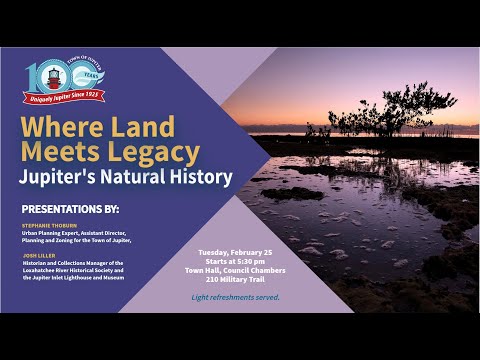
At a Town of Jupiter centennial presentation, historian Josh Liller outlined the area’s environmental history — from indigenous habitation and early European contact to 20th-century canals, logging and the creation of the Jupiter Inlet District — and described how those changes shaped the river seen today.
Josh Liller, historian and collections manager for the Loxahatchee River Historical Society and vice chair of the Town of Jupiter’s Historic Resources Board, told an audience at the town’s centennial presentation that people have lived along the Loxahatchee and its adjacent waterways for at least 5,000 years.
“We've got the Gulf Stream just offshore, which is vital for our weather and our climate,” Liller said, beginning a roughly hourlong recounting of the river’s physical evolution and human use. He described the area’s original coastal and wetland environments, Native American shell mounds and middens, early European contact and later settlement patterns that followed the construction of the lighthouse in 1860 and the arrival of rail service.
The talk emphasized how 20th‑century alterations — canals, dredging and road and rail construction — changed the river’s hydrology and ecology. Liller said large drainage projects and canals such as the C‑18, built to drain the Loxahatchee Slough and for agricultural use, likely represent “probably the single biggest change to the Loxahatchee River,” and he linked canal and ditch construction after World War II to declining water clarity, muck accumulation and changes in fish and oyster populations.
Liller detailed logging and resource extraction in the river corridor, noting both pine and cypress were harvested from pioneer settlement through World War II. He pointed to historic practices such as dredge‑and‑fill and the building of bulkheads and seawalls that narrowed the river and removed natural shoreline habitat.
The presentation also outlined political and conservation milestones: Fort Jupiter’s military reservation that delayed settlement, the post‑war push to drain wetlands that culminated in regional water‑management efforts, and conservation efforts in the 1960s–1980s that led to acquisition of river corridor land and the Northwest Fork’s designation as Florida’s first national wild and scenic river in the 1980s.
Liller cited archaeological and archival evidence during the talk: carbon‑14 dating from sites at Sawfish Bay that he said support continuous human presence “for 5,000 years or more,” and large shell mounds such as the Du Bois Mound that he described as roughly 30 feet tall and formed over centuries of shell deposition.
The talk concluded by framing current management work — including ongoing challenges with saltwater intrusion, balancing freshwater flows and preserving remaining cypress stands — as the latest chapter in a long sequence of human and natural influences on the river system.