Get Full Government Meeting Transcripts, Videos, & Alerts Forever!
Get email alerts on the Corrections Security topic
No spam. Unsubscribe anytime.
Idaho DOC asks Legislature for security upgrades after staff shot during transport
Summary
Following a spring ambush that left three Idaho Department of Correction staff wounded, the agency told the Joint Finance Preparations Committee it seeks funding for surveillance technology, expanded transport teams and a body-worn camera pilot to reduce contraband and protect staff during high-risk transports.
The Idaho Department of Correction asked the Joint Finance Preparations Committee on Feb. 4 for multiple budget additions to shore up security after a spring incident in which staff were shot while returning a hospitalized inmate to custody.
The requests include a one-time supplemental to expand the transport bureau, ongoing funding for digital mail scanning, drone detection and phone-call transcription tools, and a federally funded pilot to equip certain staff with body-worn cameras. The agency framed the package as measures intended to reduce contraband, improve situational awareness and create a trained statewide resource for high-risk medical transports.
Noah Peterson, budget and policy analyst with the Legislative Services Office, briefed the committee and summarized the agency's ask, telling members that the supplemental package was prompted by “an inmate that was transported to St. Alphonsus medical facility to receive emergency treatment … they were ambushed by a lone gunman. Three IDOC staff were shot,” and that the suspect and inmate were later linked to additional murders before being apprehended.
Director Josh Tewalt described how DOC investigated vulnerabilities exposed by the attack and recommended specific changes. He said mail and drone-borne deliveries, plus illicit cellphones, have become increasingly sophisticated and harmful. “The level of sophistication that is being deployed today to introduce contraband into correctional facilities is unlike anything any of us in the field have ever seen,” Tewalt said, adding that mail scanning and drone detection would allow staff to close “porous” points of entry and redeploy personnel to other security tasks.
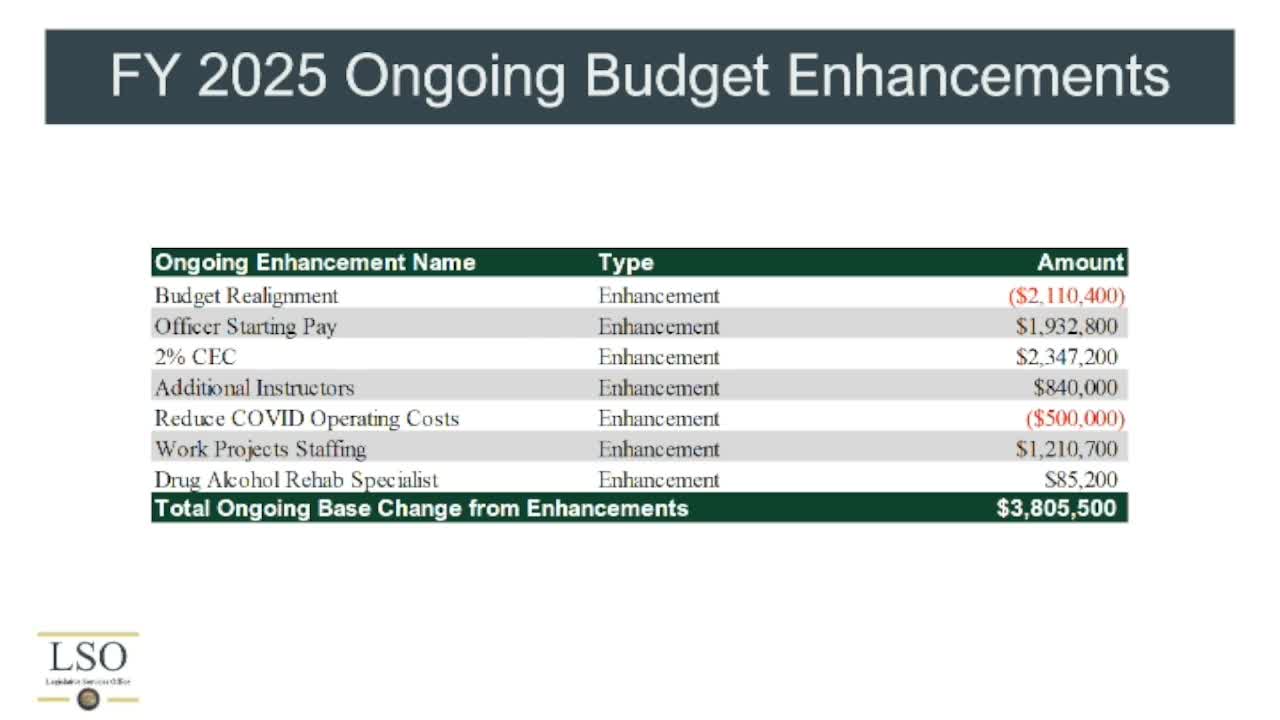
The agency’s fiscal materials break the technology request into a one-time FY2025 supplemental of about $795,000 to begin implementation and an ongoing annual cost estimate of $2,397,000. The FY2026 ongoing total is shown in the budget book with component estimates: digital mail scanning ($1,011,000 annually), drone detection ($385,500 annually) and the phone-call transcription/analysis platform (described as LEO technology, $1,000,000 annually). The LEO software was presented as a transcription and analytics tool to help identify intelligence in recorded calls and inform investigations.
To reduce operational strain from emergency transports, the department asked for both a one-time FY2025 supplement of $1,148,000 (including $455,000 in personnel costs for the remainder of the fiscal year and roughly $693,000 for seven fully equipped vehicles) and an ongoing request that would fund 12 full-time positions (12 FTE) and related operating costs (about $965,500 annually). Tewalt explained that emergency medical escorts had previously been handled as an ad-hoc duty by facility staff, producing thousands of overtime hours; after the attack, DOC concluded a dedicated, trained transport resource was necessary for high-risk moves.
The agency also proposed a body-worn camera pilot for three sites (Idaho Maximum Security Institution, a District 3 probation and parole office, and the agency’s special investigations unit). The FY2025 supplemental would cover much of the front-end equipment and storage costs through a primarily federal grant; the state match and ongoing licensing could require state funds in subsequent years.
Committee members asked about offsets and staff impacts. Senator Cook queried why the department proposed 12 new FTEs rather than reallocating existing posts; department staff and the director said the nature of emergency transport requires specially trained personnel and a higher relief factor, not a simple transfer of duties. Noah Peterson noted high overtime totals — tens of thousands of hours at some facilities — that the department cited when justifying the new positions.
Tewalt emphasized the broader public-safety argument for some elements of the package, saying transcription and analytics of custodial phone calls can provide actionable intelligence to state, local and federal partners. He said the tools leverage existing data and could be used, with appropriate controls, to support community investigations as well as internal safety work.
The committee did not take a vote on these items during the hearing; lawmakers asked for additional detail and committed to follow-up before final budget decisions.
Looking ahead, DOC told the committee it would provide additional implementation details and cost breakdowns for members’ review before appropriations are finalized.