Get email alerts on the Auditor Return Checks topic
No spam. Unsubscribe anytime.
King County auditor finds inconsistent return-check fees and recommends standardization
Summary
An Auditor's Office review found most returned payments were e-checks (78%), many due to bad account numbers, that only 2% of county checks are returned, and recommended agencies align return-check fee practices with county policy to improve revenue recovery and equity.
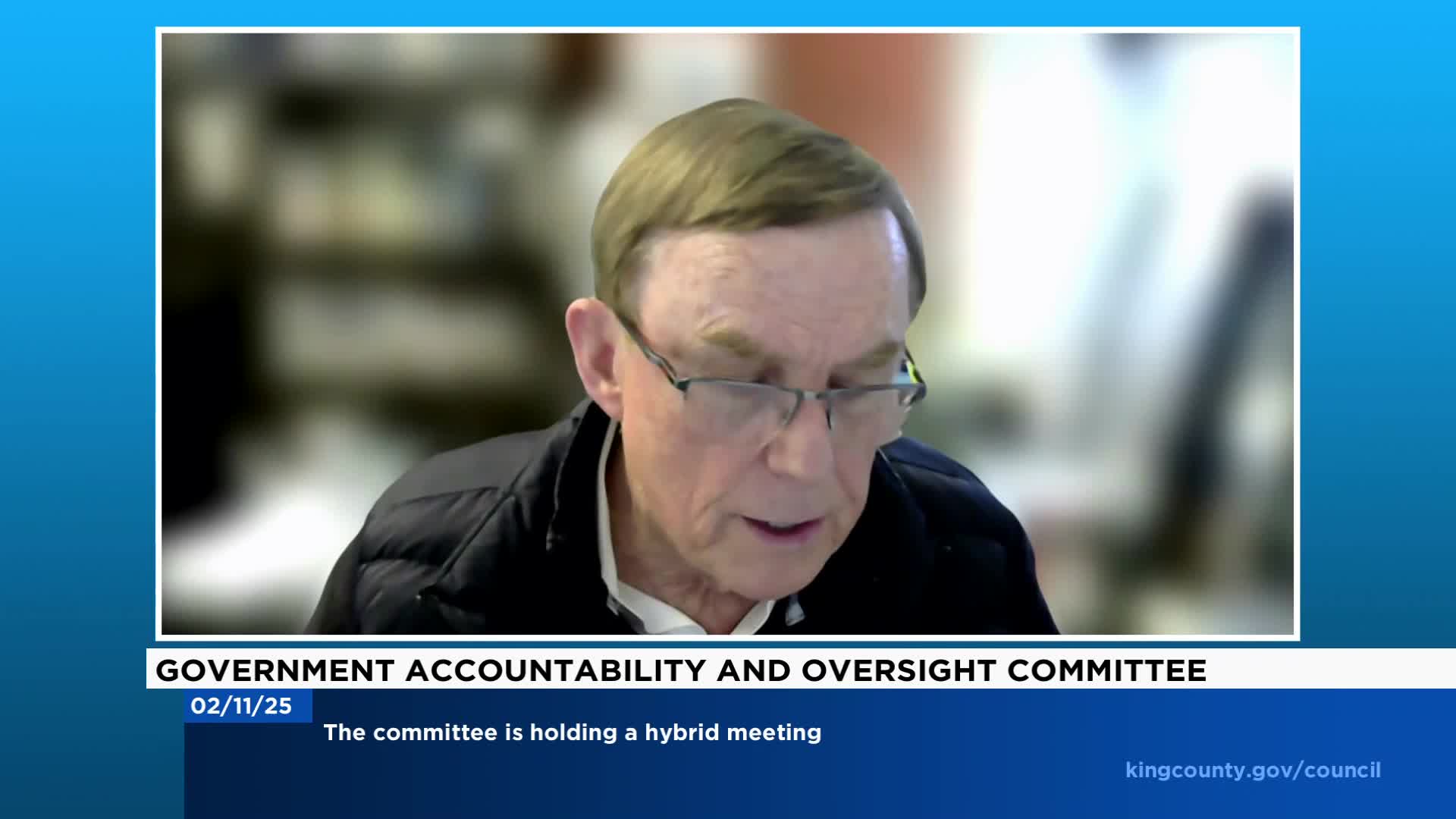
The King County Auditor’s Office on Feb. 11 presented an audit of return checks and collections that found inconsistent agency practices, potential inequities and missed revenue opportunities and recommended clearer guidance and standard operating procedures.
Ben Thompson, audit director (appearing for Auditor Kimber), summarized that returned checks represent about 2% of payments to the county and generate roughly $25,000 annually in return-check fees under current practices. The audit found that 78% of returned checks were e-checks, and that 69% of e-check failures were caused by customers entering incorrect bank account information.
Auditors highlighted variation among agencies. Treasury Operations limited fees to paper checks and reported about $12,000 per year in fee revenue; auditors estimated the office could collect an estimated $44,000 annually if it applied return-check fees consistently to e-checks as well. The Wastewater Treatment Division charged fees only when checks were returned for lack of funds; auditors estimated that WTD’s current approach yielded roughly $400 per year versus an estimated $5,000 if fees were applied uniformly. In contrast, Public Health charged the county-code fee of $35 uniformly but the auditors found County Board of Health code sets a $25 fee for certain public-health-issued checks, raising the possibility that public-health customers may have been overcharged.
Auditors concluded agencies had not conducted cost-recovery or equity analyses to justify divergent practices, which risks inequity for people with limited internet access or fewer financial resources. The report made 10 recommendations; the executive concurred with all recommendations and several agencies have begun implementing changes. Wastewater said it began applying return-check fees uniformly on Jan. 1, 2025, and the county’s Finance and Business Operations Division issued a draft collections policy in November 2024.
The audit recommended that Treasury and Wastewater review return-check fees for cost recovery and policy alignment, that Public Health adopt standard operating procedures to clarify applicable rates, and that FBOD issue clearer collections guidance to county agencies to reduce inconsistent referrals to private collections vendors.
Auditors said more strategic, documented decision-making on return checks and collections could improve revenue, reduce inequities and ensure compliance with county revenue policy.
AI generated
The text on this page is AI generated. Summaries, highlights, analysis, and video transcripts are all produced from the original source material.
AI can make mistakes, so if you spot one, and we will fix it for everyone.
Note: the source content is unaltered by us. Any content source we link to, be it a video, an audio recording, or a document, is presented exactly as its publisher released it. That publisher is usually a government body, sometimes an individual official or another organisation.