Get Full Government Meeting Transcripts, Videos, & Alerts Forever!
Get email alerts on the Marijuana Policy Hb7 topic
No spam. Unsubscribe anytime.
Senate committee advances bill setting $300 minimum fine for misdemeanor marijuana possession after hours of testimony
Summary
The Idaho Senate Judiciary and Rules Committee voted to send House Bill 7 to the Senate floor with a "due pass" recommendation after more than a dozen public witnesses and law enforcement representatives debated a mandatory $300 minimum fine for misdemeanor marijuana possession.
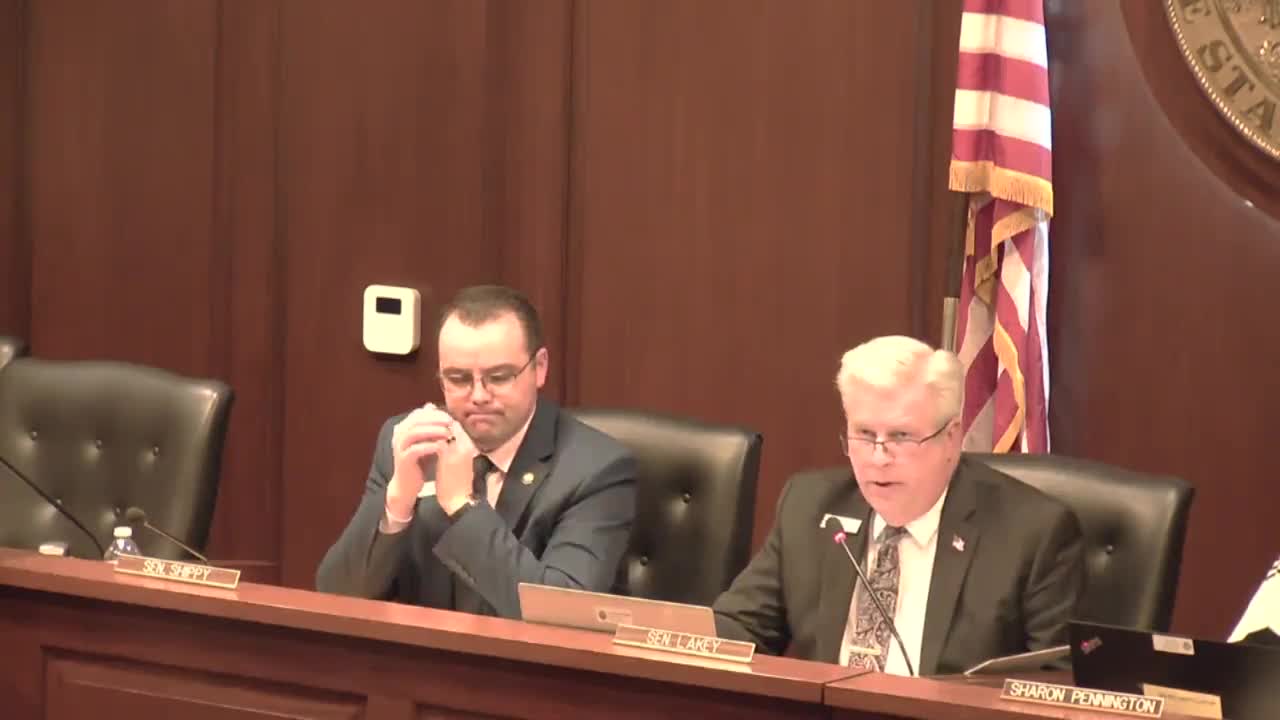
The Idaho Senate Judiciary and Rules Committee on Wednesday voted to send House Bill 7 — which would set a $300 mandatory minimum fine for misdemeanor possession of marijuana — to the full Senate with a "due pass" recommendation after extended testimony from law enforcement, medical professionals, veterans and community groups.
The bill, introduced to the committee by Representative Bruce Skaug (R., House District 10), would set a floor for fines on misdemeanor marijuana possession. "We have it right now, it's 0 to a thousand dollars for misdemeanor possession of marijuana," Skaug told the committee, and said a judge had asked him to bring a bill setting a minimum. "That judge in particular wanted $500 ... I tried $4.20 last year ... 300 is the compromised number." He asked the committee to send the bill to print and to the floor.
The bill drew sharply divided testimony. Supporting HB 7, law-enforcement groups and conservative organizations said a mandatory minimum would strengthen deterrence and underscore Idaho's stance against wider legalization. Chief Rex Ingram, president of the Idaho Chiefs of Police Association and chief of police in Caldwell, said a $300 minimum would help maintain public safety: "I urge you to consider the implementation of a mandatory minimum fine of $300 for marijuana possession as a means not only to deter this behavior but also to maintain the law and order that Idahoans value here." Sheriff Matt Clifford of the Ada County Sheriff's Office, speaking for the Idaho Sheriffs Association, said surrounding states' legalization has increased cross-border impacts and that an increased minimum would make Idaho's penalties clearer.
Opponents included medical and veterans' witnesses and advocates who warned the minimum would disproportionately harm low-income people and individuals who use cannabis for medical reasons. Dr. Mark McConnell, a critical-care physician at the Boise VA Medical Center, described clinical encounters with veterans who use marijuana to manage chronic pain and PTSD and urged a medical exception: "If marijuana were legal, I'm sure many of my colleagues would prescribe it over other pain medications ... My veterans will suffer because of this legislation since most of them are poor and live on Social Security and their VA benefits." Jeremy Kitshopper, a 22‑year‑old Air Force veteran with terminal cancer, said he worries about patients who cross state lines to obtain cannabis during treatment and would face the same minimum fine as recreational users.
Other testimony presented studies and statistics on both sides. Representative Skaug and several proponents cited research they said shows increased crashes and public-health harms in states that legalized recreational marijuana, while opponents questioned the law's fairness and pointed to costs beyond the fine (probation, drug-court fees, community-service obligations). Joseph Evans, an officer with KIND Idaho, said the measure would be "an undue burden" on indigent people and estimated downstream costs — including court fees, probation and drug-court requirements — could total thousands of dollars for many defendants.
Committee debate reflected the split among senators. Senator Chris Ricks moved to send the bill to the floor with a due-pass recommendation; Senator Fred Foreman seconded the motion and spoke in support, saying he has seen "the effects of marijuana" during his career in law enforcement and that Idaho should remain different from neighboring states. Senator Melissa Wintrow and Senator Mary Recti (both recorded in committee discussion as opposed) said they oppose mandatory minimums because they remove judicial discretion. Wintrow said the bill appears to be "about a punishment" rather than deterrence and said judges currently have the ability to assess fines up to statutory ceilings.
The committee took a voice vote and the chair declared the motion carried. Senator Wintrow asked to be recorded; the transcript records at least one recorded "nay." The committee chair then announced: "House bill 7 will be sent to the floor with the due pass."
Why it matters: supporters say a mandatory minimum will deter cross-border purchases and reinforce Idaho's stricter drug policy; opponents say the floor will disproportionately affect low-income residents and patients who rely on cannabis to manage symptoms, and that judges should retain full sentencing discretion.
Clarifying details and contested numbers from testimony: Rep. Skaug described prior versions and votes in the House (he said the bill passed the House on a "50‑14" floor vote) and noted an earlier judge-requested $500 floor and a previously proposed $420 fine. Witnesses offered widely different estimates of downstream costs for people prosecuted for possession: Joseph Evans said the total opportunity and direct costs can reach $5,000–$6,000 for some defendants after drug‑court and probation costs; opponents urged that the fine itself will primarily hit indigent people. Supporters cited studies and press summaries they said show increased crash and crime rates after legalization in neighboring states; opponents contested that those results apply directly to Idaho.
Procedure and next steps: The committee's action sends HB 7 to the full Senate for further consideration. If advanced by the Senate, the bill would return to the House for concurrence on any Senate amendments before going to the governor.
Ending note: Testimony ranged from law-enforcement leaders warning of cross‑border impacts and public-safety risks to physicians and veterans urging protections for patients and indigent defendants. The full Senate will now decide whether to adopt the committee's recommendation and advance HB 7 toward possible enactment.