Get Full Government Meeting Transcripts, Videos, & Alerts Forever!
Get email alerts on the Employee Benefits Health Insurance topic
No spam. Unsubscribe anytime.
Joint finance committee approves $14,130 per‑employee health‑insurance funding for FY2026
Summary
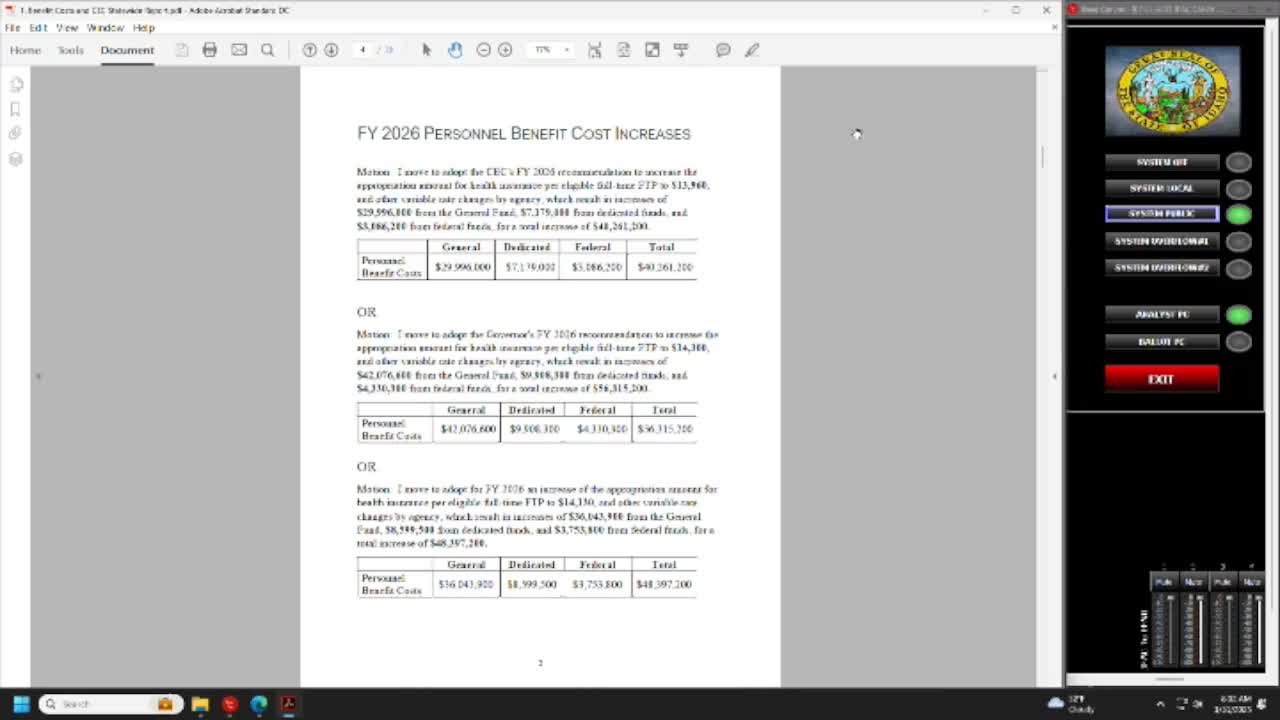
On Jan. 31 the Joint Finance-Appropriations Committee adopted a compromise funding level for state employee health insurance of $14,130 per eligible full‑time equivalent for fiscal 2026, approving the appropriation and associated agency adjustments.
BOISE, Idaho — The Joint Finance-Appropriations Committee on Jan. 31 voted to set the state’s FY2026 health‑insurance funding level at $14,130 per eligible full‑time equivalent (FTP), a compromise figure between the legislative committee recommendation and the governor’s proposal.
Senator Peter Woodward moved the measure, and Representative Tanner seconded. The motion, described by committee staff as the midpoint between a $13,960 committee recommendation and the governor’s $14,300 plan, passed on a joint roll call with 17 ayes, 0 nays and 3 absent/excused. Committee staff estimated the increase would amount to $36,043,900 from the General Fund, $8,599,500 from dedicated funds and $3,753,800 from federal funds — a combined increase of $48,397,200.
Committee analysts told members the three dollar levels on the table reflected differing reserve projections for the state’s health‑insurance fund: the $13,960 level was projected to leave about $51.6 million in reserve at the end of FY2026 and the $14,300 level about $61.4 million. Analyst Mr. Bybee said the midpoint figure was intended as a compromise between those outcomes.
The vote followed extended discussion about how actuarial projections and past reserve balances should inform the appropriation. Representative Furness said actuarial projections from Milliman have “consistently been, too conservative,” arguing the state’s reserve has outpaced premiums in recent years and urging a lower funding level. Senator Ward Engelking said the committee should “reflect the actual cost of insurance” rather than using reserve drawdowns to mask cost growth.
Committee staff also noted smaller employer‑paid benefit adjustments would be made by agency to reflect changes in workers’ compensation and Social Security contributions.
With the motion adopted, the committee instructed staff to carry the measure forward with a due‑pass recommendation. Members also confirmed the voting rule to be used for joint committee actions — a majority of the quorum present in each chamber as described in an existing leadership letter — before moving on to other agenda items.