
Legislative analyst briefs House education committee on FY2026 higher education budgets
Get AI-powered insights, summaries, and transcripts
Sign Up Free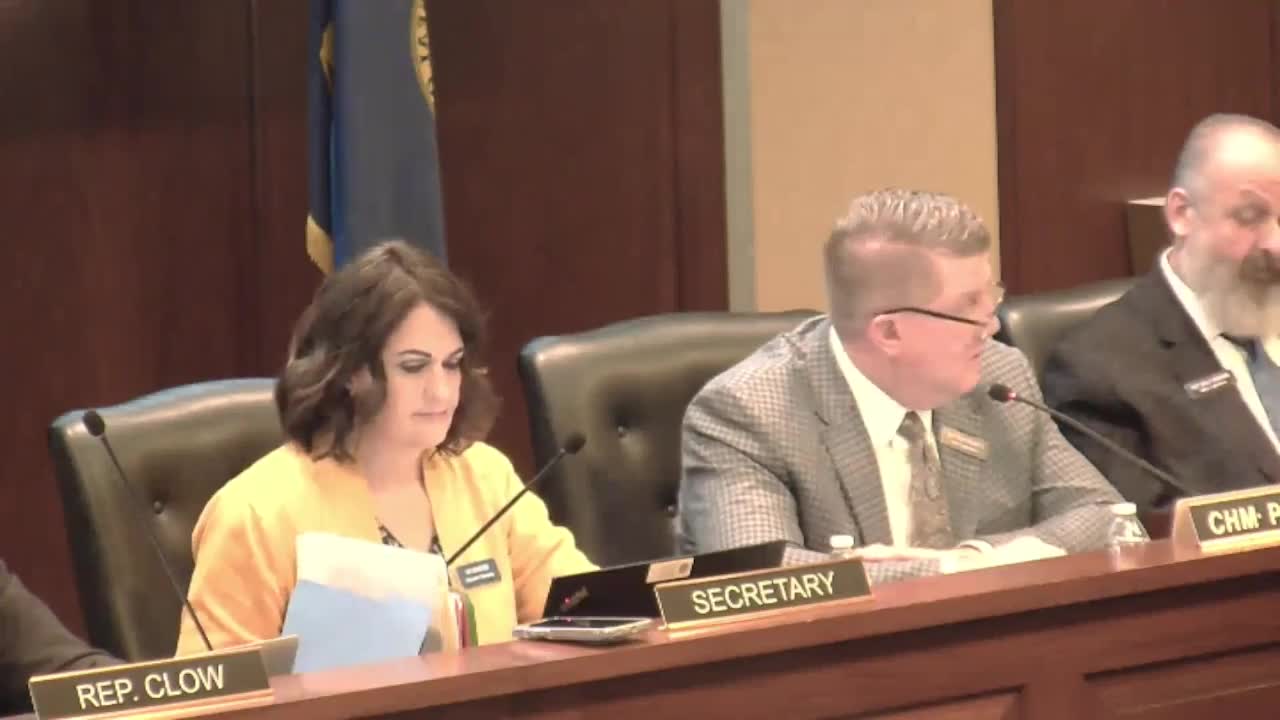
Summary
Kevin Campbell, senior budget and policy analyst with the Legislative Services Office, presented an overview of FY2026 budgets for higher education to the House Committee on Education on Feb. 12, covering seven budget groups including Ag Research, CTE, colleges and universities, community colleges, health education programs, special programs and OSB.
Kevin Campbell, senior budget and policy analyst with the Legislative Services Office, presented an overview of FY2026 budgets for higher education to the House Committee on Education on Feb. 12. He summarized base budgets, items requested by institutions, and several governor-recommended initiatives across seven budget groups: Agricultural Research and Extension, Career Technical Education (CTE), colleges and universities, community colleges, health education programs, special programs and the Office of the State Board of Education (OSB).
Key figures Campbell reported include:
- Agricultural Research and Extension: FY2026 base $37,966,900; 341.33 full-time equivalent positions (FTE). Two requests: a professor of viticulture and small fruits and $250,100 for maintenance at a new research dairy; both recommended by the governor.
- Career Technical Education (CTE): FY2026 base $94,426,500; 569.14 FTE. Requests include $664,000 for additional instructors in high-demand programs, $2,273,700 in spending authority for federal grants, $128,400 for a business-industry engagement manager, and $50,000 for adult literacy/basic education. CTE also appears in one of the governor’s initiatives (in-demand workforce funding).
- Colleges and universities (system-wide): FY2026 base $709,431,200; 4,921.68 FTE. System requests include a $3,369,900 operational capacity enhancement (a flexible pool for institutions), endowment distributions totaling $1,388,700 requested, and an Enrollment Workload Adjustment (EWA) that can shift funding by formula between institutions.
- Community colleges: EWA request totaling $707,100. Campbell noted community colleges receive lump-sum appropriations and have local boards of trustees that manage tuition, fees and many operations.
- Health education programs: FY2026 base $28,206,800; 46.65 FTP (noting the FTP figure excludes many residents and students who are not state employees). Requests highlighted include $60,000 for an additional Boise internal-medicine resident; $240,000 requested by Eastern Idaho Medical Residency for four psychiatry residents; $420,000 for six family-medicine residents and a fellowship in Nampa; and $54,000 for an additional seat in the Idaho Dental Education Program (to reach 36 students).
- Special programs: FY2026 base $35,937,600; 50 FTP. This category includes Opportunity Scholarship, Rural and Underserved Educator Incentive Program, the Idaho Geological Survey, the Museum of Natural History, and tech-transfer and forest-utilization research. Several small enhancement requests were submitted within the Governor’s cap on budget requests.
- Office of the State Board of Education (OSB): FY2026 base $55,800,000; 84.25 FTP. OSB requested a $15,000,000 one-time grant program to expand institutional infrastructure related to workforce training and in-demand careers. Campbell said OSB described matching ratios that differ by institution: a 1-to-1 match for Boise State, Idaho State and the University of Idaho, and a larger state match for Lewis-Clark State College and community colleges to offset fundraising capacity differences; Campbell clarified the intent was to provide a larger match for Lewis-Clark and community colleges (state contribution greater than local fundraising in those cases).
Committee members asked clarifying questions during and after the presentation. Representatives asked whether FTPs are headcount (Campbell: "It's an equivalency, it's not a headcount"), how endowment distributions work, how the operational capacity enhancement is intended to function, and whether the state makes separate investments in clinical sites for medical students and residents. Campbell said the state generally invests in medical education through program funding and partnerships with out-of-state medical schools (WAMI/University of Utah) and residency programs, but he did not identify separate line-item funding for clinical sites and said availability of clinical placements remains a constraint noted by program directors.
Campbell ended by pointing committee members to the legislative budget book and online dashboards for line-by-line detail and offered to meet with members individually for deeper walkthroughs of specific programs.