Get Full Government Meeting Transcripts, Videos, & Alerts Forever!
Get email alerts on the State Prisons Security topic
No spam. Unsubscribe anytime.
After staff shooting, Idaho DOC proposes new transport team, drone detection and call‑analysis tools
Summary
Following a spring ambush that wounded correctional staff, the Department of Correction requested funding for mail scanning, drone detection, phone‑call transcription analytics, an expanded transport bureau and a pilot body‑worn camera program for selected facilities.
The Idaho Department of Correction told the Joint Finance Preparations Committee on Feb. 4 that a violent ambush during a medical transport last spring exposed security gaps and prompted the agency to request a package of new security measures, an expanded transport bureau and technology to detect contraband entering prisons.
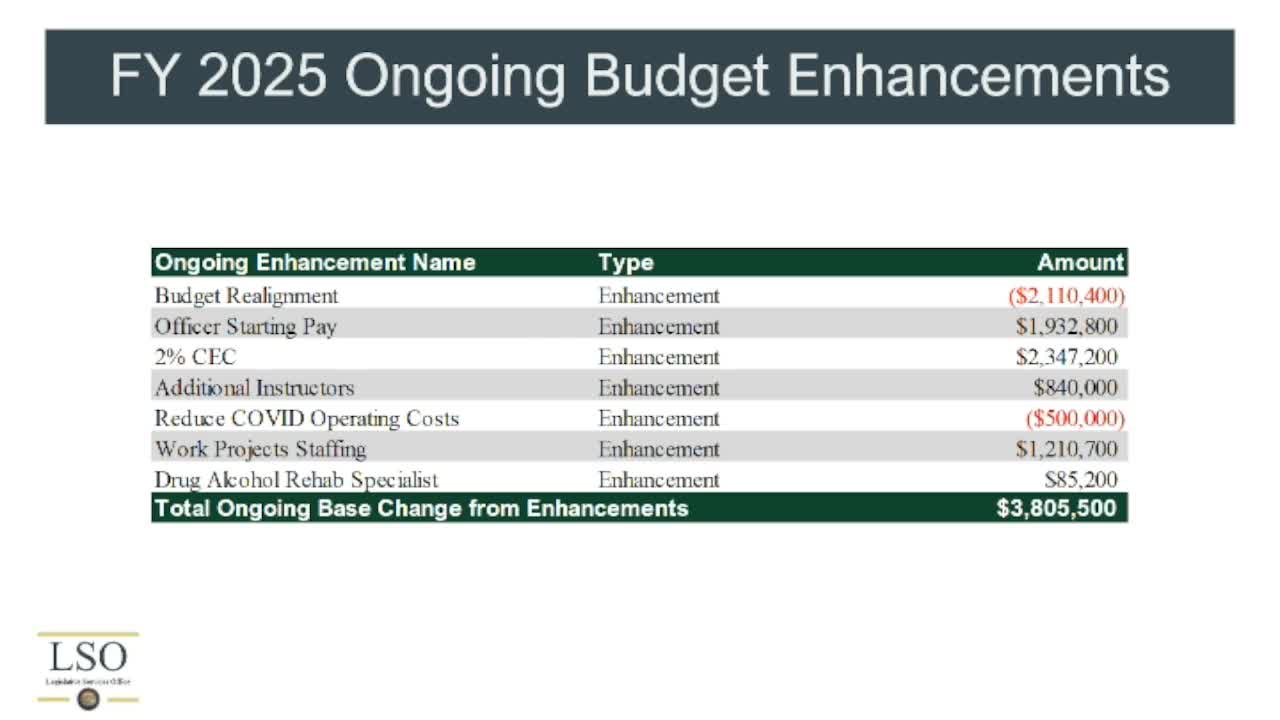
Noah Peterson, a Legislative Services Office analyst, said the proposal included one‑time and ongoing requests: digital mail scanning, a layered drone detection system, phone‑call transcription and analysis (the LEO technology), expansion of the transport bureau with 12 FTP and equipped vehicles, and a body‑worn camera pilot funded largely by federal grants. The combined first‑year supplemental for some items totaled about $795,000 for partial-year implementation; ongoing full‑year costs were projected at $2.397 million for the surveillance technologies alone.
The requested digital mail scanning would route incoming mail off‑site to be opened, scanned and delivered to residents electronically; the agency says that would remove a major entry vector for contraband. Drone detection would provide layered sensors to identify approaching drones that could deliver contraband, and the LEO analytics would transcribe and analyze inmate phone calls — the department reported inmates made roughly 4,000,000 calls totaling 49,000,000 minutes in 2023.
The transport expansion seeks 12 positions ($909,000 of the ongoing estimate) and $693,000 one‑time to outfit seven vehicles (six SUVs and one wheelchair van) with barriers, dividers, emergency lighting and tinting. The agency also requested $1,051,000 in a federal grant submission for the initial year of a three‑facility body‑worn camera pilot; the supplemental asked for federal funds for year one and the state match appears in the agency’s projected FY2026 costs.
Director Josh Tewalt tied the package directly to the ambush of staff during a medical escort: “This was a planned event where they were able to manipulate our transport and get our staff in a really vulnerable position in ways that, candidly, as their director, I do not believe they were trained to respond to,” he said. Tewalt said the transport bureau currently handles nonemergent statewide movements, but emergency transports have been covered by facility staff assigned to other duties and without specialized equipment or training.
Tewalt described the mail‑scanning request as a way to eliminate the department’s “most porous point of entry for contraband.” He noted rising sophistication — treated inks and semi‑autonomous drones — and said identifying drone approaches also helps coordinate law enforcement response to those attempting to smuggle contraband. On phone‑call analysis, Tewalt said transcribing, searching and sharing relevant intelligence with local, state and federal partners could help disrupt organized criminal activity beyond the prisons.
Analysts flagged significant overtime driven by transport and emergency coverage: Peterson said ISCC (Idaho State Correctional Institution) had generated 20,000 overtime hours and IMSI 14,000 hours as a result of additional emergency duties. Committee members asked why the agency was adding 12 FTP rather than reallocating existing positions; Tewalt explained relief‑factor and training requirements make reallocation impractical without major increases in staff at the facility level.
The governor recommended most items, but chose a smaller ongoing option for snow removal at the St. Anthony work camp: instead of a one‑time purchase of a skid loader (skid steer) for ~$83,200, the governor recommended $30,000 ongoing to contract snow removal. The agency said it would accept contracting as a reasonable alternative for seasonal needs.
No formal appropriations were decided at the hearing. The committee requested follow‑up material on implementation, training plans for the expanded transport bureau and cost comparisons for long‑term staffing options.