Get Full Government Meeting Transcripts, Videos, & Alerts Forever!
Get email alerts on the Construction Funding topic
No spam. Unsubscribe anytime.
ITD tells JFAC cash‑flow pressure on multi‑year projects requires more reappropriation authority and continuous appropriation language
Summary
The Idaho Transportation Department told the Joint Finance‑Appropriations Committee it needs supplemental authority and a higher reappropriation cap to pay contractors on multi‑year projects; department officials said $600 million is currently obligated but unspent on contracts.
The Idaho Transportation Department (ITD) told the Joint Finance‑Appropriations Committee that it faces cash‑flow challenges on long‑term, multi‑fund construction projects and asked for supplemental spending authority and changes to appropriation language to avoid payment delays on active contracts.
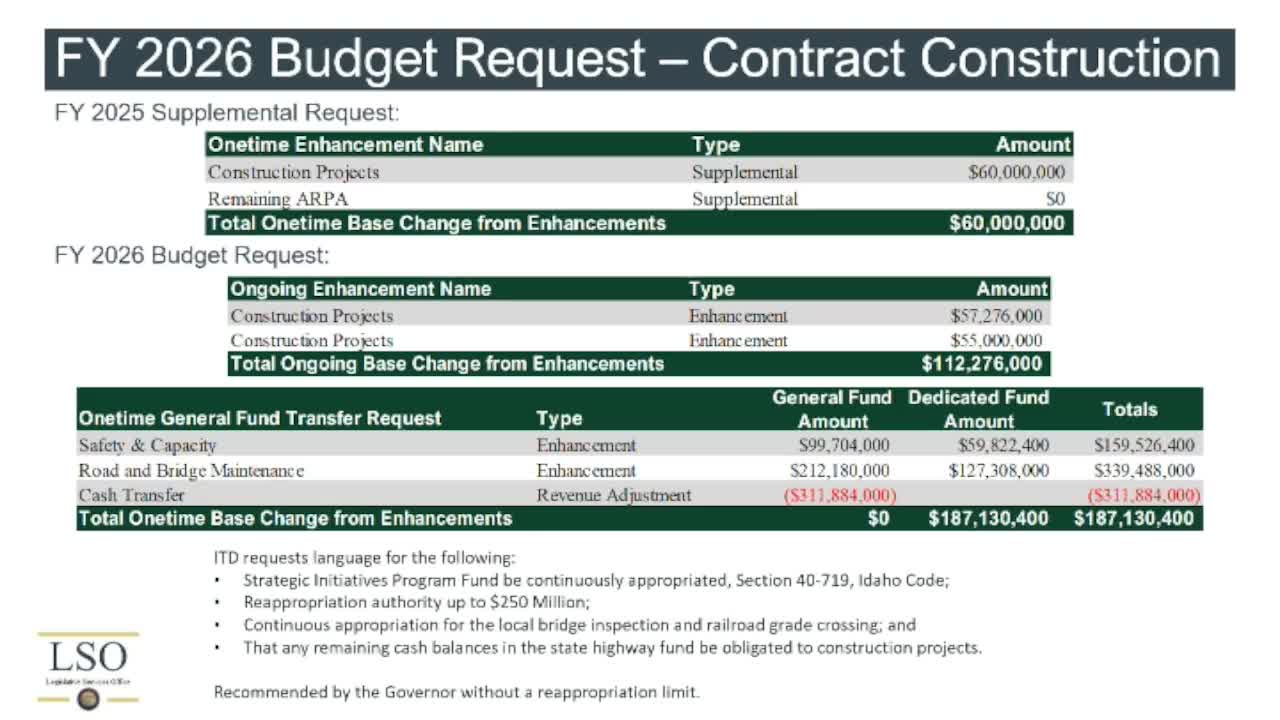
ITD requested a $60 million fiscal‑year 2025 supplemental (ten million from State Highway Local and $50 million from State Highway Federal) and ongoing capital outlays of roughly $57 million and $55 million tied to IIJA federal funding and other available revenues. The department also requested one‑time general fund transfers — $99.7 million for safety and capacity projects and $212 million for road and bridge maintenance — and asked the committee to allow certain Strategic Initiatives Program funds to be continuously appropriated rather than capped by a single‑year appropriation.
Why it matters: ITD said a large set of multi‑year projects are under contract and the department needs both cash and spending authority to complete contractor payments. Dave Tolman, ITD chief administrative officer, told the committee "as of the end of FY 24, our obligated unspent construction program was a little over $600,000,000 across multiple funding sources." He said the statutory continuous appropriation for the Strategic Initiatives Program currently becomes limited when the legislature makes a single‑year appropriation, constraining ITD's ability to pay multi‑year contractor obligations.
ITD also reviewed borrowing programs and dedicated funds. The department reported GARVEE (grant anticipation revenue vehicle) bond authorization of roughly $1.116 billion with $522 million currently outstanding and an expected payoff date in fiscal 2040. TECM (Transportation Expansion and Congestion Mitigation) bond totals were shown in the materials as about $986.6 million outstanding, with debt service and schedules noted in the department overview.
Committee members pressed ITD about whether the requests fund new projects or cover payments on contracts already awarded. Director Scott Stokes said the supplemental requests are largely to pay contractors on projects already under way: "We were in danger of running out of spending authority" he said, describing the need to match cash on hand with spending authority. Representative Tanner asked whether the requests would cover cost overruns or simply provide spending authority for previously contracted work. Stokes and Tolman said the issue was not contractor overruns but the timing and statutory limits on spending authority for multi‑year contracts.
Representative Woodward and others discussed the prior reappropriation cap of $250 million and whether raising that cap would reduce administrative pressures. Tolman said the cap left ITD with a sizable amount of obligated contract dollars for which the department lacked appropriation to complete payments. Senator Woodward noted monthly construction payments during peak season can run "between $50 and $80,000,000 a month," underscoring the scale of seasonal cash flow needs.
Ending: The committee did not take immediate action; members said they would weigh the department’s supplemental requests, potential language changes to appropriation rules, and the broader budget before acting.