Get Full Government Meeting Transcripts, Videos, & Alerts Forever!
Get email alerts on the Military Division Budget topic
No spam. Unsubscribe anytime.
Military Division seeks supplemental funding for public safety communications, hazmat equipment and IT upgrades
Summary
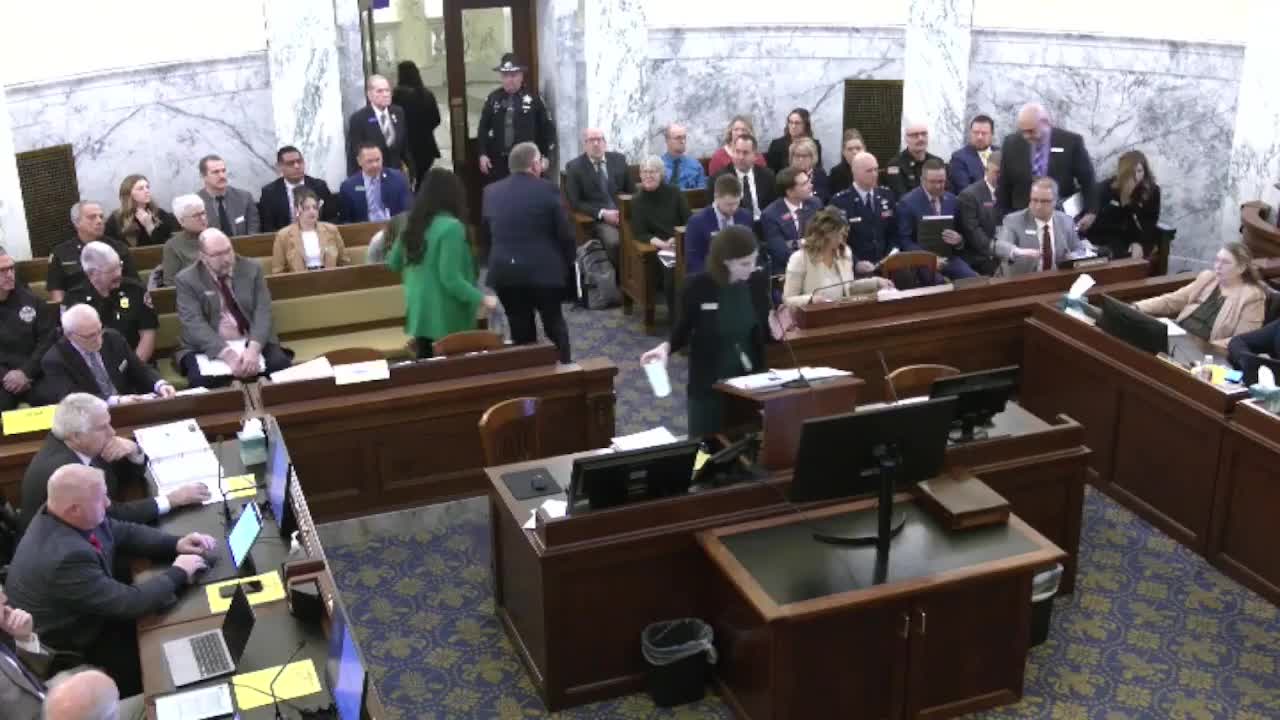
Major General Tim Donilon and Legislative Services briefed JFAC on the Military Division’s FY2026 requests, including supplemental funding to finish communications work on 40 state police vehicles, IT infrastructure separation from ITS, and an $8.6 million cash transfer for regional hazardous materials response teams.
Frances Lippitt, budget and policy analyst with the Legislative Services Office, presented the Military Division’s five‑year appropriation trends and explained a mix of federal, dedicated and continuously appropriated funds in the division’s budget.
Lippitt outlined the governor’s supplemental and enhancement recommendations for FY2026. Those included a supplemental to finish public safety communications installations in vehicles owned by the Idaho State Police (text referenced 40 Dodge Durangos), a private contract estimated at $240,000 to clear a backlog and $300,000 for construction work to add installation bays. The governor’s recommendation also included $759,200 for IT infrastructure and licensing that would allow Public Safety Communications to establish a network independent of the Office of Information Technology Services (ITS).
Lippitt also described a recommended appropriation of $8,600,000 to be distributed by the Office of Emergency Management via a cash transfer from the State Emergency Relief Fund to regional hazardous materials response teams.
Major General Tim Donilon, the adjutant general and commander of the Idaho National Guard, spoke about operational needs. He said the state recently had to perform treatments on the Snake River and that the division had expanded sampling and inspections on other missions. On public safety communications, Donilon explained the division is modernizing hardware and will separate the public‑safety microwave network from ITS to improve security and capability.
On hazardous materials response, Donilon said equipment has not been updated since about 2005 and described seven regional hazmat teams that serve multiple counties. “Our hazmat teams are spread out throughout the state in seven different regional teams,” Donilon said. He explained the request would modernize equipment, reduce risk to first responders and distribute updated gear through the Idaho Office of Emergency Management.
Committee members pressed on timing and execution. Senator Cook and Representative Handy asked why funding had been proposed as a supplemental rather than a FY2026 enhancement. Donilon and other witnesses said the supplemental reflects immediate timing needs, particularly for vehicles and to clear an installation backlog created when vehicles and communications packages arrived in large batches after a prior procurement delay. Donilon said the state expects to be able to execute the vehicle and installation work promptly and that additional installation bays will reduce future backlogs.
Lippitt noted the military division requests a shift in funding sources to better align charges for Office of Emergency Management use of ITS services, plus replacement‑item requests for vehicles and IT hardware recommended by ITS. The division also requested a deficiency warrant of $34,200 related to hazardous substance response costs that were not recouped from incident originators.
Committee members asked for additional detail about hazmat team composition and costs; Donilon offered to provide more specifics through analysts. The general emphasized the modernization was aimed at improving safety and response capability across the state’s seven regional teams.