Get Full Government Meeting Transcripts, Videos, & Alerts Forever!
Get email alerts on the School Choice Education Opportunity topic
No spam. Unsubscribe anytime.
Committee introduces RS 32171 to create Idaho Education Opportunity Program, a school-choice funding mechanism for low-income families
Summary
Representative Lance Clow introduced RS 32171 to create the Idaho Education Opportunity Program, allowing eligible families to direct most of the state's per‑pupil state funding into individual education accounts.
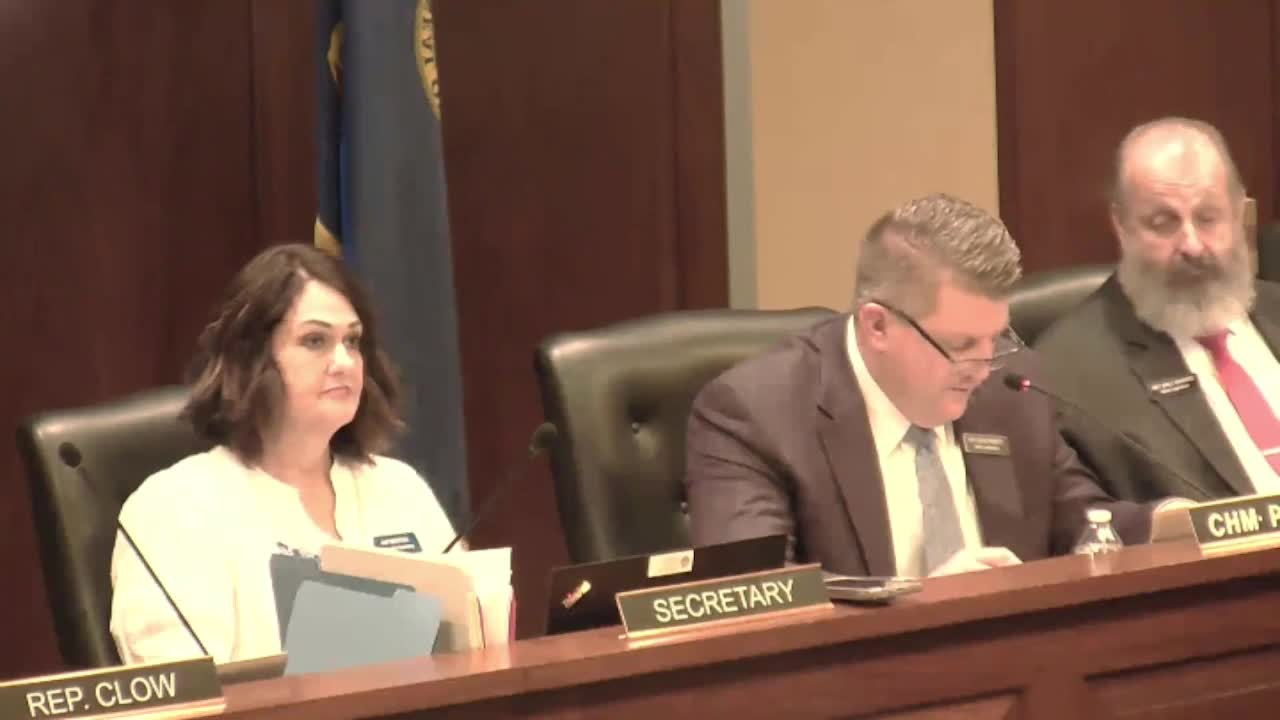
Representative Lance Clow (District 25, Twin Falls) presented RS 32171, the Idaho Education Opportunity Program (IEOP), which would allow certain students to use a portion of state K‑12 funds in education opportunity accounts for private school tuition, tutoring, curriculum and other allowable expenses. "This is a bill that I would describe as a true, school choice program," Clow said.
Key parameters presented in the RS and by Clow's summary: eligible students must be prior public‑school students (grades 1–12) or kindergarten entrants; household adjusted gross income (AGI) cap is $75,000; the state portion of average per‑pupil distribution (estimated at $8,440 in the sponsor's figure) would be considered and 80% of that amount would follow the student into an education opportunity account while 20% (~$1,688) would remain with the resident district to hold the student's seat. Clow said the 80% figure would translate to roughly $6,700 per student on the sponsor's estimates and that special‑education students would be eligible for a higher share (the sponsor said the full ~$8,400 would follow special‑education students).
Clow described allowable uses (nationally normed assessment reporting to parents, curriculum, tutors — noting tutors may not be immediate family), rollover rules, and potential post‑secondary uses for remaining funds. He walked through a sponsor fiscal estimate: the program would likely serve an estimated 2,000 students switching from public schools, about 600 qualifying kindergarten students and up to 500 personalized education plans — roughly 3,100 students. Administrative costs at the State Department of Education were estimated to require two new staff (approximately $200,000 including benefits), third‑party account administration fees capped at 3.5%, an estimated $8.6 million in reduced income tax deductions for taxpayers (per sponsor estimate), and an approximate total fiscal impact of about $14 million in combined tax relief and program payouts per the sponsor’s preliminary calculation.
Representative Harris asked whether the estimated $200,000 for two staff included benefits; Clow said it did. Representatives questioned how homeschoolers and personalized education plans would be treated; Clow said families using the personalized plan would not be considered homeschoolers for the program and that tutors may not be immediate family. Representative Mendoza moved to introduce RS 32171; the committee approved introduction by voice vote. The RS will be printed and scheduled for a full hearing where fiscal details, administration, eligibility rules and taxpayer implications will be examined.