Get Full Government Meeting Transcripts, Videos, & Alerts Forever!
Get email alerts on the Mask Mandate Preemption topic
No spam. Unsubscribe anytime.
Senate committee advances bill limiting government mask mandates for state agencies, with carved-out exemptions
Summary
Senate State Affairs advanced House Bill 32 to the Senate floor with a recommendation that it pass; the bill would bar government-mandated face masks for most state agencies and political subdivisions, while exempting vocational and specified health and safety roles.
Senator Brian Lenny (District 13) presented House Bill 32 to the Senate State Affairs Committee, a bill that would prohibit state and political subdivisions from imposing compulsory face-mask requirements in most public settings while specifying a set of exemptions.
Lenny said the bill’s purpose is to prevent future government-mandated masking like that imposed during the COVID-19 pandemic. “This bill does not prevent anyone who wants to wear a mask from wearing a mask,” Lenny told the committee, adding that the measure was intended to “draw a line between advisory and compulsory.” He argued mandatory masking had harmed children’s development and individual liberties.
The bill defines political subdivision broadly and expressly excludes from the prohibition vocational settings and roles where mask wearing is integral and required for job performance and safety; the text lists examples including healthcare professionals, individuals working with hazardous materials or biohazards, and confined facilities. Sponsor and supporters said the exemptions are intentional to preserve occupational-safety requirements.
A mix of witnesses testified both for and against the bill. Supporters included Leslie Manoukian (Ketchum), who cited studies and Freedom of Information Act emails and said mandates had been dishonest; Thad Butterworth, chairman of the Ada County Republican Party, said his party supports the bill; Dr. Brandon Couchman described occupational concerns about improper mask fit and maintenance. Opposing testimony came from Kelly Packer, executive director of the Association of Idaho Cities, who urged preservation of local authority to respond to emergent public-health threats. Garden City Mayor John Evans said he opposed an absolute prohibition because future threats and technology could require responsive public-health action in ways not foreseen today.
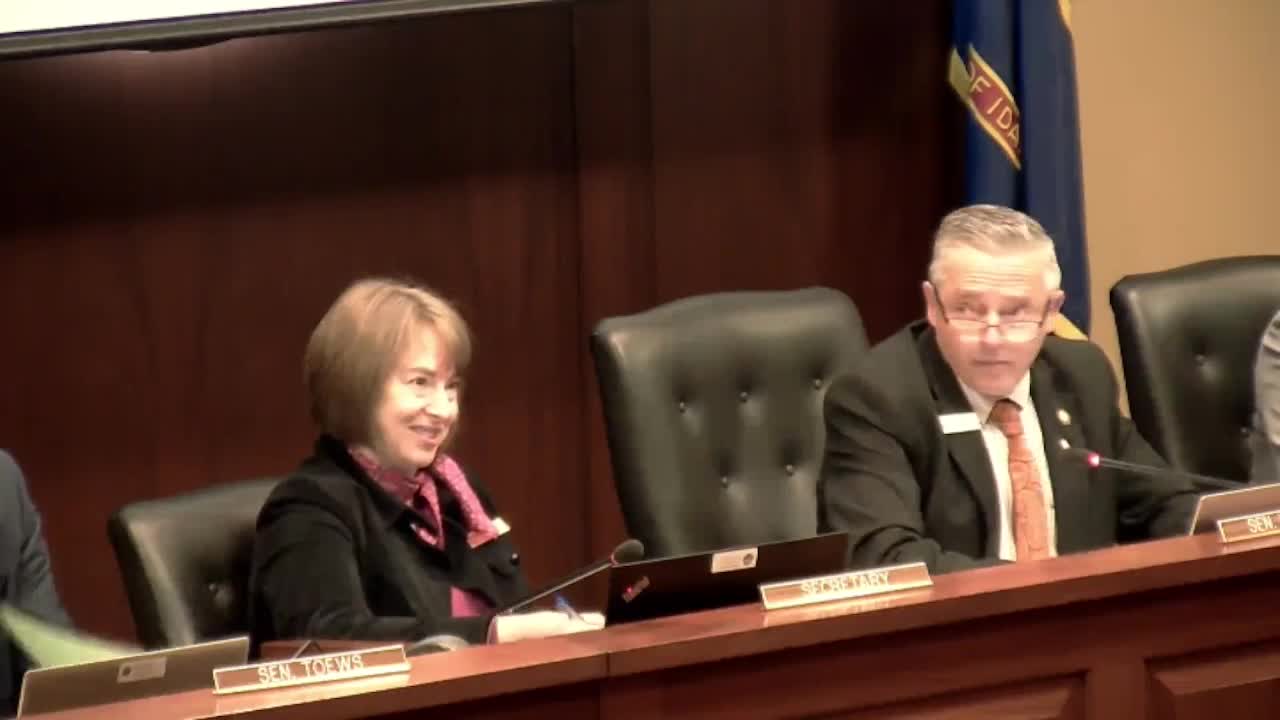
Committee discussion ranged from statutory scope (whether public health districts are treated as political subdivisions in the bill) to carve-outs for occupational safety. Senator Toews, among others, said the bill sought to protect individual rights; Senator Ratty and other members urged deference to local governments on emergency public-health measures. Committee votes were by voice; the motion to send the bill to the floor with a recommendation that it pass carried. Two senators were recorded as voting no.
The bill advanced to the full Senate; committee supporters said the measure preserves personal choice while opponents raised concerns about preempting local emergency authority.