Get Full Government Meeting Transcripts, Videos, & Alerts Forever!
Get email alerts on the State Budget topic
No spam. Unsubscribe anytime.
DFM briefs JFAC on governor’s ‘keeping promises’ budget emphasizing schools, reserves and infrastructure
Summary
Laurie Wolf of the Division of Financial Management presented Gov. Brad Little’s executive budget to the Joint Finance and Appropriations Committee on Jan. 8, outlining $151 million in recommended enhancements, large transfers to reserve funds and proposals for education, transportation, wildfire and cyber investments.
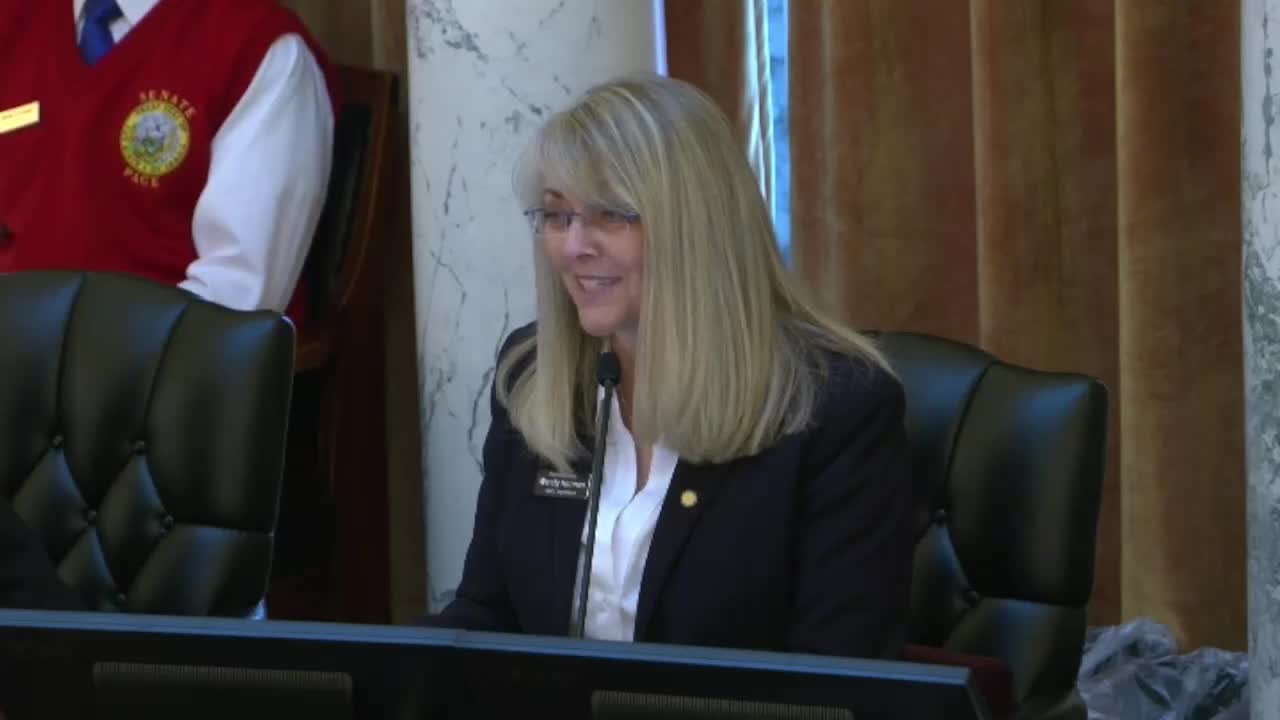
Laurie Wolf, administrator of the Division of Financial Management (DFM), told the Joint Finance and Appropriations Committee (JFAC) on Jan. 8 that the governor’s executive budget is a “keeping promises” proposal that prioritizes education, infrastructure and savings while taking a conservative revenue forecast.
Wolf said the proposal leaves a projected FY2025 ending general fund balance of about $383 million and a projected FY2026 ending balance of about $227 million after recommended actions, while directing transfers to the state’s reserves. The budget recommends a $59 million transfer to the budget stabilization fund and a $50 million transfer to a public education stabilization fund, which DFM noted would leave a large revert reserve balance — roughly $1.4 billion, or about 22% of the budget.
The nut of the governor’s pitch, Wolf said, is more investment in K-12 and workforce supports while maintaining fiscal conservatism. “This is his keeping promises budget,” Wolf said, summarizing the administration’s priorities.
Most prominent among the administration’s recommendations is $150 million in new public-school support. Wolf said the package includes roughly $83 million aimed at teacher pay and about $30 million for school health insurance costs, plus $50 million set aside for education choice initiatives subject to later policy action. The DFM presentation said the state will continue to fund teacher compensation tied to career ladder commitments and that the department and Board of Education will provide program-level detail during agency hearings.
Transportation and infrastructure proposals include a $50 million recommendation to support transportation expansion and congestion mitigation through the Idaho Transportation Department (ITD). Wolf said the additional funding is intended to seed bonding capacity for high-value expansion projects once ITD’s current bonding capacity is exhausted later this year.
On workforce development, the governor proposes $25 million: $15 million one-time to seed competitive grants (requiring private match) for capacity-building at community and technical colleges and $10 million ongoing for career-technical education (CTE) operating support. Wolf said the one-time grants mirror earlier GEAR-funded block grants the State Board of Education previously administered.
Natural-resources and public-safety priorities in the package include a supplemental request of $60 million in FY2025 to replenish the state’s fire-suppression account for costs already incurred, and a $40 million ongoing appropriation beginning in FY2026 to stabilize that account going forward. Wolf said the five‑year average state fire-suppression cost is about $40 million and that the administration intends the ongoing funding to reduce the need for reactive supplementals in high-fire years.
Water and wildfire planning also appear in the proposal: Wolf described a $30 million ongoing recommendation for the Idaho Water Resource Board for prioritized recharge projects, and $5 million for aviation and early-detection tools for wildland fire response. For cybersecurity, the governor recommends $10 million for statewide IT security and infrastructure replacement, to be administered through the state’s central IT office.
Public defense funding was another item Wolf highlighted. She described last year’s transition of state public defense from a county-based system to a consolidated state program on Oct. 1 and said legal developments and contracting costs have increased the department’s needs. DFM recommended a $5.4 million supplemental for FY2025 and roughly $16.8 million in FY2026, with a total FY2026 appropriation request for state public defense reported by DFM as about $83 million. Wolf said the structural approach to funding that program remains a policy decision for the legislature because the public-defense fund currently receives a distribution from sales tax.
On revenues, Wolf said DFM used a conservative approach for FY2026 revenue projections: general fund revenues in the administration’s materials show year-over-year growth of roughly 5.6 percent from FY2025 to FY2026, and the department stressed prudent forecasting and maintaining healthy reserves amid continuing economic uncertainty.
Committee members pressed for details. Representative Price asked about year-over-year spending increases; Representative Tanner asked why the administration proposed the mix of new spending and $100 million reserved for tax relief; Senator Carlson and others asked about the structure of the fire-suppression funding. Wolf repeatedly pointed members to forthcoming agency-level hearings and to LSO and DFM staff for line-item clarifications.
The DFM presentation sets the headline priorities JFAC will vet in agency hearings and work‑group sessions over the coming weeks, where staff will present maintenance budgets, replacement-item requests, and individual agency enhancement proposals for committee action.