Get Full Government Meeting Transcripts, Videos, & Alerts Forever!
Get email alerts on the Public Safety topic
No spam. Unsubscribe anytime.
Military Division seeks supplemental funds for public safety communications, vehicles and hazmat teams
Summary
Major General Tim Donilon and Legislative Services analyst Frances Lippett told the Joint Finance‑Appropriations Committee the Idaho Military Division needs supplemental funds to clear a backlog of communications‑equipped vehicles, modernize public‑safety communications infrastructure and replace decades‑old hazardous‑materials equipment.
Major General Tim Donilon, Adjutant General for Idaho and commander of the Idaho National Guard, and Legislative Services analyst Frances Lippett briefed the Joint Finance‑Appropriations Committee on the Military Division’s budget needs, including supplemental requests tied to public safety communications and hazardous‑materials response equipment.
Lippett summarized the division’s federal‑state programs and described a supplemental request that included funding to install critical communications equipment in 40 Dodge Durango vehicles owned by the Idaho State Police. The vehicles currently cannot be used without the installations, Lippett said, and the supplemental included an estimated $240,000 for private contract installation and about $300,000 in construction to add installation bays. The governor’s recommendation—Lippett said—also included $759,200 for IT infrastructure and licensing to allow public safety communications to establish an independent network separate from the state ITS for enhanced security.
Major General Donilon told the committee that a backlog developed when vehicle computer chips became available after supply‑chain delays and a flood of vehicles arrived; he said the supplemental is intended to clear that backlog and add facility capacity to prevent future backlogs. “We do believe that we can spend this. We’re ready to move, as soon as possible to clear the backlog and also create facilities,” Donilon said.
Hazardous‑materials response equipment
Representative Petzke asked about an $8.6 million governor‑recommended cash transfer for regional hazardous‑materials response teams. Donilon said the state’s hazmat equipment has not been updated since about 2005; the military division supports seven regional teams and the proposed funding would allow the Office of Emergency Management to procure modern equipment and distribute it to those teams. Donilon cited a large propane spill on Highway 95 as an example of recent responses that stressed the state’s aged equipment.
Deficiency warrant and continuous appropriation
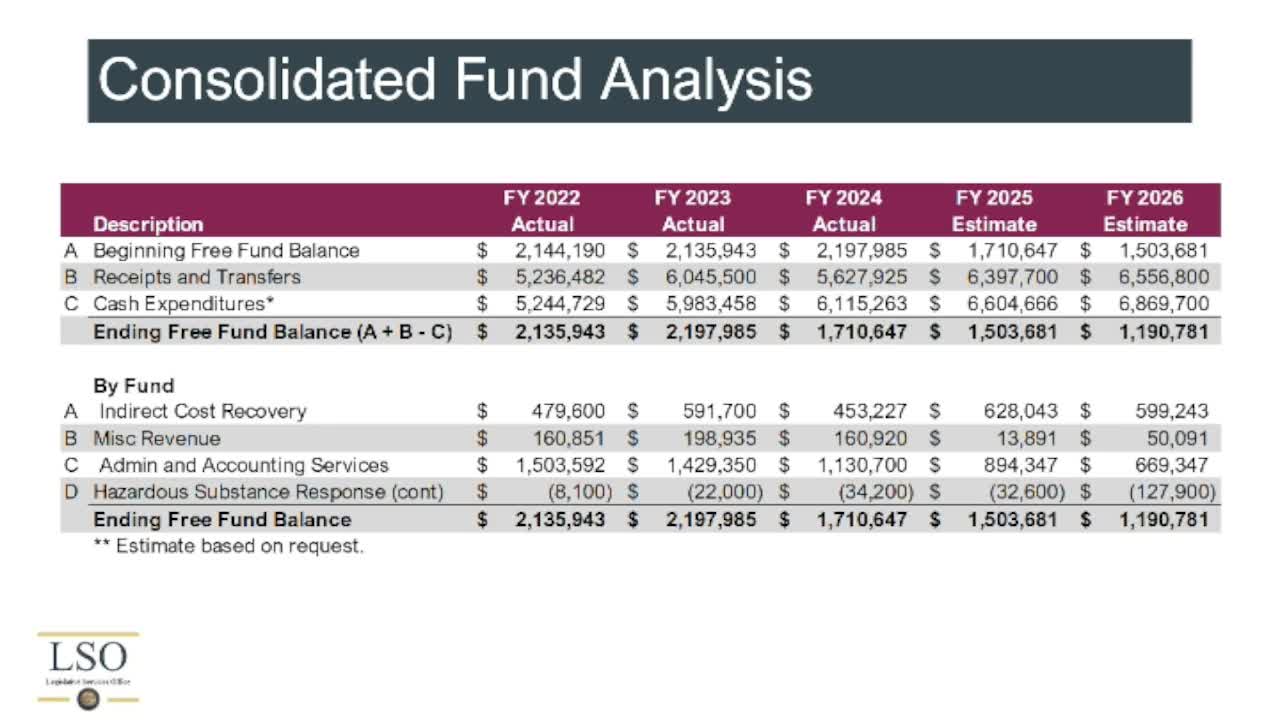
Lippett noted a fiscal‑year 2024 hazardous‑substance response deficiency warrant of $34,200 for costs the division could not recoup from incident originators; Donilon explained the division attempts to recoup cleanup costs but sometimes cannot and will seek appropriation to cover unrecovered expenses. He also described continuous appropriation authorities for federal disaster aid and emergency distribution funding that the office manages.
Personnel and vacancies
The division is authorized roughly 430 full‑time equivalents across several programs. Donilon and his staff told JFAC about ongoing hiring challenges driven in part by federal continuing resolutions that complicate hiring authorities for federally funded positions. The division reported about a 15% turnover rate and a recent 10% vacancy rate overall, with many vacancies actively being recruited.
Why it matters
Committee members repeatedly asked about timing and execution: whether the state could obligate the supplemental dollars and complete installations and infrastructure work before fiscal year‑end. Donilon and staff said they had plans to use private contractors to address the backlog quickly and to expand installation bays to prevent reoccurrence; they said the IT work included separating the public‑safety microwave network from ITS and modernizing servers and hardware.
No formal votes were recorded during the presentation. The governor’s recommended supplemental and the $8.6 million cash transfer to fund regional hazmat equipment were described on the record for JFAC consideration.