Get Full Government Meeting Transcripts, Videos, & Alerts Forever!
Get email alerts on the Environmental Health Spills topic
No spam. Unsubscribe anytime.
Study request on oil and chemical spills on Fort Berthold fails after debate over scope and funding
Summary
A proposal to fund a legislative study of oil and chemical spills on state highways within the Fort Berthold Reservation failed in the House after members debated tribal oversight, existing reporting systems and the availability of other funding sources.
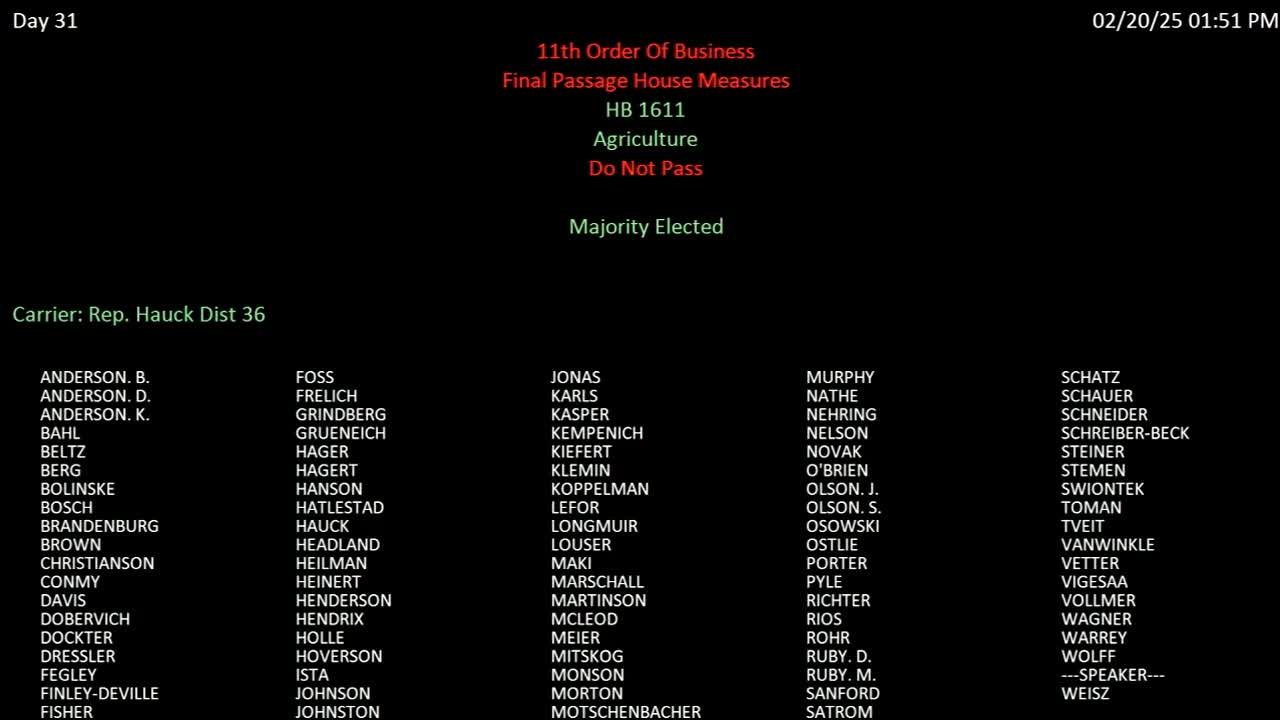
House Bill 16‑11, a request for a legislative management study on oil and chemical spills on state highways within the Fort Berthold Reservation, failed in the North Dakota House on a final vote of 24 yea, 62 nay.
Representative Hout, chairing the agriculture committee, reported the committee's do‑not‑pass recommendation. The committee described the current response process: the North Dakota Department of Environmental Quality (DEQ) operates a common notification system that triggers notifications and routes to appropriate agencies, and the DEQ’s involvement on tribal lands is limited to notification unless a tribal nation grants oversight authority.
Sponsor Representative Finley DeVille said the study was requested by constituents in oil‑producing regions who want a better understanding of the environmental and public‑health consequences of spills on highways and right‑of‑ways, including oil, brine and industrial chemicals. She said Nueta Hidatsa Sahnish College had agreed to conduct and oversee the study and that the MHA Nation tribal chair had provided a letter of no objection. The sponsor said federal grants applied for by the college were not awarded and asked the House to authorize the state study.
Committee members who opposed the funding argued that (1) existing notification and remediation authorities already govern spill response; (2) remediation on tribal lands is overseen by the tribes; and (3) a one‑time funded study was not recommended by the committee. An amendment to provide one‑time funding and to contract with a college was considered but not adopted by the committee.
On final vote the House rejected the study request. The transcript records that the committee had received technical testimony on remediation processes and the limits of state authority on tribal lands, and that coordination would require tribal invitation or agreements.
Why this matters: The bill would have commissioned a focused study of spills affecting state right‑of‑way on a sovereign reservation, which proponents said is necessary to inform remediation, public‑health responses and policy decisions. Opponents said the study would duplicate existing processes and that DEQ and tribal authorities already play primary roles in spill oversight.
What the record shows: Sponsor remarks, the committee’s report and a final roll‑call vote rejecting the bill. The floor record also notes the college identified in testimony as the proposed contractor; the transcript used a name that appears to be a phonetic rendering of Nueta Hidatsa Sahnish College (NHSC). The House record does not show any appropriation adopted for this study.
Ending: The House’s rejection leaves no legislative study mandated by the state; any future study would require a new bill, committee vote or external funding.