Get Full Government Meeting Transcripts, Videos, & Alerts Forever!
Get email alerts on the Personnel Benefits Health Insurance topic
No spam. Unsubscribe anytime.
Joint finance committee approves higher health-insurance allocation per state full-time equivalent for FY2026
Summary
On Jan. 31 the Joint Finance-Appropriations Committee voted to set health-insurance funding at $14,130 per eligible full-time equivalent for fiscal year 2026, shifting employer cost assumptions and changing projected reserve balances.
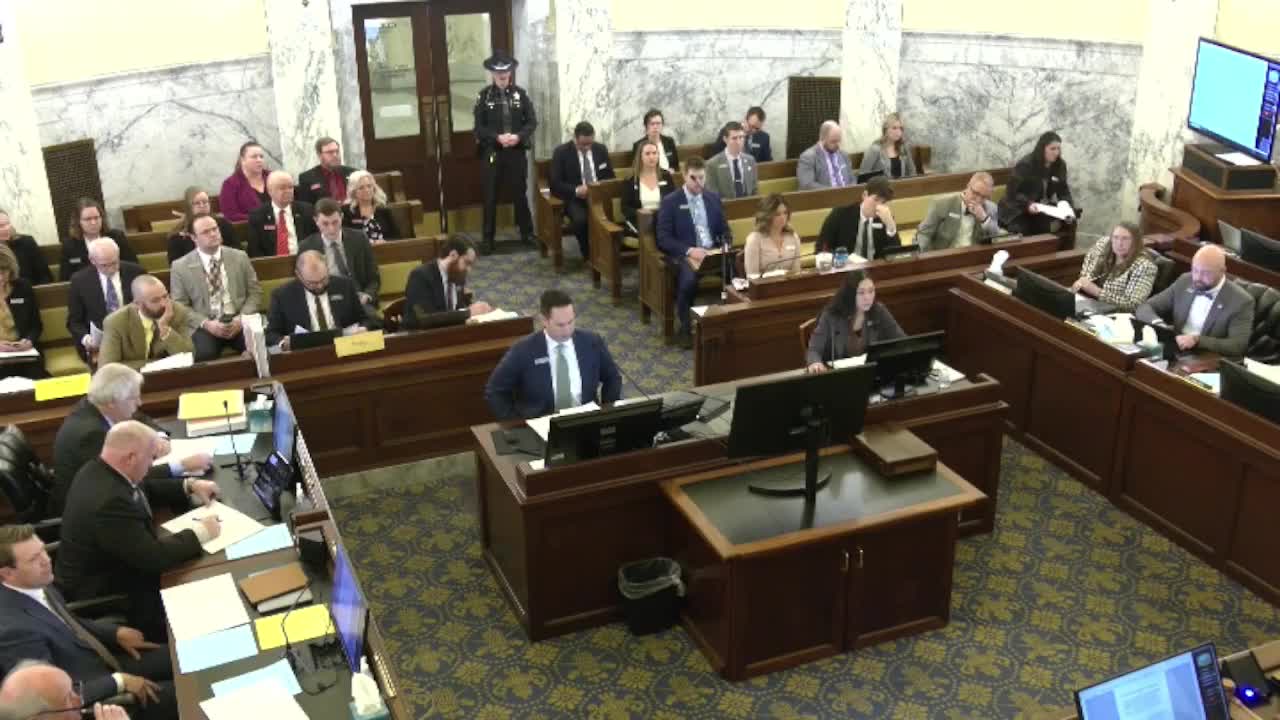
BOISE, Idaho — The Joint Finance-Appropriations Committee voted Jan. 31 to increase the appropriation for state employee health insurance to $14,130 per eligible full-time equivalent (FTP) for fiscal year 2026, a compromise between three proposals the committee considered.
The move, advanced by Senator David Woodward and seconded by Representative Tanner, passed on a recorded roll call with a combined 17 ayes, 0 nays and 3 members absent or excused. Committee staff said the change produces a larger projected ending reserve for the state health-insurance fund than the CEC recommendation but smaller than the governor’s recommendation.
Committee analysts presented three dollar-level options for the committee to consider: the CEC recommendation at $13,960 per FTP, the governor’s recommendation at $14,300 per FTP and a midpoint compromise at $14,130 per FTP. Mr. Brian Bybee, legislative budget staff, described the three options and the associated smaller employer-paid adjustments for workers’ compensation and Social Security.
Members debated whether to reflect the full actuarial cost or to use reserve balances to buy down premiums. Representative Furness criticized the reliability of actuary projections and urged caution in raising funding levels, saying, “They are conservative. They're very conservative.” Senator Ward Engelking pushed for showing the “actual cost of insurance” rather than masking it by using reserves, saying buying down the premium in prior years produced a jump this year that doesn’t reflect year-to-year costs.
Staff provided reserve-balance projections tied to the three funding options. Bybee told the committee the projected ending reserve balances for FY2026 would be about $51.6 million under the CEC motion ($13,960), about $61.4 million under the governor’s recommendation ($14,300) and an intermediate amount for the $14,130 compromise.
The motion that passed increased appropriations across funding sources by a total of $48,397,200: $36,043,900 from the general fund, $8,599,500 from dedicated funds and $3,753,800 from federal funds. Committee members noted the change will affect agency budgets and the premiums or budget instructions that state entities — including school districts — receive when the legislature communicates benefit-cost assumptions.
The committee also clarified the joint voting procedure for combined House–Senate JFAC votes during the session. Staff said the ballot is programmed to require a majority of the quorum present from each chamber for a joint motion to pass.