Get Full Government Meeting Transcripts, Videos, & Alerts Forever!
Get email alerts on the Wildfire Budget And Policy topic
No spam. Unsubscribe anytime.
Department of Lands seeks more fire staff and program dollars as governor proposes $100 million-plus to suppression fund and bonuses
Summary
The Idaho Department of Lands described requests for new wildfire-management positions, equipment and one-time items and outlined how Good Neighbor Authority receipts fund federal-lands work; the governor proposed major transfers to the fire suppression deficiency fund and firefighter bonuses.
The Joint Finance-Appropriations Committee on Tuesday reviewed the Idaho Department of Lands’ FY2026 budget and heard requests for additional wildfire-management positions and one-time equipment alongside administration recommendations to bolster the state’s fire suppression reserve.
Janet Jessup, budget and policy analyst for the Legislative Services Office, told the committee the department’s FY2026 package included multiple ongoing staffing requests and roughly $5,700,000 in line‑item enhancement requests, of which about 79% were one-time. She highlighted several requested positions that would add or professionalize fire response and assessment work, including a fire emergency support program manager, a fire aviation section manager and a statewide forest assessment program manager.
Dustin Miller, director of the Idaho Department of Lands, described the department’s wildfire, forest and restoration programs, and outlined how the Good Neighbor Authority (GNA) operates. “About $40,000,000 is what's been generated to date,” Miller said of GNA activity, adding that timber-sale proceeds and related receipts now help cover department personnel, operating costs, payments to the U.S. Forest Service and restoration contracts. He told the committee the department currently has agreements with six of Idaho's seven national forests and that GNA helped the state supply roughly 24% of forest-service timber volume in Idaho last year.
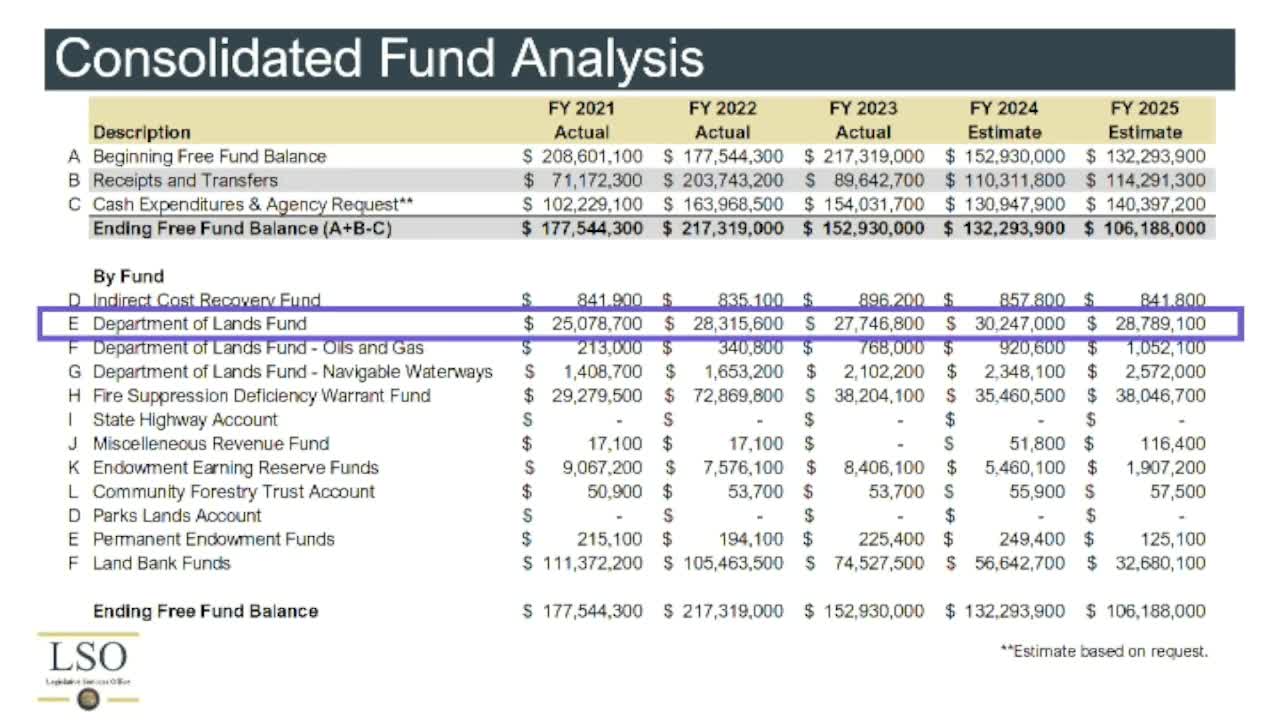
Jessup explained that the fire suppression deficiency warrant fund—an account continuously appropriated to the department for emergency suppression costs—has been prefunded by the legislature since 2015 to smooth the state’s exposure to large fire years. She said the governor’s budget recommended a $60,000,000 supplemental transfer for the current year (FY2025) and a $40,000,000 transfer from the general fund to the suppression fund for the coming year.
Director Miller told lawmakers the current suppression account balance is about $35,800,000 but that, without the governor’s requested additional transfers, the department projects the fund could drop to roughly $13,000,000 in FY2026 after outstanding invoices and partner cost shares are accounted for. “That account dropping down to 13,000,000 is going to provide us some challenges,” Miller said.
Committee members pressed for detail on how timber-protection assessments are collected and distributed. Jessup said Timber Protective Associations (TPAs) receive assessments for private timberland fire protection and that TPA employees are not state employees; the governor’s recommendation included a line-item equivalent to a 5% compensation enhancement for those TPA personnel in recognition of parity with state firefighter CECs. The department noted that the governor recommended $1,000,000 for firefighter bonuses for Department of Lands employees and that TPAs later asked the legislature to add $250,000 so association-employed firefighters would receive similar bonuses.
Committee members also discussed wildfire trends, reimbursement timing and the department’s abandoned‑mine obligations. Director Miller said the state has nearly 9,000 abandoned mine sites that need attention, the abandoned-mine fund is not sufficient to meet the workload, and the department relies on the Idaho Geological Survey and partners to prioritize closures.
No formal committee action was taken during the hearing; lawmakers asked for additional data on historical suppression expenditures and the timing of federal reimbursements to inform budget deliberations.