Get Full Government Meeting Transcripts, Videos, & Alerts Forever!
Get email alerts on the Soil Water Conservation topic
No spam. Unsubscribe anytime.
Soil and Water Commission reports high district satisfaction, details Waukapa demand and funding leverage
Summary
The Idaho Soil and Water Conservation Commission told the House Agriculture Affairs Committee it achieved high district satisfaction for fiscal year 2024 and reported intense demand for Waukapa cost‑share funds that leveraged roughly $3.54 of conservation work for every state dollar in FY24.
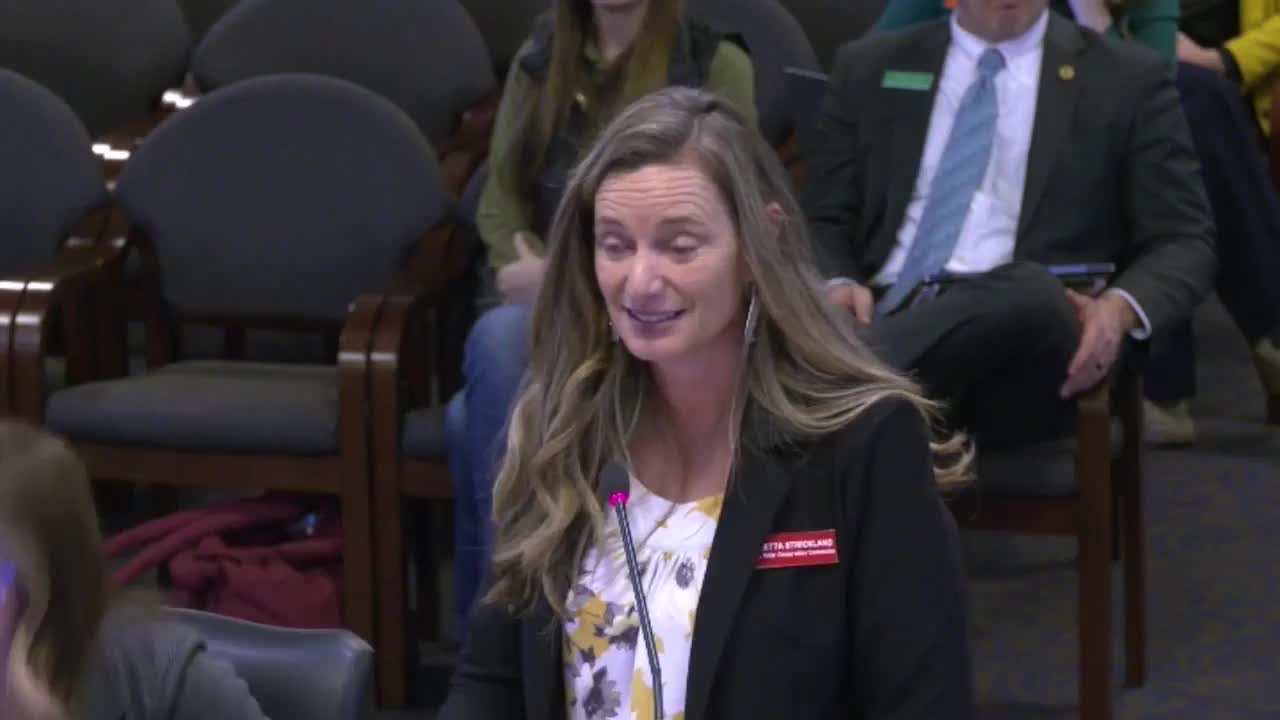
Loretta Strickland, acting administrator for the Idaho Soil and Water Conservation Commission, told the House Agriculture Affairs Committee the commission’s fiscal year 2024 performance report shows strong district satisfaction and heavy demand for state conservation cost‑share funds.
The commission reported that 97.5 percent of conservation districts responding to its annual survey indicated they were satisfied overall with services and programs in fiscal year 2024. “This level of customer satisfaction is, I suggest, directly related to the quality of our staff,” Strickland said.
The commission described four core functions: district support and services; comprehensive conservation services; fiscal administration; and outreach. Strickland said total revenues for FY24 were “approximately 3,950,000.00” and expenditures totaled “just over 7,900,000.0.” She said $1,580,000 appropriated for distribution to conservation districts was disbursed “per statute and rule.”
Why it matters: the report documents both the scale of state investment in voluntary, nonregulatory conservation and how those dollars were used and leveraged by local districts and landowners.
Commission staff summarized program outcomes and the biggest program news of FY24: renewed state funding for Waukapa (the commission’s water‑quality cost‑share program for agriculture). Strickland said $10 million appropriated across 2022–24 drew 170 project proposals requesting $20,200,000 in cost share; 98 proposals were funded from the $10 million appropriation and, combined with partner and landowner match, resulted in about $36,100,000 in conservation activity. For FY24 specifically, $5,000,000 was appropriated, 80 proposals were submitted and 50 were selected to receive Waukapa funds; those projects combined state funds with other monies to implement $17,700,000 in conservation work. Strickland summarized the program’s FY24 leverage: “for every dollar the state invested in Waukapa in fiscal year 20 24, Idahoans accomplished $3.54 worth of conservation.”
Program and service metrics: the commission reported it assisted 10,31 landowners in conservation efforts, delivered nearly 12,000 staff hours assisting districts, and logged 2,771 staff hours providing technical assistance to CREP participants. Staff provided technical support for 9,705 acres enrolled in CREP; the RCRDP loan program assisted financing conservation projects on 8,221 privately owned acres; staff worked on best‑management practices affecting 63,075 acres; and the commission developed two TMDL implementation plans. Strickland noted EPA did not approve any new TMDLs in FY24, which left staff capacity to focus on Waukapa implementation.
Committee questions focused on program distribution, project types and funding mechanics. Representative Miller asked what types of projects were not funded; Strickland said proposals were ranked for public benefit and return on investment and cited major FY22–24 Waukapa investments: about $4,350,000 in irrigation infrastructure and efficiency projects, $949,000 in livestock BMPs, $949,000 in streambank and erosion BMPs, $203,000 in soil health BMPs and roughly $942,000 in district administrative funds. Representative Nelson asked how state funding reaches local districts; fiscal manager Melanie Ziegler explained the first $725,000 is distributed equally to districts (each receiving $14,500) and the remainder is allocated as state match proportionate to eligible local support, per statute and IDAPA rules.
Other testimony: Idaho Association of Soil Conservation Districts leaders emphasized locally led volunteer conservation, youth outreach and community infrastructure work. Devin Fielding, IASCD treasurer and a district supervisor, told the committee the districts’ mission is voluntary, nonregulatory conservation and stressed local capacity to help with irrigation efficiency, soil health and community infrastructure. Tori O’Neil, IASCD vice president and local district supervisor, detailed district projects including a pivot upgrade and youth education programs such as Envirothon and fifth‑grade tours.
What the committee did: no committee votes on policy items were taken during the presentation; the committee heard the report and asked follow‑up questions.
Ending: Strickland and IASCD leaders thanked the committee for support and said the commission and districts will continue implementing voluntary conservation where local landowners opt in.