Get Full Government Meeting Transcripts, Videos, & Alerts Forever!
Get email alerts on the Public Defense topic
No spam. Unsubscribe anytime.
New Idaho State Public Defender office seeks millions to cover staffing, transcripts and county transitions
Summary
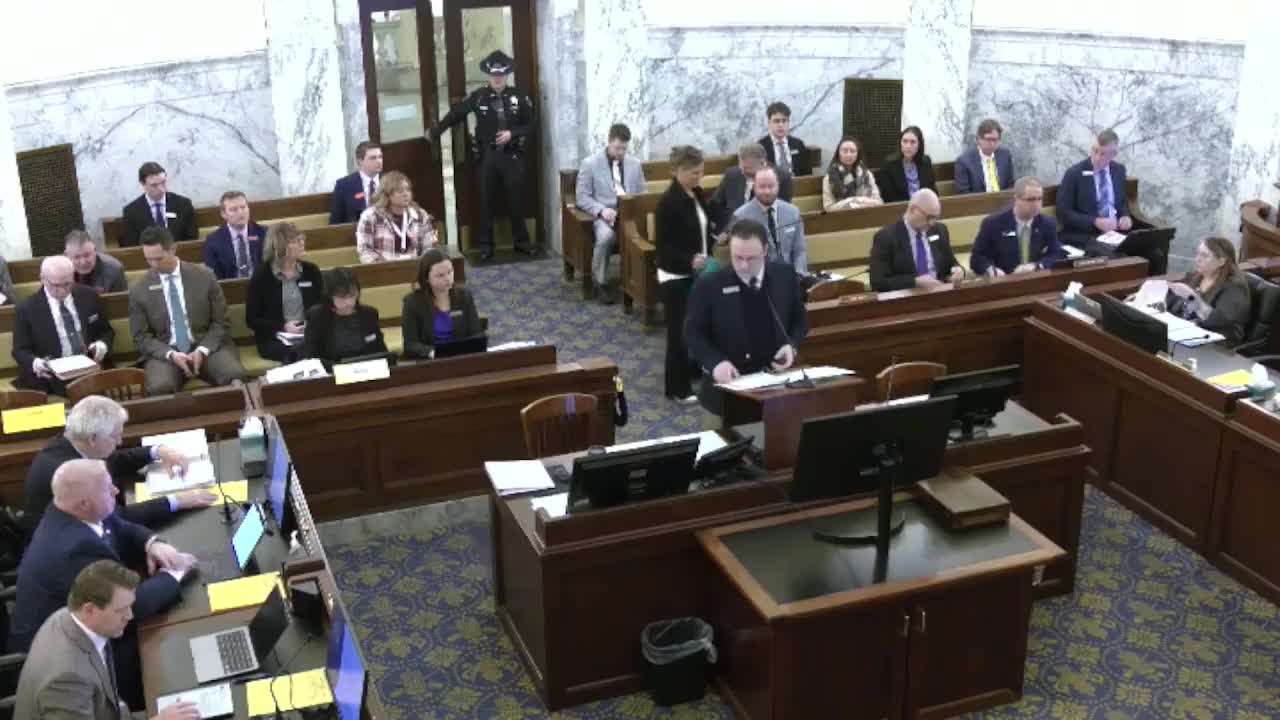
At a Joint Finance-Appropriations Committee budget hearing, State Public Defender Eric Frederickson and Legislative Services Office analysts outlined supplemental and ongoing funding requests to finish implementing the new State Public Defender agency, citing rising caseloads, previously omitted appropriations and costs shifted from counties.
Eric Frederickson, Idaho State Public Defender, told the Joint Finance-Appropriations Committee that the newly created State Public Defender office needs supplemental and ongoing funding to cover a rapid influx of cases, higher contract rates and costs counties previously paid.
The agency asked the legislature to approve a mix of one-time and ongoing appropriations, including a request to fully appropriate a $39 million cash transfer to a new state public defense fund and supplemental funding for transcript and personnel/contracting costs. Christopher Lahoset, budget and policy analyst with the Legislative Services Office, reviewed the requests for the committee.
The agency described the requests as responses to several strains since the agency began operating. “We walked into 1,300 withdrawals and cases,” Frederickson said, describing the early months of the agency’s transition. He told lawmakers the statewide rollout uncovered under‑resourced contract arrangements in some counties and higher-than-forecast needs for complex litigation, including capital cases.
Why it matters: the office was created by statute (the State Public Defender Act) and funded in part by a one-time transfer from a tax-relief fund; lawmakers must authorize spending authority before the agency can use the cash. Committee members said the sums are large and requested detail before committing ongoing general fund increases.
Requested funding and key uses - Cash transfer and appropriation: Lahoset summarized that the legislature directed a $39,000,000 transfer into a dedicated state public defense fund (cited in presentation as Idaho Code §57-8207) and that the agency is requesting a $2,500,000 one-time supplemental appropriation to allow full use of that cash in the current fiscal year. He said the agency earmarked that appropriation to provide representation for children and parents under the Child Protective Act. - Transcript costs: The governor recommended a one-time supplemental of $390,200 for transcript costs after the Idaho Supreme Court ruling in State v. Blasick, which the analyst said made the state responsible for transcript costs previously borne by counties. The governor also recommended an ongoing $1,290,200 to continue covering transcript costs in future years. - Personnel and contract costs: The agency requested $5,427,600 one-time for additional personnel and contract rate increases for the current fiscal year and sought larger ongoing operating increases for FY 2026 to raise contract investigator and attorney rates, cover capital litigation experts and fund other operating needs. Lahoset also reported an agency request to add 17.96 full‑time positions to support onboarding of institutional offices in specific counties (Benewah, Elmore, Jerome and Shoshone). - One-time recruitment/retention cash: Lahoset said the governor recommended a one-time cash transfer of $16,867,400 from the general fund to the state public defense fund to boost recruiting, retention and contract rates.
Implementation, counties and scope of work Frederickson and committee members described several operational issues revealed by the transition. Frederickson said prior county-level flat-fee contracts were “unethical” and insufficient and that the state moved to equalize compensation across counties to recruit attorneys into rural areas. He described efforts to create institutional offices and said counties are expected to continue providing facilities until 2029 under current statute.
The new agency has responsibilities created in statute to establish uniform contract rates, implement ABA standards and provide oversight; Lahoset quoted the enabling statute as Title 19, Chapter 60, Section 3 of Idaho Code. Frederickson said the agency is already litigating appointments to matters he described as outside the agency’s statutory mission (for example, some custody and private termination matters) because courts sometimes appoint the agency when private counsel is not available.
Committee concerns and follow-up requests Lawmakers repeatedly asked for more line‑item detail on several budget lines. Senator Zinerfeld asked for specifics about the $2,000,000 “experts” line; Frederickson responded that capital cases and psychosexual evaluations (which he said run about $2,500 each) drive the expert costs. Representatives and senators asked for a breakdown of the $3,581,000 item listed as “training, transcripts and miscellaneous expenditures.” Frederickson acknowledged that some costs previously paid by counties—such as certain evaluations and district court funds—were not always transparent during the transition.
Several committee members urged the agency to provide more granular documentation of where supplemental and ongoing funds would be spent and requested distribution lists and project-level details for prior workforce and county onboarding money. Lahoset told members the detailed breakdowns are available in the budget book (LBB 5‑103) and that staff would provide additional follow-up on the tax-relief fund totals.
Ending: next steps Committee members signaled they want more detailed spending plans and asked the agency to provide itemized breakdowns of the supplemental and ongoing requests, evidence of contract rate changes, and county-level facility agreements (memoranda of understanding). Frederickson said the agency is five months into the statewide transition and that the requests reflect rapidly changing caseloads and revealed gaps from pre-transition assumptions.