Get Full Government Meeting Transcripts, Videos, & Alerts Forever!
Get email alerts on the Budget Process topic
No spam. Unsubscribe anytime.
JFAC staff present new "clear language" and reappropriation sections for program maintenance bills
Summary
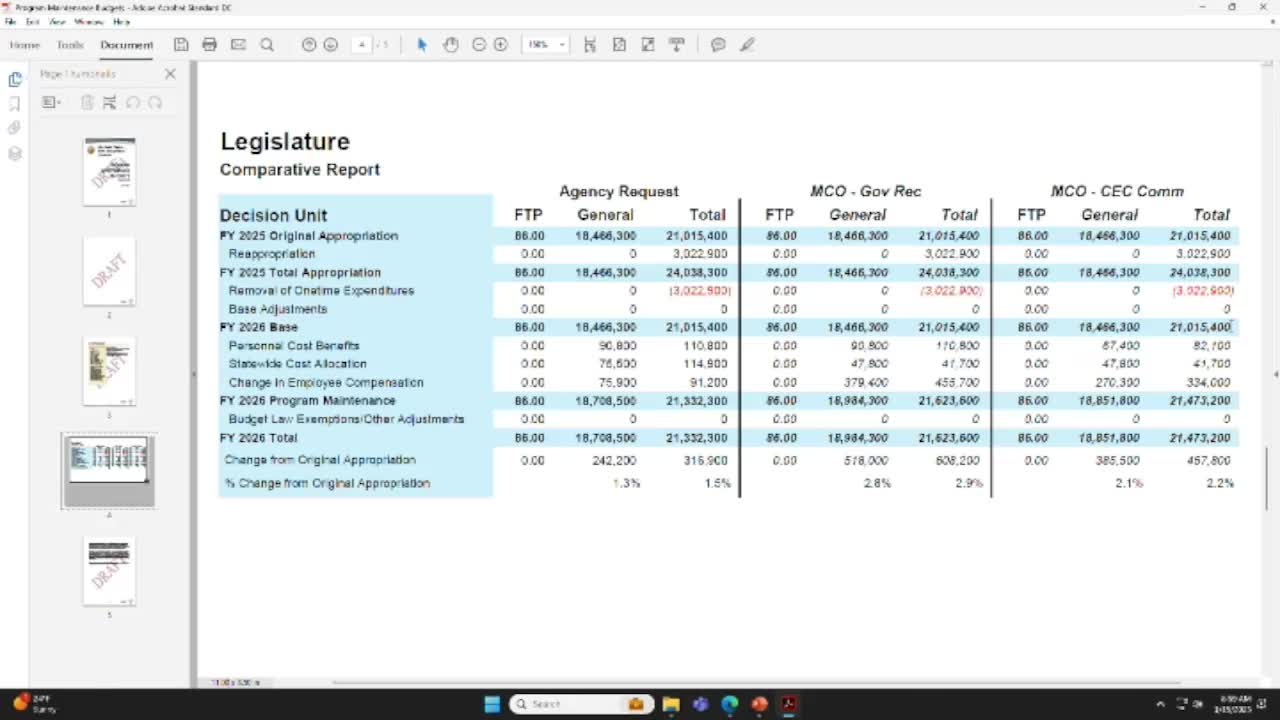
Legislative staff walked the committee through program maintenance packets that add a committee recommendation column, reappropriation provisions (often for ARPA and capital projects), exemptions from transfer restrictions, and a new category described as "conditions, limitations and restrictions" — labeled "clear language" — meant to make the
Committee budget staff reviewed the program maintenance packets that will form the basis of FY2026 maintenance appropriations and described a new presentation format and several categories of recurring appropriation language the committee will consider when it sets maintenance budgets.
Keith Bybee, division manager for Budget Policy Analysis, told members the packet format now includes a third column showing the committee’s recommendation in addition to the agency base and the governor’s recommendation. Staff emphasized several recurring categories of language that the committee will review in maintenance bills, including (1) exemptions from statutory limits on transfers between expenditure categories (presented in the materials as an exemption "from Section 60 seven‑thirty five‑eleven"), (2) reappropriation authority (commonly used for multi‑year capital projects and ARPA funds), (3) "conditions, limitations and restrictions" (presented as "clear language" to specify how appropriated funds must be used), and (4) accountability audits or reporting requirements tied to specific appropriations.
Bybee and other staff walked members through examples in the packets across functional areas: Judicial Branch language about judge retirement contributions and monthly transfers to retirement accounts; reappropriation authority for environmental remediation projects at the Department of Environmental Quality; continuous appropriation language for the Endowment Fund Investment Board; and transfer directions for water infrastructure and flood‑management funds at the Department of Water Resources. He said some language is longstanding and carried from past appropriation bills; other provisions (particularly reappropriations tied to ARPA funds) will remain until those projects conclude.
Committee members asked about how to remove or change prior intent language and whether the committee could lift statutory caps (for example, replacement caps or transfer limits) when necessary. Chair Hormann responded that the committee has full discretion to adjust numbers and language as it sees fit when the committee votes on budgets. Several members stressed the need to add explicit reporting requirements in appropriation language if the committee wants regular performance updates.
Bybee asked members to review the packets before maintenance‑budget votes, noting that some language that appears routine is legally binding and will be incorporated into the appropriations acts unless the committee amends it.