Get Full Government Meeting Transcripts, Videos, & Alerts Forever!
Get email alerts on the Health Insurance Benefits topic
No spam. Unsubscribe anytime.
JFAC deadlocks on health insurance rate; debate centers on reserves and contractual risk
Summary
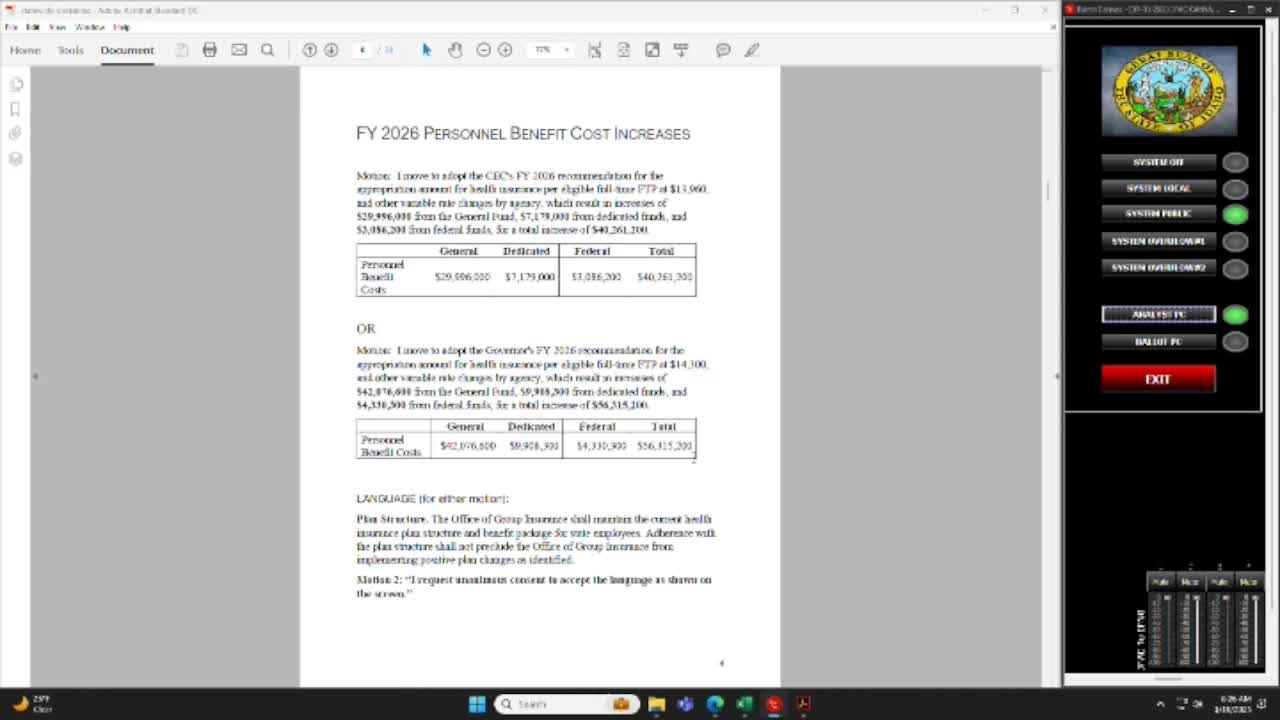
Members of the Joint Finance and Appropriations Committee debated competing health insurance funding proposals for fiscal 2026 but did not adopt either the committee’s $13,960 recommendation or the governor’s $14,300 recommendation; the matter was left unresolved.
Members of the Joint Finance and Appropriations Committee debated personnel benefit cost decisions, including the health insurance per-eligible-full-time-position (FTP) rate for fiscal year 2026. The committee did not adopt either the Economic Outlook and Revenue Assessment Committee (CEC) recommendation of $13,960 per eligible FTP or the governor’s recommended $14,300 figure.
Analysts told the committee that under the CEC recommendation the plan’s contingency reserve was projected to fall to the statutory minimum of 10 percent of plan costs—approximately $51.6 million—while the governor’s $14,300 recommendation would leave roughly $61.4 million in reserves and provide about $10 million more cushion. Keith Bybee, the Division Manager for Budget Policy Analysis, summarized the Milliman actuarial projections and the reserve impacts.
DFM administrator Laurie Wolf and Office of Group Insurance administrator Faith Knowlton answered specific questions about contractual consequences if the reserve falls below the 10 percent contingency. “If we fall below the 10% contingency reserve, then a risk charge can be assessed to the state,” Knowlton said. Wolf added that the 10 percent contingency is a contractual minimum and that actuary projections show roughly a 50 percent chance of meeting that minimum depending on claims experience.
Committee debate split along risk and affordability lines. Proponents of the lower CEC number argued the state’s reserve balance is already substantial (the committee was told the current balance is about $80,491,337) and that a lower premium increase would draw reserves down but keep them within acceptable bounds; supporters urged avoiding overfunding the contingency. Other members favored the governor’s recommendation, arguing it preserves a cushion against high-claim years and reduces the possibility of a larger rate increase next year.
Roll-call votes failed to advance either proposal under JFAC’s dual-majority rule. A substitute motion adopting the CEC recommendation failed to win the necessary majority from both houses (combined tally recorded as 9 ayes and 11 nays). A later vote on the governor’s recommended $14,300 figure also failed to attain the required Senate majority even though the House supported it. Chairman Groh and staff said the committee would return to the issue at a later meeting.
Ending: The committee left the health-insurance decision unresolved; analysts were asked to provide follow-up material about reserve levels, contractual thresholds and the likely next-year premium implications.