Legislative staff and DAS outline Oregon rulemaking steps, timeframes and oversight
Loading...
Summary
Legislative Policy and Research Office and the Department of Administrative Services briefed the House Rules Committee on Oregon's Administrative Procedures Act, required impact statements, notice timelines, temporary rules and legislative oversight; DAS said the governor directed common communication standards for agencies.
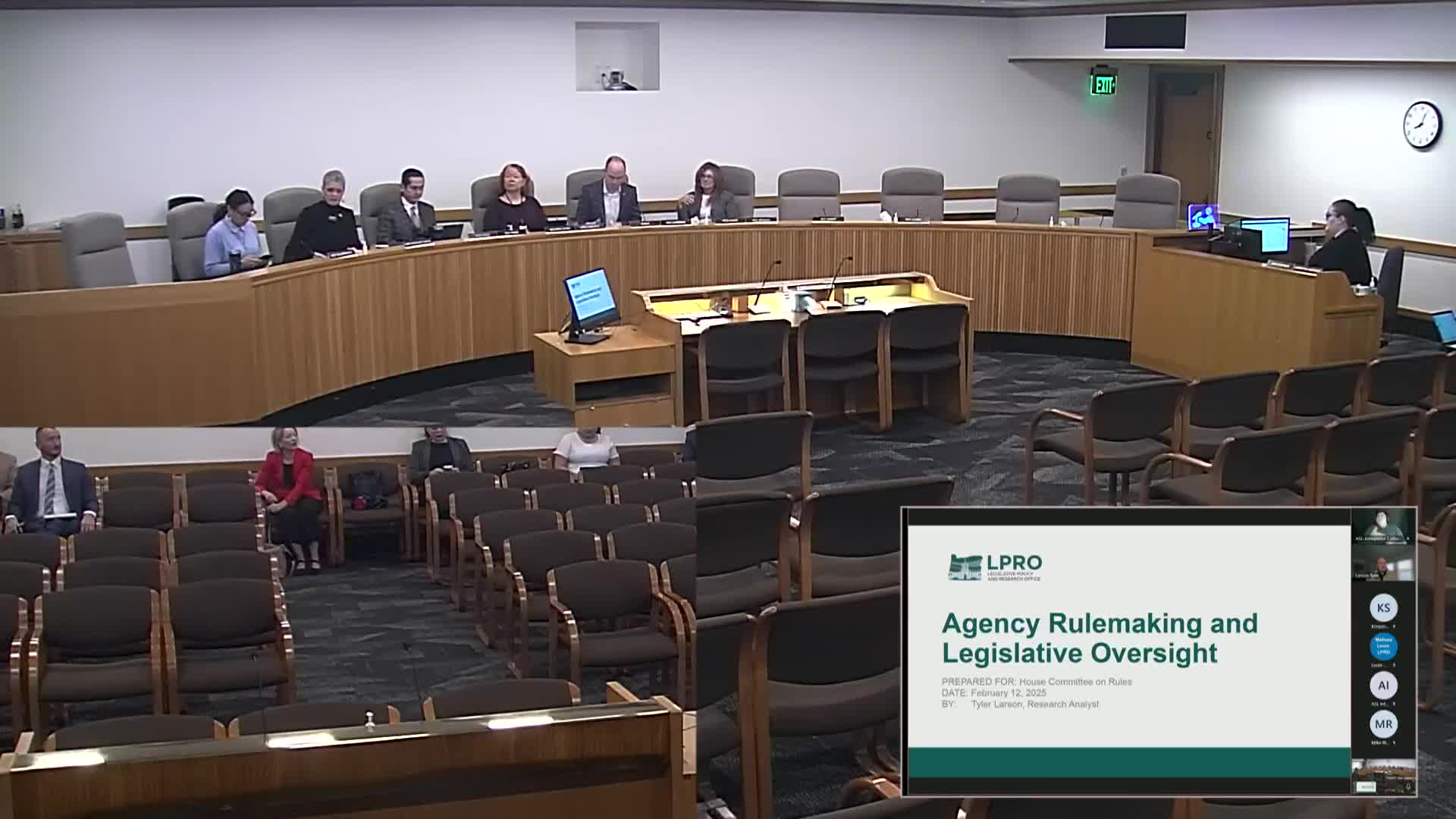
The House Committee on Rules heard an informational briefing on state administrative rulemaking on Feb. 12, when Legislative Policy and Research Office analyst Tyler Larson reviewed statutory processes and Department of Administrative Services Director Mary Lehi described executive-branch efforts to standardize agency communications.
Larson summarized the Administrative Procedures Act (APA) and the rulemaking sequence used across agencies, saying agencies generally must: seek public input; complete required impact analyses (fiscal, housing cost where applicable, and racial equity); publish notice of intent; provide an opportunity for public comment and hearings; file adopted rules with the Secretary of State; and conduct five‑year rule reviews.
The briefing emphasized statutory timelines for notice: proposed rules must appear in the Oregon Bulletin at least 21 days before a rule’s effective date, interested persons must be sent notice at least 28 days before the effective date, and specified lawmakers must receive email notice at least 49 days before the effective date when the enabling legislation was passed within two years. Larson also described temporary rules, which agencies may adopt for up to 180 days without fulfilling full notice and hearing requirements if the agency finds that delay would cause serious prejudice to the public interest.
Lehi said the governor has directed the Department of Administrative Services to issue a short set of cross‑agency expectations to improve how agencies communicate about rulemaking, including consistent website placement of rulemaking materials, public summaries of comments received, and showing how public comments were considered in final rules. Lehi described the initiative as an effort to create a “solid foundation” so agencies can move into continuous improvement and better serve Oregonians.
Committee members asked about gaps in notice to minority‑party legislators and to members who do not receive targeted email lists; Larson said the APA specifies notice recipients (sponsors, committee chairs/co‑chairs, and presiding officers when committee notice cannot be given). Committee members also raised questions about the statutory history of notice requirements and the provenance and timing of the three required impact statements; Larson and Lehi offered to follow up with more detail.
The information session closed with committee members and witnesses urging greater transparency so the public and affected businesses know when rules change and how to participate.