Get Full Government Meeting Transcripts, Videos, & Alerts Forever!
Get email alerts on the Employee Compensation topic
No spam. Unsubscribe anytime.
JFAC approves $177.4 million employee compensation package including $1.55 hourly minimum increase
Summary
The Joint Finance-Appropriations Committee voted to approve a compensation package that provides at least $1.55 per hour per full-time equivalent position for state agency and institution employees and includes targeted adjustments for specific salary schedules.
The Joint Finance-Appropriations Committee voted to approve a compensation package that provides at least $1.55 per hour per full-time equivalent position for state agency and institution employees and includes targeted adjustments for specific salary schedules.
The motion, offered on the committee floor by Representative Miller, directs pay increases between $1.05 and $1.55 per hour for employees except where specific exceptions apply, and includes additional targeted funding: a 4.5% increase for classified and nonclassified IT and engineering workers, up to an 8% total increase for Idaho State Police troopers, and funding for nursing and health-care employees equal to $1.55 per hour or 3%, whichever is greater. The package also includes funding for community colleges (calculated at a 5% equivalent) and $84,669,500 for public schools and the Idaho Educational Services for the Deaf and the Blind.
Why it matters: The package is a state-level change to ongoing salary schedules and will be incorporated into the maintenance budgets that the committee has already approved. It affects tens of thousands of state employees, public-school funding and several mission-critical salary groups (IT, public safety and healthcare), and it imposes new reporting requirements on agencies and the Division of Human Resources.
Key provisions and funding breakdown - Provide $1.55 per hour per FTE as a baseline; employees should receive pay increases between $1.05 and $1.55 per hour except as enumerated in the motion's paragraphs 2–5. The language bars agencies from transferring the new funding out of personnel categories and requires reversion and reporting of unused funds. - Community colleges: a budgeted equivalent of 5% ($2,305,700 shown in the packet) because community college FTP is not tracked in the state personnel database. - Salary-schedule shifts: Move four salary schedules upward by at least $1.55 per hour (primary schedule; IT/engineering; public safety; nursing/health-care). The motion funds a 4.5% supplement for IT and engineering and provides additional funding so troopers may receive up to an 8% increase. - Nursing/health care: Funded at $1.55/hour or 3%, whichever is greater. - Reporting: Requires monthly reports developed by the Division of Human Resources and the Office of the State Comptroller identifying pay changes and any additional pay outside the CEC implementation window.
Totals and budget sources The motion as read into the record listed totals of $128,354,900 from the general fund, $34,266,900 from dedicated funds and $14,807,300 from federal funds, for a combined total of $177,429,100. The packet presented to the committee shows $84,411,100 allocated for the $1.55/hour baseline and $84,669,500 for public schools and the Idaho Educational Services for the Deaf and the Blind.
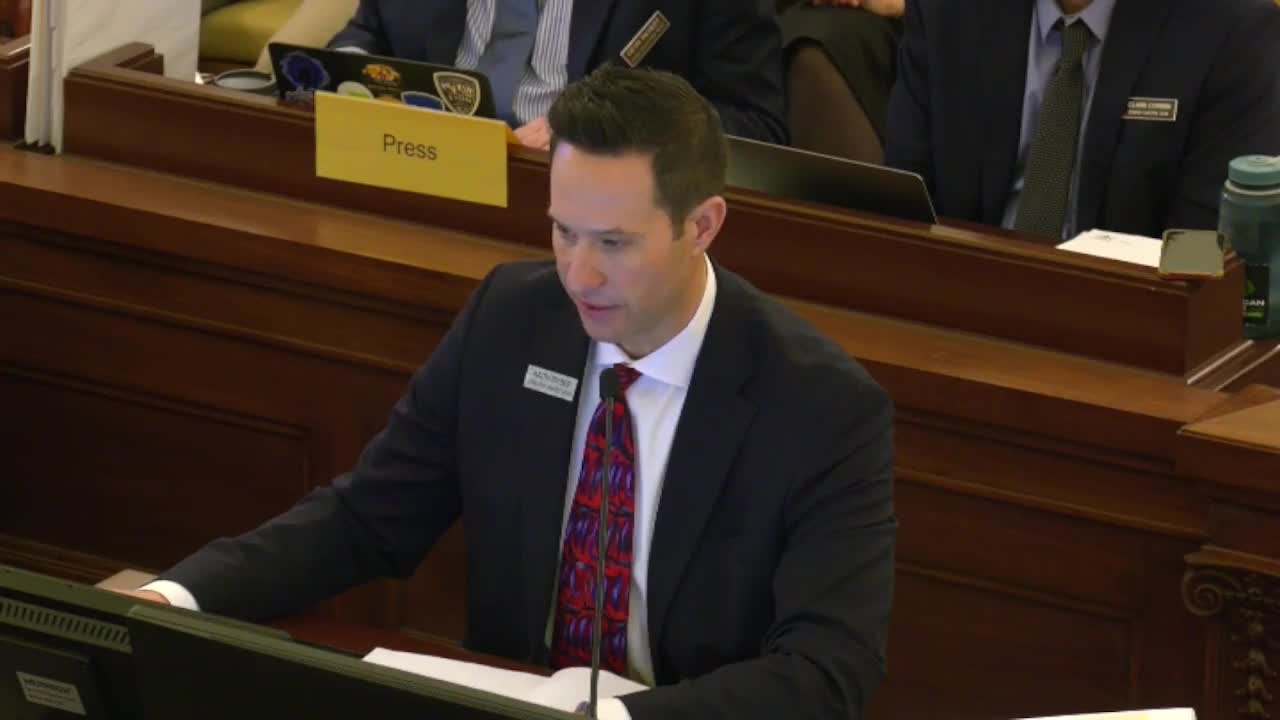
Debate and positions Keith Bybee, Division Manager, Budget Policy Analysis, presented the language and the packet and described the funding lines and reporting requirements. Representative Miller moved the motion and summarized the funding components.
Several members expressed reservations about long-term effects on salary compression and retention. Senator Ward Engle King said she could not support the motion and argued the package did not address pay compression above about $64,000; she said the committee needs further work to address higher-salary retention (quote: "I won't be able to support the motion"). Senator Wintrow also said she could not support the motion, citing statutory direction to provide a competitive salary package. Senator Cook and Senator Woodward said they would support the motion despite concerns; Woodward warned the baseline could create "use it or lose it" dynamics that limit managers' discretion.
Vote and next steps As recorded on the committee floor, the motion passed and will carry a due-pass recommendation to the floor. The committee roll call as announced in the transcript recorded the Senate vote as 8 ayes, 2 nays; the clerk then announced the final counts and that the motion passed and would carry a due-pass recommendation. The packet and the approved language will be inserted into the maintenance budgets for floor consideration.
What the language requires agencies to do - Agencies must implement the baseline and targeted adjustments as prescribed and cannot transfer the new funding out of personnel costs. - Agencies that provide increases above $1.55 per hour using internal salary savings must report those actions to the legislature. - The Division of Human Resources and the Office of the State Comptroller must produce monthly reports that identify pay changes, which the committee said will help the CEC committee and JFAC track implementation.
Context and reaction Opponents said the package does not resolve pay-compression issues among higher-paid, highly trained employees; proponents said the combination of a minimum increase and targeted supplements strikes a balance between cost-of-living relief and market adjustments for critical roles. Committee leaders urged further study and follow-up in the coming months to address outstanding recruitment and retention concerns.
Ending The committee asked staff to compile a list of additional pay requests that agencies submit outside the standard CEC framework (a staff request Mr. Bybee was asked to assemble) and directed that future follow-up and reporting be used to track implementation.