Get Full Government Meeting Transcripts, Videos, & Alerts Forever!
Get email alerts on the State Budget topic
No spam. Unsubscribe anytime.
Tennessee finance chief previews FY‑26 plan: $1 billion for roads, education boosts and $17 billion in reserves not stated but budget totals discussed
Summary
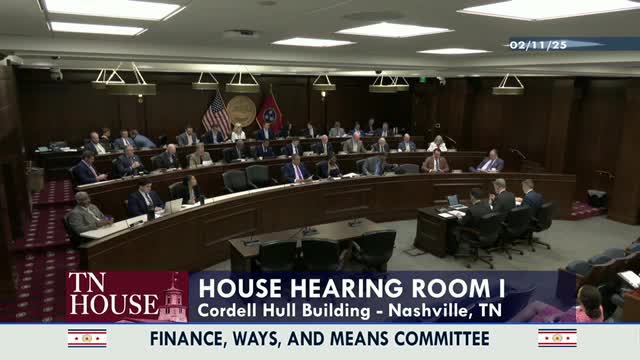
Commissioner Jim Bryson told the House Finance, Ways and Means Committee that Tennessee’s FY‑26 budget assumes 2% tax growth, uses prior recurring revenue for one‑time spending and proposes a $1 billion addition to the state road fund alongside major education and higher‑education investments.
Commissioner Jim Bryson, Commissioner of Finance and Administration, told the House Finance, Ways and Means Committee that Tennessee’s proposed FY‑26 budget assumes modest tax growth, taps prior-year recurring funds for one‑time needs and includes new investments in roads, education, higher education and public safety.
Bryson said the administration is using a conservative 2% tax‑revenue growth target set by the funding board and expects federal revenues to fall as COVID emergency funding ends. "Because of this decline in federal funding, total revenues for the FY‑26 budget are expected to be slightly lower at approximately $58,400,000,000," Bryson said. He added that state tax revenues are "now growing slightly," producing an estimated $540 million in new recurring dollars under the growth assumption.
The nut of the presentation was how the state smoothed revenue by using recurring receipts for one‑time investments in prior years. Bryson noted that during high growth years the administration and the General Assembly intentionally spent recurring funds on nonrecurring items—capital projects and other one‑time outlays—so those dollars remained available to smooth later budgets. "These recurring funds were spent on nonrecurring one‑time expenses such as capital or other one‑time investments," he said.
Top spending proposals and claims in Bryson’s overview include:
- Roads: a proposed additional $1 billion investment in the state road fund, plus a legislative proposal to redirect the sales tax on tire sales to transportation, creating an $80 million recurring transfer to support future road maintenance. "We propose another $1,000,000,000 investment in our state road fund," Bryson said.
- K‑12 and higher education: an increase in TISA (the state school funding formula) totaling $244 million for the coming year (Bryson said $164 million was new funding plus an $80 million correction from last year’s overestimate). Higher education would receive a proposed $780 million increase, including $649 million for higher‑education capital projects.
- Public safety and workforce: Bryson said the plan adds 100 new state troopers (part of 372 added over five years) and personnel increases at the Tennessee Bureau of Investigation, plus $10 million in nuclear workforce education grants.
- Airports and conservation: $34.5 million for commercial airport investment and a $25 million farmland conservation fund. For the Duck River watershed Bryson proposed $24.5 million for planning and $100 million in seed money for a water distribution project that would seek other investors.
- Capital and bonding: the administration proposes roughly $1.4 billion in capital projects, with an estimated $930 million of that to be bonded. Bryson said proposed new debt service would add about $87.5 million in gross debt service ($61.7 million net when expiring debt is removed), raising total debt service by roughly 0.39 percentage points of tax revenues. He cited the funding board’s debt policy and said debt service should remain below the policy threshold of 6% of state tax revenues.
- Rainy‑day fund: a proposed additional $35 million deposit, bringing the balance close to $2.2 billion and above the statutory 8% goal.
Committee members pressed Bryson on a range of follow‑ups. Questions included the funding status of the State’s retirement systems (TCRS), the status and location and timeline for juvenile facility projects such as Woodland Hills and Wilder, whether higher‑education institutions could be allowed to issue their own bonds, and whether the budget offsets declines in federal VOCA victim‑services funding. On VOCA, Bryson said the budget includes an increase in the state VCIF victim‑services fund that he believes will help, and that staff would follow up with members for specific local concerns.
Bryson told the committee the administration will continue to follow the funding board’s conservative approach and work with the legislature through the session.
Coming next: the administration’s FY‑26 proposals will be considered in committee as the budget and appropriation bills are drafted and filed; Bryson and budget office staff pledged to provide members with additional line‑item data on teacher pay components, county‑level capital projects and other requested details.