Get Full Government Meeting Transcripts, Videos, & Alerts Forever!
Get email alerts on the Estate Tax Reform topic
No spam. Unsubscribe anytime.
Senate committee hears competing proposals to change Oregon estate tax; no vote taken
Summary
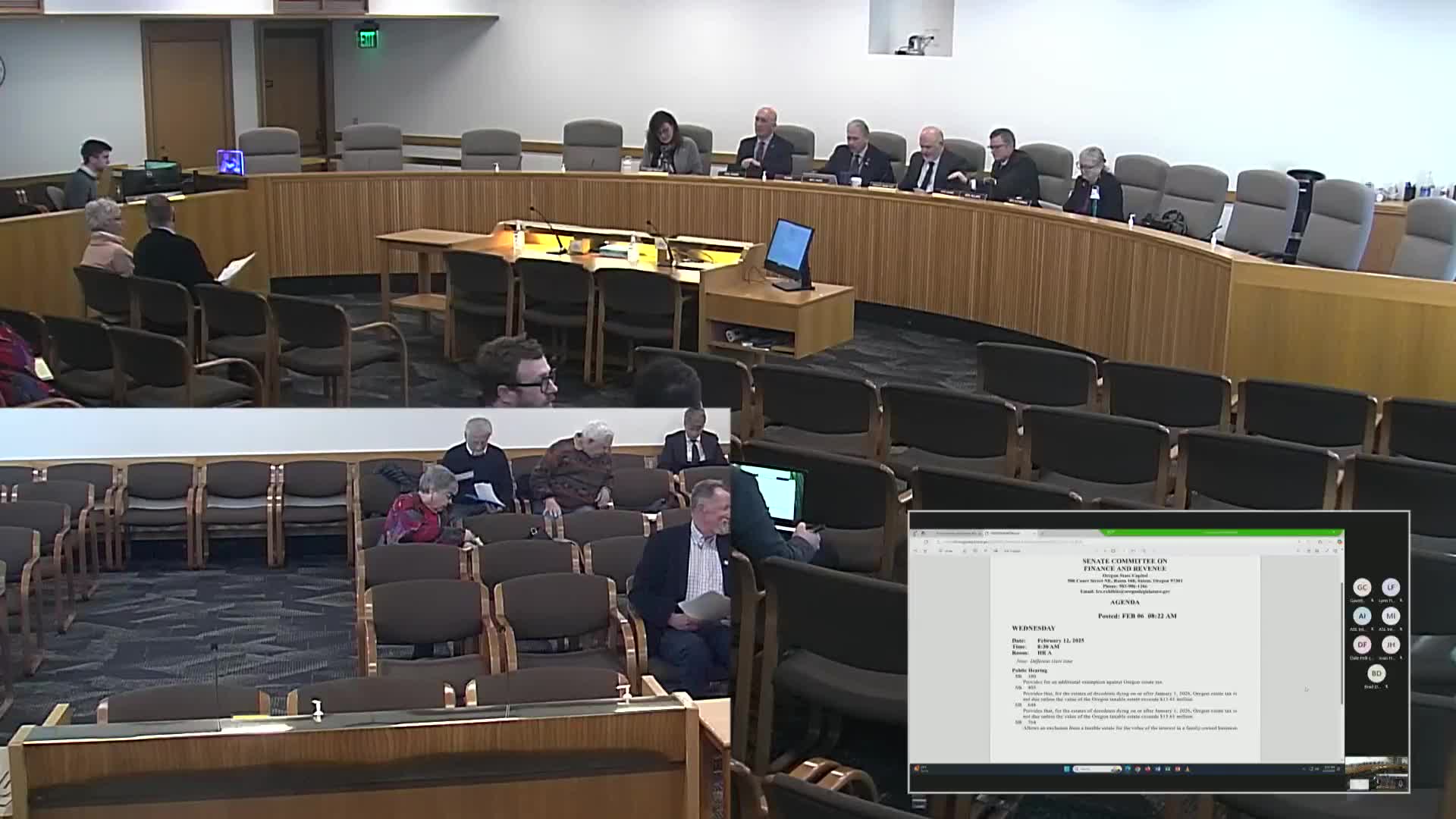
The Oregon Senate Committee on Finance and Revenue convened a public hearing Feb. 12 to consider four bills that would change Oregon’s estate tax: Senate Bill 380, Senate Bill 405, Senate Bill 648 and Senate Bill 764.
The Oregon Senate Committee on Finance and Revenue convened a public hearing Feb. 12 to consider four bills that would change Oregon’s estate tax: Senate Bill 380 (a sliding additional exemption for small taxable estates), Senate Bill 405 and Senate Bill 648 (which would align Oregon’s exemption with the federal exemption level of $13,610,000), and Senate Bill 764 (an exemption for family-owned business interests meeting ownership and holding requirements). No committee votes were taken.
Sen. Suzanne Weber, sponsor of SB 380, said the proposal is intended to make it easier for family farms and other family-owned businesses to pass to a next generation. “Senate bill 3 80 would do just that by modestly increasing the exemption to Oregon's estate tax,” she said, and added, “the estate tax hurts more than the millionaires who have somehow won the birth lottery.” Under the measure described in committee materials, SB 380 would add a $1,500,000 additional exemption for estates with taxable values below $4,500,000 and phase that extra exemption out through $8,500,000; estates would still receive the existing $1,000,000 exemption.
Sen. Fred Girod, sponsor of SB 405, framed his proposal as a simplification and competitiveness measure. “Senate Bill 4 0 5 is simple. It ties it to the federal, tax rate,” he told the committee, referring to the federal exemption level currently cited as $13,610,000. Both SB 405 and SB 648 were described to the committee as eliminating Oregon estate tax for estates below that federal threshold while leaving taxation in place for larger estates.
Sen. Todd Nash, sponsor of SB 764, described a targeted exemption for family businesses. As explained in testimony, SB 764 would exempt from the estate tax ownership interests held by a decedent for at least one year and transferred to family members, with a 75% family-ownership requirement for the company to qualify.
Witnesses presented sharply divided views on fiscal and public-policy effects. Business and trade groups including the Oregon State Chamber of Commerce, Oregon Business & Industry and the Oregon Bankers Association testified in favor, saying the tax pushes family businesses to sell or move and that reforms would help retain employers and human capital in rural communities. J. L. Wilson of the Oregon State Chambers said family-owned local businesses are “pillars of their community” and argued current policy encourages consolidation.
Opponents — including representatives of the Oregon Education Association (OEA), SEIU Local 503 and Tax Fairness Oregon — warned of large, uncertain revenue losses. Louis Sitter of OEA and Anthony Castaneda of SEIU 503 said estate-tax reductions that are not revenue neutral would force cuts to education and other services funded from the general fund. John Calhoun of Tax Fairness Oregon urged caution and noted the state’s exposure to federal funding uncertainty: “I suggest that any consideration of reducing estate tax revenue be put aside in this session,” he said, citing federal funding risks that could increase pressure on the state budget.
Several witnesses and senators pressed the Legislative Revenue Office (LRO) and staff to provide more detailed data on how many estates fall into specific tax brackets, current revenue impacts by bracket, and whether residents are leaving Oregon specifically because of the estate tax. Representative Kevin Mannix and other legislators asked the committee to request updated LRO analysis comparing Oregon’s current exemption with other states and estimating potential revenue impacts and distributional effects. Committee leadership told witnesses staff would be asked to gather more research and that the Feb. 12 hearing served as an introductory fact‑gathering session.
Other details offered at the hearing: - Sponsors and staff described SB 405 and SB 648 as aligning Oregon’s threshold with the federal exemption amount cited in testimony ($13,610,000). SB 380 would add an extra $1.5 million exemption on a sliding scale for estates under $8.5 million. - SB 764 would require at least 75% family ownership and a one‑year holding period prior to death for the family-business exemption to apply. - Several witnesses referenced a 2023 natural-resources exemption for farms, ranches and woodlands that the Legislature enacted (described in testimony as a $15,000,000 exemption for qualifying natural-resources property). Committee members cited that as precedent for targeted relief to preserve family-owned natural resource operations.
Committee Chair Mark Meek closed the hearing without a vote and said the committee would schedule additional hearings after staff research is complete; the chair noted there were dozens of additional witnesses who had signed up and asked for two‑minute testimony slots given time limits. The committee did not take any formal action on the four bills during the Feb. 12 hearing.
The hearing record includes written testimony submitted after the session; committee staff said they will post additional LRO material and related research for members.