Get Full Government Meeting Transcripts, Videos, & Alerts Forever!
Get email alerts on the Welcome Home Assistance topic
No spam. Unsubscribe anytime.
Credit-union-backed loan-loss reserve bill aims to enable zero-down mortgages for creditworthy renters
Summary
House Bill 3,188 would create a state loan-loss reserve to allow credit unions (and potentially other regulated lenders) to offer zero-down, no-mortgage-insurance mortgages to qualified first-time buyers; proponents said the program is modeled on successful pilots and would recycle funds as loans are repaid.
House Bill 3,188 would establish a Welcome Home Assistance Program Fund — a state loan-loss reserve intended to let regulated lenders offer zero-down, no-mortgage-insurance mortgages to qualifying first-time buyers with sufficient credit profiles but insufficient savings for a down payment.
Devin Mullins, testifying on behalf of Representative David Bowman, said the bill targets "reliable renters with at least a 680 FICO score who can afford monthly rent payments but cannot afford the upfront cost of a home." Mullins said the fund would allow credit unions to extend 0% down mortgages for buyers at or below 130% of area median income, backed in part by a state reserve that reimburses a capped share of lender losses in specified circumstances.
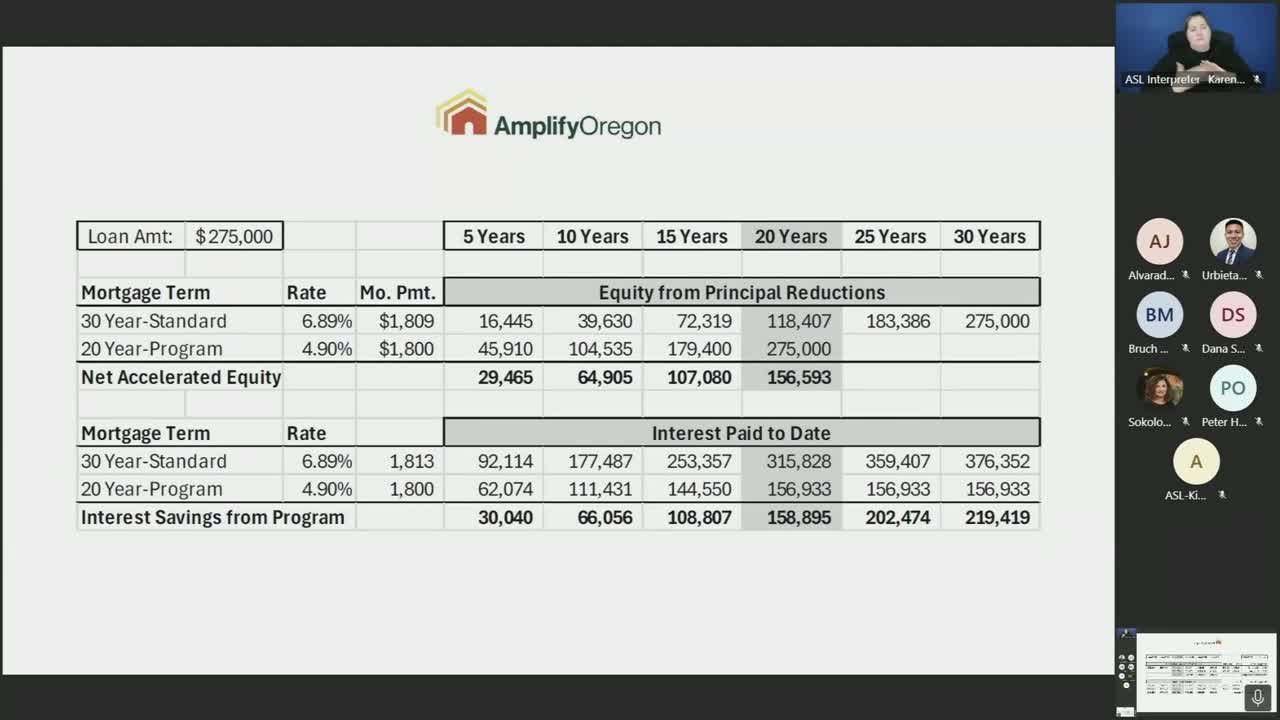
Pam Levitt of the GoWest Credit Union Association and Larry Elifritz of Consolidated Community Credit Union described existing pilot models and testified the loans have performed well. Elifritz said his credit union has used a similar approach for seven years and that in Oregon it helped about 26 families with roughly $10–11 million in loans; he told the committee his organization saw no delinquencies or charge-offs on those pilot loans.
Hal Scoggins, outside counsel for the credit union association, explained the mechanics: when a lender registers a loan with the state program, the Department of Consumer and Business Services would set aside an agreed portion of the fund as a reserve for that loan (testimony discussed a working assumption of about 5% rather than the 20% maximum in the draft bill). If a lender suffers a loss following foreclosure and liquidation, the lender could apply to the fund for reimbursement up to the amount reserved for that loan. If the loan is paid off, refinanced or otherwise resolved, the reserved amount returns to the fund after a prescribed period (testimony referenced a five-year recycling period in which reserved funds become available for new loans once loans are repaid or otherwise resolved).
Committee members asked about underwriting and program safeguards. Scoggins said the bill references federal Regulation Z ability-to-repay standards; lenders will still underwrite loans and the fund is designed to cover a limited, capped share of loss so the lender retains skin in the game. Representative Helfrich and Representative Levy asked about loan caps and local market differences; witnesses said maximum loan amounts and other operational details can be set in administrative rule and can be indexed to local market conditions.
Witnesses and Rep. Bowman’s representative characterized the fund as a recyclable, catalytic investment that leverages private lenders’ originations and expands access for borrowers who otherwise have sufficient income but lack the upfront cash for down payments. Proponents asked the committee to consider friendly amendments to ensure all regulated lenders can participate.