Get Full Government Meeting Transcripts, Videos, & Alerts Forever!
Get email alerts on the School Finance topic
No spam. Unsubscribe anytime.
Finance director: state revenue forecast forces cautious budgeting; special education reimbursement focus
Summary
Director of finance Jason Hall and acting Superintendent Frost told the board the May revenue forecast limits new dollars; the district should budget conservatively, with any unexpected funds likely directed by the state toward high‑cost special education reimbursement.
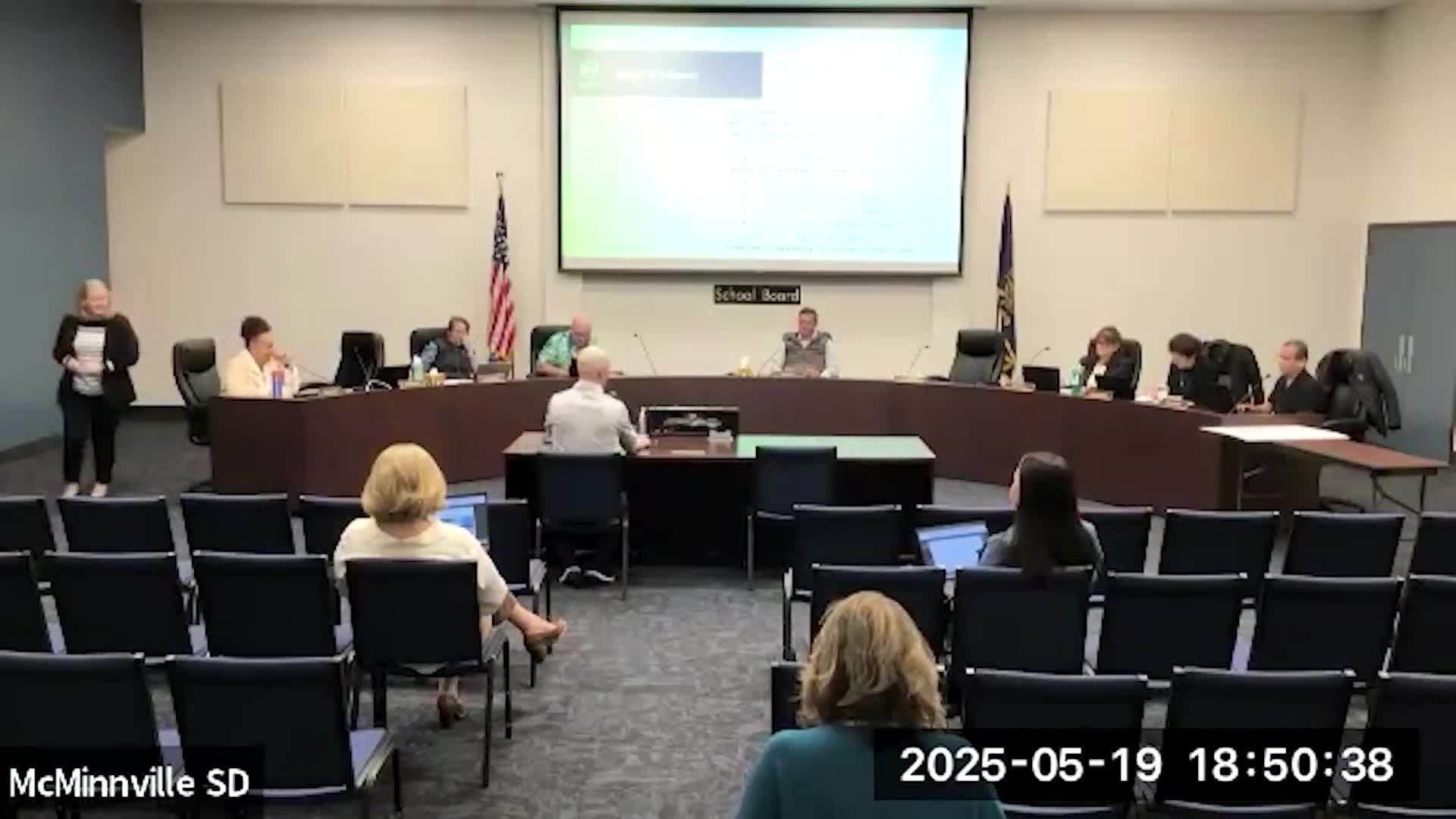
Jason Hall, the district’s director of finance, told the board on May 19 that the state’s May revenue forecast was weaker than earlier projections and that the State School Fund estimate of about $11.36 billion (often summarized as $11.4 billion) is the amount districts should expect for budgeting purposes.
Hall said preliminary information shows Title I allocations are essentially flat from the prior year, with final allocations to be released by the Oregon Department of Education at the end of the month. He said the projected high‑cost disability reimbursement is roughly $0.25 on the dollar for the coming year and that statewide advocacy groups are pushing to raise that to about $0.50 on the dollar.
Hall said statewide advocates and COSA told superintendents and business managers that districts should not count on additional special education funding this year. “They told all superintendents and business managers they should be budgeting for no increase in special education reimbursement,” he said, adding that any additional funds at the state level would likely be directed to the high‑cost disability reimbursement.
On local budget specifics, Hall said the district has factored approximately $125,000 in contract savings into the 2025‑26 proposed budget. He said an earlier estimate of $900,000 in PERS savings (based on a 1.68 percentage‑point reduction) was not included in proposed expenditures; any realized PERS savings would roll to the district’s ending fund balance and could be applied to the 2026‑27 budget.
Acting Superintendent Frost and Hall repeatedly urged prudence. Frost summarized the statewide message: do not presume additional state funds in your operating budget and, if extra funds arrive, use them to address high‑cost special education needs or unexpected expenses rather than to expand ongoing expenditures.
Hall and Frost said the district is monitoring federal and state program allocations (Title I, Title II, Title III and IDEA) and will present additional details at upcoming budget‑committee meetings. Board members asked that the finance presentation and the items related to maintenance of effort for IDEA be discussed at the budget committee meeting scheduled for Wednesday.
Discussion points - State School Fund budgeting assumption: $11.36 billion statewide estimate. - Title I allocations appear flat; final allocations pending from ODE. - High‑cost disability reimbursement projected at ~25¢ on the dollar; advocacy focused on raising it to ~50¢. - Contract savings of about $125,000 already factored into the 2025‑26 proposed budget; a PERS estimate of $900,000 was not included and would roll to ending fund balance if realized.
Direction/duties assigned - Finance staff to present details to the budget committee (Wednesday) and to continue monitoring ODE allocations and federal program notices.
Decisions - No formal board vote; board was advised to budget conservatively and staff were instructed to brief the budget committee.