Get Full Government Meeting Transcripts, Videos, & Alerts Forever!
Get email alerts on the Speech Language Pathology Audiology topic
No spam. Unsubscribe anytime.
Speech‑language board flags workforce growth and rising enforcement needs; warns of SLPA misuse in schools
Summary
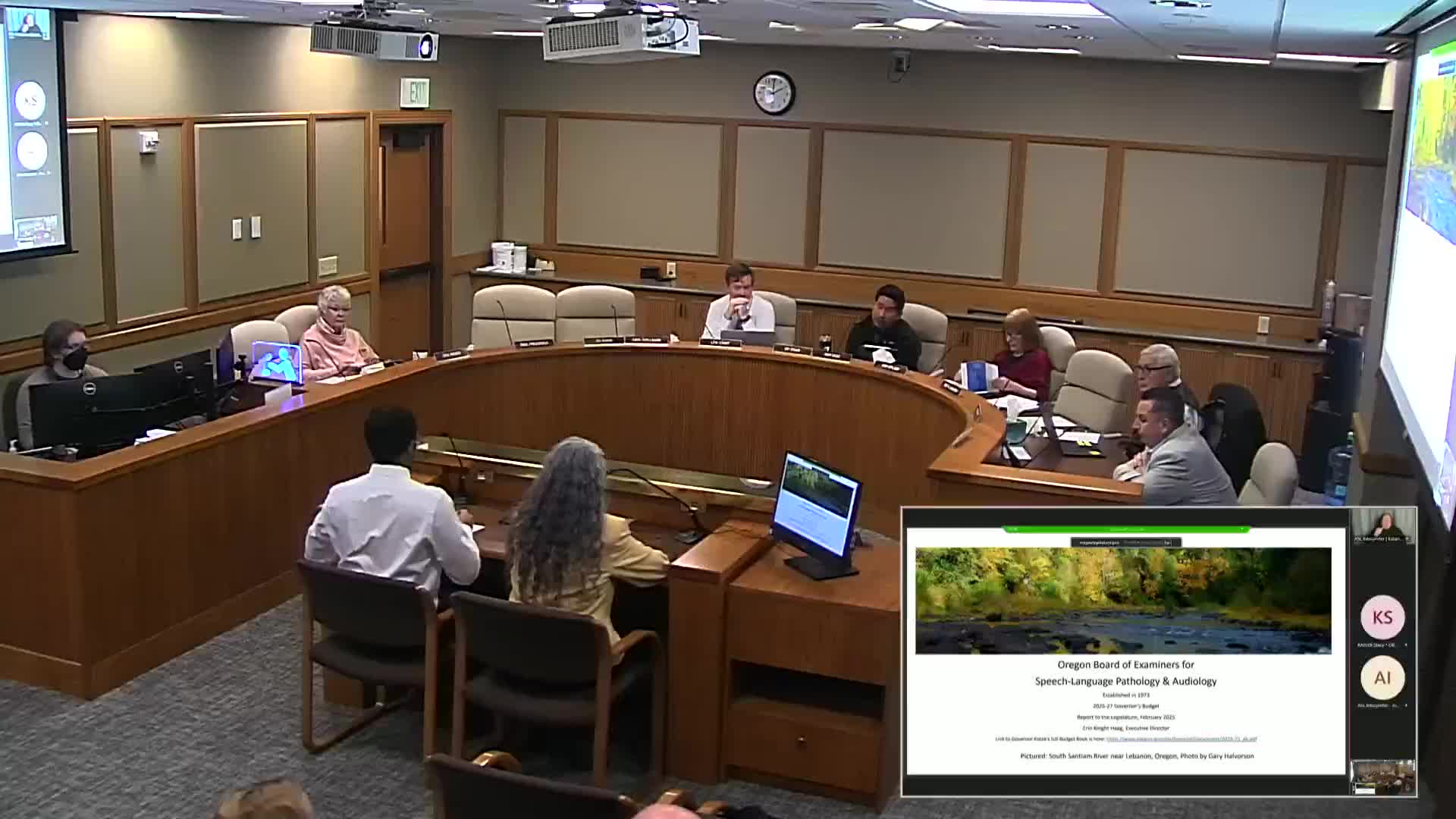
The Oregon Board of Speech‑Language Pathology and Audiology told the Education Subcommittee on Feb. 13 that rapid license growth, telepractice and rising enforcement work — especially cases involving improper SLPA delegation and Medicaid billing — are driving new oversight needs.
The Oregon Board of Speech‑Language Pathology and Audiology told the Education Subcommittee on Feb. 13 that the profession has grown rapidly in recent years, that many new licensees come from out of state, and that the board is seeing an increase in complicated enforcement matters — particularly cases involving improper delegation to speech‑language pathology assistants (SLPAs).
Erin Knight Hague, executive director of the board, said the agency regulates audiologists, speech‑language pathologists (SLPs) and SLPAs to protect public health across settings that include newborn hearing screening, hospitals, schools and private practice. The board reported roughly 3,500 SLPs and roughly 400 audiologists; it said the total licensee pool has grown from about 2,100 ten years ago to several thousand today. Knight Hague said the board’s total biennial budget is about $1.3 million.
Education, licensure requirements and training
Knight Hague told the committee that SLPs require a master’s degree, a clinical fellowship (about nine months) and passage of a national exam before licensure. Audiologists now require a doctoral degree (PhD) in the state; the board indicated only one Oregon program provides that degree. SLPAs typically train at a limited number of in‑state programs — Chemeketa Community College was cited — and must complete 100 hours of supervised fieldwork.
Telepractice and out‑of‑state licensure
The board said it has adopted telepractice rules that have made it easier for out‑of‑state practitioners to obtain Oregon licenses; Knight Hague said a large share of new licensees are not Oregon residents, and that in one month (January) about 80% of new licensees were from out of state. The board maintains a reserve (about 13 months of contingency, the agency said) to manage continuous renewal cycles and caseload-driven costs.
Enforcement concerns: SLPA misuse and Medicaid billing
Knight Hague told lawmakers that the board has seen private practices and some school districts assign caseloads to SLPAs in ways the board considers improper, sometimes resulting in inadequate oversight of patients and, in some cases, improper Medicaid billing. The board said it has encountered examples where children were not clinically seen by an SLP for extended periods yet were billed to Medicaid. Knight Hague said the board is increasing audits of school districts and private practices and is revising key performance measures to better track those audits and customer service.
Key performance measures and staffing
The board proposed swapping an existing KPM to make customer service a primary metric and to add measures that capture the percentage of education service districts and school districts audited. Knight Hague said the board recently filled a vacancy for an investigator after a multi‑month gap and that DOJ legal costs have risen due to a higher volume and complexity of cases. The board said it has not increased fees since 2021 and expects reserves to remain sufficient for the near term.
Questions from lawmakers
Representative Wright asked about the board’s 60‑day supervisory cadence for SLPs overseeing SLPAs; Knight Hague clarified that, as a minimum, SLPs should see or review a given client at least every 60 days and that higher‑need cases require more frequent direct oversight. Knight Hague said CE requirements were reduced from 30 to 20 hours every two years, aligning with national professional practice standards, and that cultural‑competency training is part of the CE mix.
The board told the committee it will continue outreach on workforce development, work with the Oregon Department of Education on “grow your own” programs and coordinate training for school districts to avoid improper delegation and Medicaid errors. The subcommittee closed public testimony after the three boards presented and scheduled the remaining three boards for the following day.