Get Full Government Meeting Transcripts, Videos, & Alerts Forever!
Get email alerts on the Medical Imaging Licensing topic
No spam. Unsubscribe anytime.
Oregon Board of Medical Imaging reports strong reserves, seeks investigator reclassification
Summary
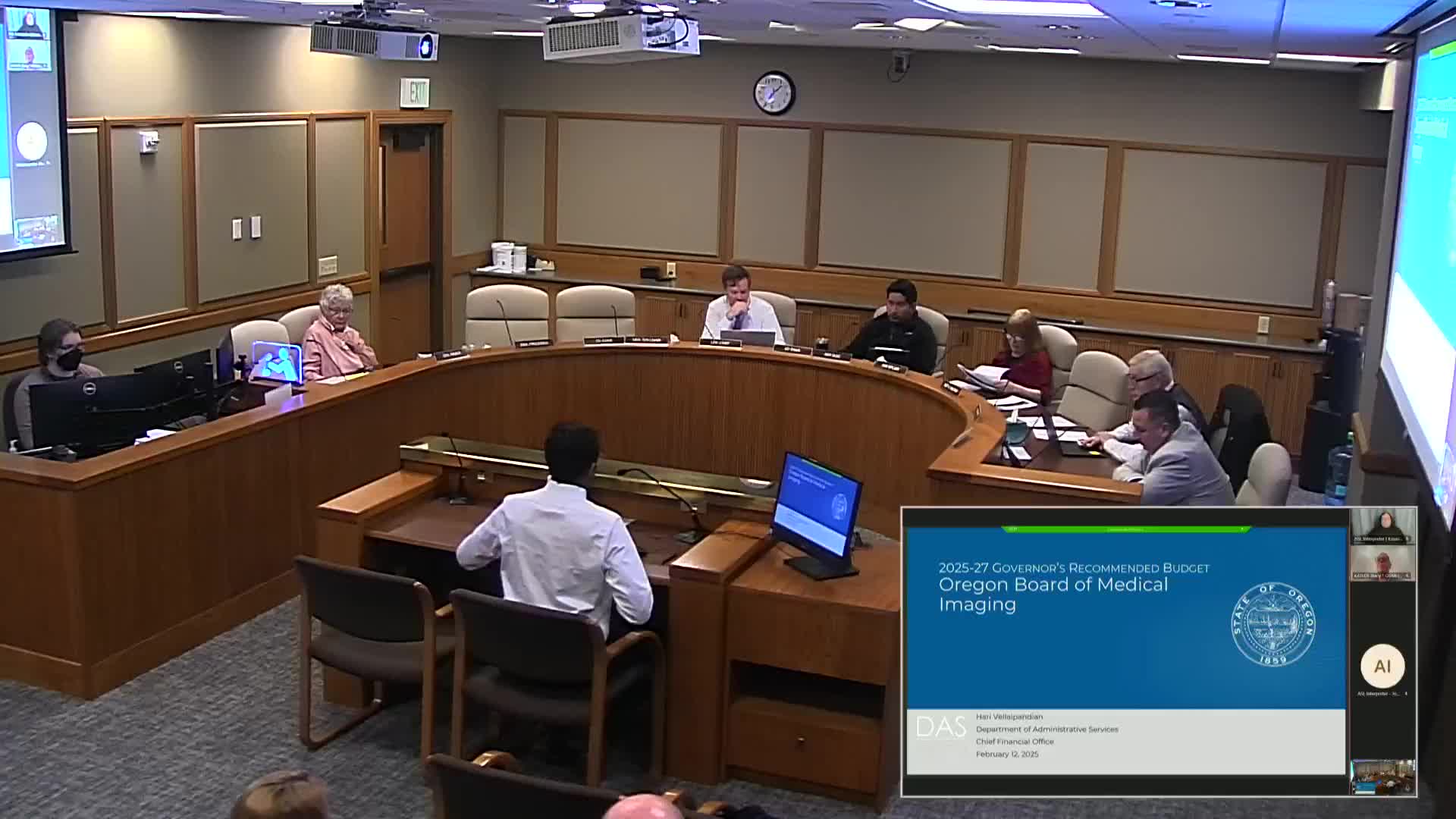
At the Feb. 13 Education Subcommittee hearing on Senate Bill 5524, the Oregon Board of Medical Imaging described steady license growth and a healthy cash balance after a 2021 fee increase and asked the committee to fund converting a part-time investigator to full-time and reclassify that position to handle complex disciplinary caseloads.
The Oregon Board of Medical Imaging told the Education Subcommittee on Feb. 13 that it has a strong ending balance and steady license growth but requested funding to increase an investigator from 0.75 to 1.0 full-time equivalent to handle a growing and complex disciplinary caseload.
Stacy Catler, executive director of the board, testified that the agency — funded entirely by licensing and exam fees and without a backlog — currently manages about 8,600 active licensees across radiography, sonography (ultrasound), MRI, nuclear medicine and radiation therapy. The governor’s recommended 2025–27 budget supports current services, automations and the investigator reclassification.
Catler said the board has benefited from a 2021 fee increase and post-pandemic growth in license applicants. The agency’s recommended budget is weighted toward personal services (about 68%) and maintains an ending balance sufficient for roughly 30 months of operations, Catler said.
Timeliness and enforcement
The board reported rapid processing of licensure transactions: complete license applications and renewals are typically processed within two business days, often faster. Catler said the average time from investigation start to written board report is about 45 days, and the board has no backlog of complaints. The agency resolves a large share of disciplinary matters through negotiated agreements.
The board’s key justifications for the investigator change were caseload complexity and rising average disciplinary-case volumes, Catler said. The board currently uses a committee of four to six board members to review disciplinary cases in advance of quarterly meetings to improve efficiency.
Education and workforce
Catler noted constraints in training capacity for technologists in Oregon and identified Portland Community College, Oregon Institute of Technology (Klamath Falls), Linn–Benton Community College (Albany) and OHSU as training partners. PCC’s programs, she said, run at capacity and admit roughly 36 students per cohort.
The board also oversees approval of limited X‑ray machine operator (LXMO) programs and continued expansion of license categories and subspecialties has increased administrative complexity, Catler said. License and permit fees are $216 for a two‑year license.
Questions from lawmakers
Representative Wright asked which schools train imaging students; Catler listed Portland Community College, OIT, Linn–Benton and OHSU. Representative McLean congratulated the board on its lack of backlog and stable reserves.
Catler said the governor’s recommended budget for the board totals an expenditure limitation of $1,806,246 in other funds and supports four FTE; the agency’s cash flow is large enough to avoid a fee increase for at least two biennia under current projections.