Get Full Government Meeting Transcripts, Videos, & Alerts Forever!
Get email alerts on the Public Safety Finance topic
No spam. Unsubscribe anytime.
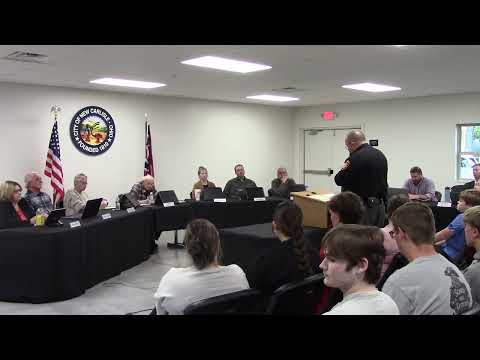
Clark County officials brief New Carlisle council on half-point sales-tax proposal to fund new jail
Summary
Clark County officials told the New Carlisle City Council that a proposed half-percentage-point sales-tax increase will appear on the November ballot to help pay for a new public-safety complex that would include a replacement jail.
Clark County officials told the New Carlisle City Council that a proposed half-percentage-point sales-tax increase will appear on the November ballot to help pay for a new public-safety complex that would include a replacement jail.
The county presentation, delivered by Clark County Commissioner Sasha Rittenhouse and an unidentified Clark County sheriff, outlined a DLZ consulting estimate of about $100 million for construction and related hard and soft costs and described how the county would use sales-tax revenue to cover the project and related needs.
Rittenhouse said the county is asking voters to increase the county portion of the sales tax from 7.25% to 7.75% — a half-percent increase — and that the levy would be placed on the November ballot. “We have asked to increase our sales tax from 7.25% to, 7.75%. So, half of a percent,” she said. Rittenhouse told the council the county lacks other reliable local revenue streams it could use for the project — “We cannot, collect income tax” — and emphasized that sales tax revenue also captures purchases by nonresidents who pass through the county on I‑70.
Rittenhouse said county consultants DLZ estimated the total cost of the facility at about $100,000,000 and that the county has applied for state grants but has been unsuccessful so far because it lacks a completed land purchase and an identified local funding source. She added the state jail‑construction grant pool is limited, noting the program’s dollar cap: “That funding right now is $50,000,000 for the entire state of Ohio. So all 88 counties battle for the same $50,000,000 each year, and it’s a very competitive grant.”
The sheriff described operational and capacity problems at the existing Clark County Jail and argued they increase pressure for a new facility. The sheriff said the existing jail dates to the late 1970s, is rated by the state to hold 167 inmates, and that the facility’s average daily population has been about 204, which he said exceeds the recognized capacity. “The current facility was built as a 168 bed facility... The state of Ohio currently today recognizes the Clark County Jail as being able to hold 167 inmates. Today our average daily population is 204,” the sheriff said. He told the council the jail failed 14 of roughly 172 minimum-jail-standards checks on a recent inspection, and that many of the failures involved the physical plant and layout.
The sheriff argued that overcrowding reduces the county’s ability to hold people for lower-level crimes and to provide in‑custody rehabilitation programs. He described a plan for a new facility he said would be about 130,000–140,000 square feet with roughly 454 beds and built to support programming, including medication-assisted treatment in custody. He also described the financial consequences of having to house inmates out of county if the facility were ordered vacated: “It costs me $90 per day per inmate, to take inmates and house them someplace else… that would be $6,241,500 per year over the 3 year period of constructing a new jail,” he said.
Council members asked clarifying questions during the presentation. When asked whether the proposed sales-tax increase would have a lifetime limit, Rittenhouse said the levy is written for 20 years and that the County Commission could end it earlier if revenues or other funding sources are secured.
No formal action by the council on the county proposal was recorded in the meeting transcript. Council members were given the presentation and were able to ask questions; the county officials requested that the council consider the information as they move toward the November ballot.
Ending: County officials said the levy’s success would help provide a local funding source the county can use to leverage state grants and build the new facility; they urged voters to consider the proposal on the upcoming ballot. The council took no vote on the matter at the meeting.