Get Full Government Meeting Transcripts, Videos, & Alerts Forever!
Get email alerts on the Agricultural Research Extension topic
No spam. Unsubscribe anytime.
University of Idaho Ag Research, Extension Ask for Ongoing Positions; Dean to Retire After Nine Years
Summary
The Joint Finance-Appropriations Committee heard the University of Idaho’s agricultural research and extension summary, including requests for a viticulture/small fruits faculty position and building maintenance funds, updates on ARPA-funded digital-literacy work and a federal broadband-related grant application.
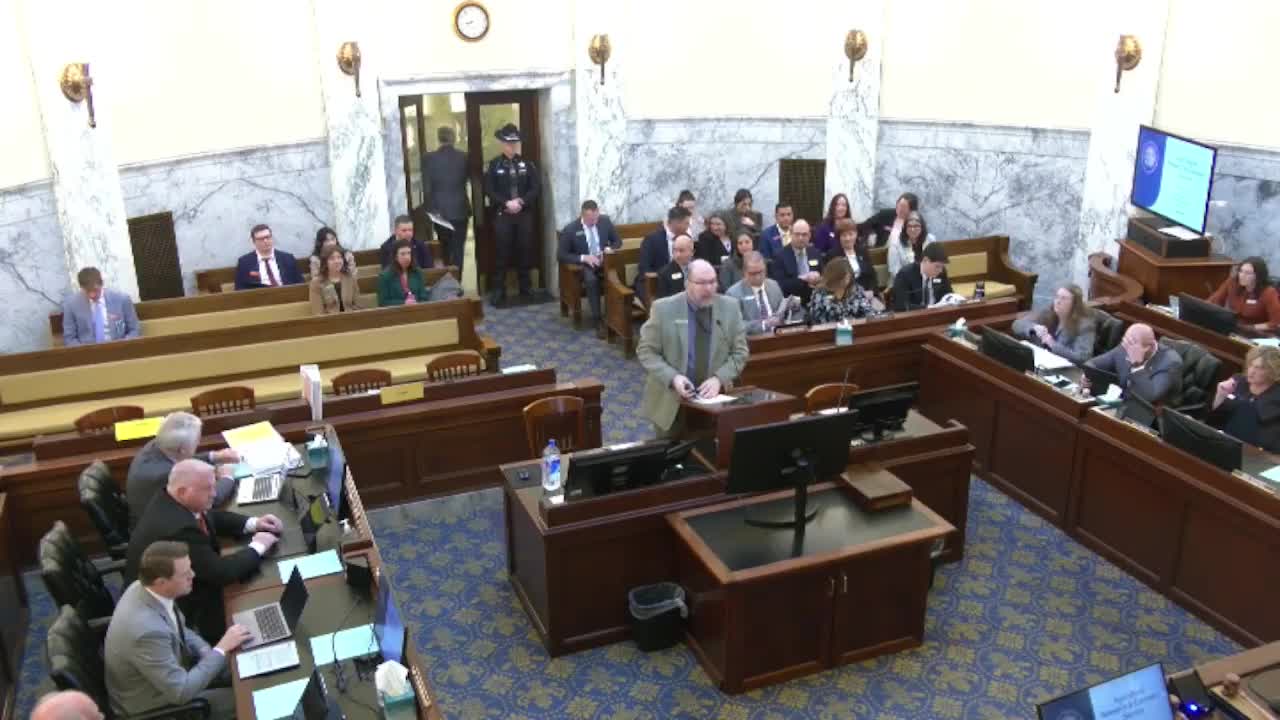
The Joint Finance-Appropriations Committee on Feb. 10 heard an overview of Idaho’s Agricultural Research and Extension Service and the College of Agricultural and Life Sciences’ FY2026 requests, and received an update from Dean Michael Perella, who told the committee he will retire in June after nine years as dean.
Kevin Campbell of the Legislative Services Office presented the service’s budget history and recent appropriations. Dean Perella and college staff described recent hires, new facilities and specific FY2026 requests, including an ongoing $157,900 request for a viticulture and small-fruits research faculty position and $250,100 proposed to cover part of building maintenance costs at the Idaho Center for Agriculture, Food and the Environment.
Perella said the viticulture hire would respond to growers’ needs for research on disease prevention, water and pest management and post-harvest storage for grapes and small fruits — a “rapidly growing” segment of Idaho agriculture, according to the presentation. He said extension and research operate statewide: the service has a presence in 42 of Idaho’s 44 counties and three tribal communities and maintains research centers with access to about 14,000 acres for field research.
The committee also discussed digital-literacy work funded earlier with federal ARPA money. Campbell and Perella said the college used ARPA funds to support community computer-literacy efforts and to partner on broadband and digital-literacy work. Perella reported that faculty had successfully competed for a Federal Communications Commission grant opportunity and that the university-led proposal — one of 24 funded nationally in the program list mentioned in the hearing — could bring roughly $13,000,000 in federal funds to projects engaging two-year and four-year institutions and rural communities if the federal award is finalized.
Perella highlighted extension’s reach and impact: extension recorded more than 450,000 face-to-face contacts with Idahoans last year and engaged more than 75,000 youth in 4‑H programming, figures he used to illustrate statewide extension activity. He also cited a national ranking in agricultural sciences: the college was ranked 13th nationally last year, “the highest ranking for any agricultural college in the Northwest,” the dean said.
Committee members asked about scope and priorities. Representative Handy asked whether research emphasis might shift from yield (volume) toward nutritional content; Perella said the college has programs in nutrition and dietetics and is increasing research connections in nutrition and human health. Representative Miller asked about crop breeding, irrigation efficiency and the college’s capacity to address Idaho’s agricultural diversity; Perella described new facilities (including the Idaho Center for Plant and Soil Health in Parma), ongoing breeding programs and investments in faculty with modern expertise, including in AI applications for agriculture.
Senator Rose and others raised concerns common to ARPA-funded initiatives: whether temporary federal funding had created programs now requiring ongoing state support. Perella said extension had planned to phase programs if federal funding ended but noted the college is also pursuing larger federal grants to sustain and expand digital-literacy work.
Perella closed by thanking the legislature for sustained investments, citing improvements in research facilities, increased ability to attract external funding and a modest decline in turnover after recent compensation increases. He told the committee he is proud of the college’s statewide impact and the research and extension teams that deliver technical assistance to Idaho communities.
No formal votes or motions were recorded on the service’s budget in the committee transcript for this hearing.