Get Full Government Meeting Transcripts, Videos, & Alerts Forever!
Get email alerts on the Child Welfare Budget topic
No spam. Unsubscribe anytime.
Idaho health officials ask lawmakers for $14 million supplemental, prioritize prevention and foster-family recruitment
Summary
Director Adams, head of the Idaho Department of Health and Welfare, told a Senate committee the department will prioritize child-welfare prevention and foster-family recruitment in its upcoming budget request and is seeking a $14 million supplemental to address rising placement costs.
Director Adams, head of the Idaho Department of Health and Welfare, told a Senate committee the department will prioritize child-welfare prevention and foster-family recruitment in its upcoming budget request and is seeking a $14 million supplemental to address rising placement costs.
Adams said Idaho has about 463,000 children and receives roughly 24,000 hotline calls about possible abuse or neglect each year; the department responds to about 15,800 of those, and in 89% of assessed cases the child is deemed safe. “It’s the right thing to do,” Adams said of focusing on child welfare, “We can make a big difference in the lives of these children.”
Why it matters: Adams and Deputy Director Monte Pro said costs have risen because more children are being placed in congregate-care settings and incoming cases have higher clinical acuity. Congregate care is far more expensive than home-based services, and officials argued that investing in prevention and recruitment will both improve outcomes and slow budget growth.
Most important details
- Supplemental and budget ask: Adams said the department has a $14,000,000 supplemental request this year tied to child-welfare spending growth.
- Caseload and placement data presented by Adams: Idaho has about 24,000 hotline calls per year; the department assesses about 15,800. In 11% of assessments (roughly 1,700 cases annually) children are found unsafe. Adams reported about 300 prevention cases and roughly 1,400 placements per year; about 1,200 children achieve permanency annually, most commonly reunification (65%) or adoption (25%).
- Costs: Adams said a child in basic foster care costs about $5,800 per year (about $16 per day), a prevention case costs about $657 per year (about $1.80 per day), and congregate care has averaged $385 per day based on 2024 data but can reach about $1,400 per day in some contracts — translating to more than $140,000 per child per year in high-cost placements.
- Drivers of cost growth: Officials attributed recent budget spikes to a higher share of placements in congregate-care settings (rising from single-digit percentages to the high teens) and higher acuity among children entering care. Adams said the state faced a “seller’s market” for scarce congregate beds after some facilities closed during the COVID-19 pandemic.
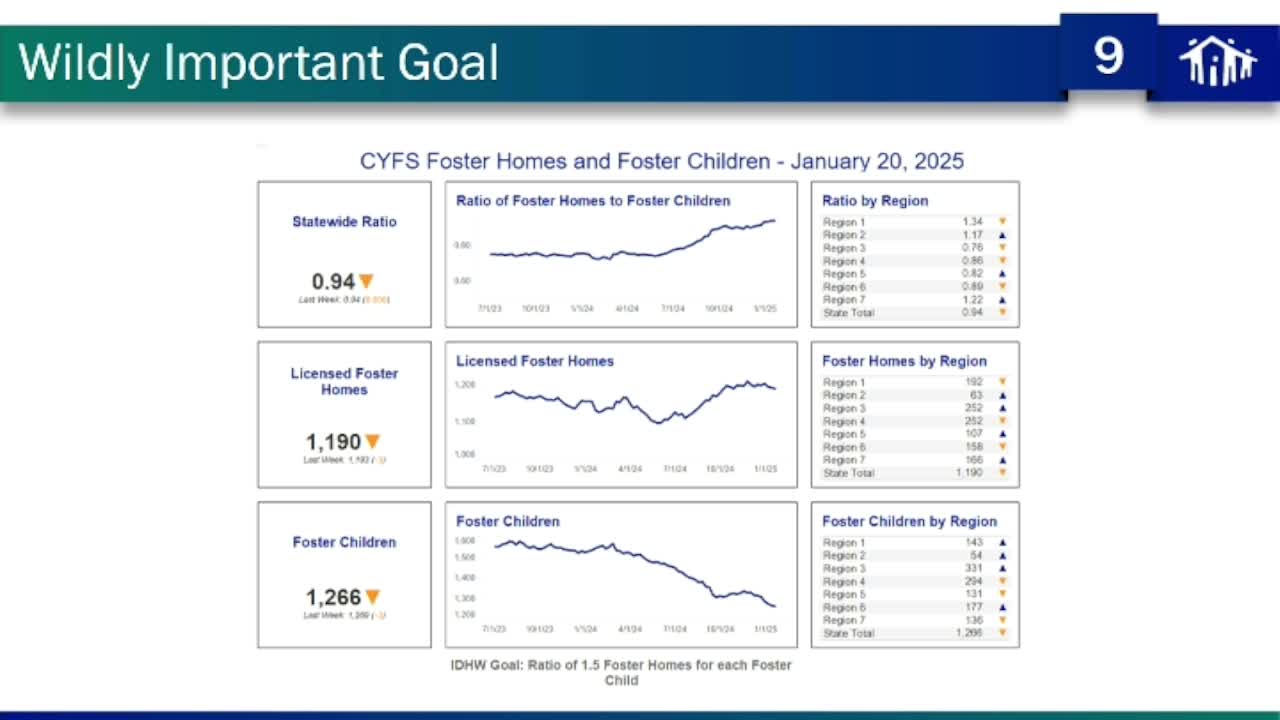
- Strategy and goals: The department set a “wildly important goal” to double the rate of foster families within 24 months. Adams described this as two levers: recruit more foster families and reduce the number of children entering care through prevention services. Adams said the department’s foster-family ratio rose from 0.74 to 0.94 (measured as families per 100 children entering the system).
- Concrete recruitment and retention measures: Adams and Monte Pro described several actions already under way or proposed: - Streamlined licensure rules and reciprocity for families who fostered in other states. - A new Office of Faith Initiatives to engage houses of worship as potential recruitment partners. - Public relations and outreach campaigns, including free parks passes and fishing licenses for foster families, yard signs and targeted media buys. - A foster-family Bill of Rights, a foster-family newsletter and a foster forum to improve communication and retention. - A proposal for targeted pay increases for foster families: an overall 5% increase proposed, with higher supplements (8–10%) for hard-to-place older children and sibling groups and a smaller increase (2%) for infants. - Waivers of adoption-related fees and efforts to shorten licensing timelines, including staff to accelerate licensing and a 24-hour “warm line” for foster families to access clinical advice.
- Prevention emphasis: Adams and Monte Pro repeatedly said prevention cases cost far less and yield better outcomes than placements. Officials said prevention services can include substance-use treatment, therapy, concrete supports and brokerage of community resources (for example, Care Portal–style local responses) and that many neglect cases are candidates for prevention rather than removal.
- Congregate care and out-of-state placements: Adams reported a decline in congregate-care placements (from about 268 to 90 at the time of his slides) and a reduction in out-of-state placements to 49. He told the committee the department has closed its last short-term Airbnb placement and reported “0 Airbnbs and 0 kids” in them after shutting the final one in November.
Committee questions and clarifications
Senators asked how the department achieved better recruitment in some regions. Adams and Monte Pro said regional variation exists and pointed to faith-based recruitment, streamlined rules and targeted outreach. Monte Pro said Idaho’s average social-worker caseloads exceed the national target and the department aims to bring caseloads to the national standard of around 12–15 cases per worker, acknowledging regional variation (for example, some regions may have 8 cases per worker and others as high as 19).
On regulatory changes, Adams said temporary rule changes enacted the prior June reduced licensing barriers (for example, reciprocity for families who fostered in other states) and produced improved recruitment months.
On the impact of federal policy, Adams said mandatory federal funding streams such as Title IV‑E are not targeted by the administration’s stated cuts to discretionary grants. He said a small subset of discretionary grants tied to programs such as certain IRA-funded weatherization or energy‑related programs may be at risk, but the department has reviewed federal grants and has exit plans and central clearance for future applications.
What the department did not decide here
No formal votes or committee actions were taken on the budget request during this presentation. Adams said detailed budget hearings are scheduled with JFAC (the Joint Finance-Appropriations Committee) in the coming weeks.
Ending
Adams closed by thanking the committee for prior oversight and said the department will discuss details of the budget request with JFAC in the weeks ahead. He asked lawmakers to consider district-specific foster-family ratios and offered to accept ideas from legislators representing districts with lower ratios.
Direct quotes in this article are taken from the committee transcript and are attributed only to speakers listed in the record.