Idaho State Police outlines budget requests, staffing shortfalls and new forensic and fentanyl initiatives
Loading...
Summary
Colonel Bill Gardner and budget staff briefed the Joint Finance and Appropriations Committee on ISP’s FY2026 requests, including a fentanyl interdiction unit, forensic staffing, a housing supplemental for remote posts, an HDA fund shift, IT consolidation, and concerns about trooper vacancies and pay competitiveness.
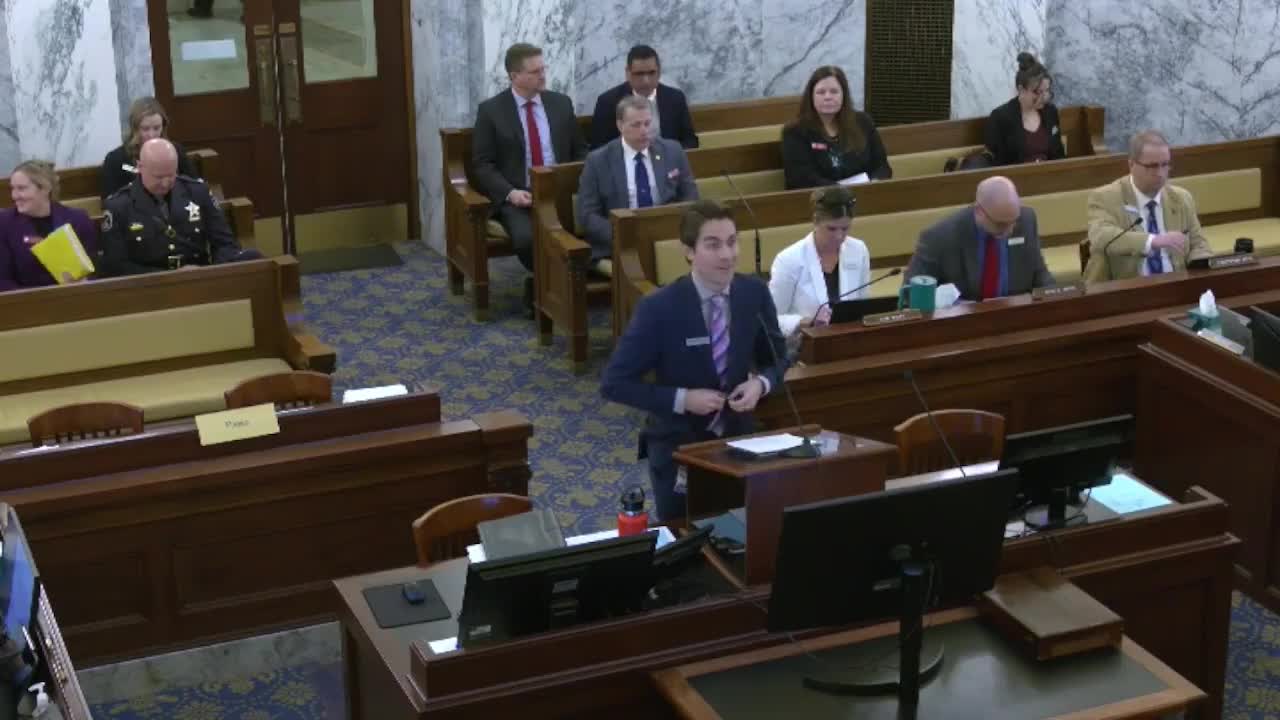
The Idaho State Police presented its FY2026 budget requests and described operational pressures, staffing shortages and several program and capital requests during the Joint Finance and Appropriations Committee meeting on Feb. 12.
Noah Peterson, budget policy analyst for the Legislative Services Office, reviewed the division’s budget structure and highlighted major items in ISP’s request, including a 10‑position, $1,043,300 enhancement for a fentanyl trafficking unit; conversion of several forensic contractors to full‑time staff; a proposed transfer of roughly $4,995,500 and 37.48 FTP from the Law Enforcement Fund because of changes in the Highway Distribution Account; and a supplemental request of $268,100 for a remote housing unit originally planned for Mackay but moved to Fairfield with no change in cost.
Colonel Bill Gardner, director of the Idaho State Police, described the operational need driving the requests and emphasized staffing shortfalls in many parts of the state. "Over the last year, we've seized over 65,000 fentanyl pills, over a pound of fentanyl powder, [and] 150 pounds of methamphetamine," Gardner said, citing recent interdiction results and the value of concentrated patrol efforts. He said the agency is "genuinely struggling" with recruiting and retention in parts of the state, particularly Northern Idaho, and noted pay discrepancies with city and county agencies are driving turnover.
Committee members pressed for details about specific requests and implementation. Peterson explained a requested forensic deputy lab manager (1 FTP, $118,200) is intended to support a new Meridian laboratory and the expansion of forensic services; Peterson deferred detailed construction timelines to the colonel. Gardner said the Meridian lab will be a "top‑of‑the‑line lab" to consolidate the agency’s equipment and staff, and that an addition in Twin Falls will focus on drug identification for the Burley/Twin Falls/Rupert area.
On personnel and IT, ISP requested two fleet service positions (2 FTP, $63,300 net) to convert contractor roles to employees to address a backlog of patrol vehicle upfitting and asked for consolidation of certain IT positions under the Office of Information Technology Services (OITS) with a proposed net increase in operating costs; the governor’s recommendation adjusted that transfer from 20 FTP to 16 FTP. Peterson also described a planned transfer of the digital forensics team into the Forensic Services Program (2 FTP, net zero), and an ILETS (Idaho law enforcement telecommunications) disaster recovery database request ($233,000 ongoing) to maintain law‑enforcement communications if the primary site goes down.
Committee members raised repeated concerns about vacancies and pay. Gardner told lawmakers his agency’s fill rate averaged 92.5% over five years but that vacancy patterns vary geographically and that some districts have large shortfalls: "we're losing people because we're not competitive in the market with our pay," he said, adding the agency is pursuing short‑ and longer‑term pay and retention strategies and intends to return with proposals to address turnover.
On evidence and sexual assault work, Peterson described the SACI (Sexual Assault Kit Initiative) investigator request to convert contractors into permanent employees so they may obtain POST certification; Senator Wintrow and others praised ISP’s SACI work and the agency’s statewide evidence‑tracking efforts.
The governor recommended a one‑time $500,000 Millennium Fund appropriation for a public communications campaign on fentanyl prevention; Lori Wolf, administrator for the Division of Financial Management, confirmed to the committee that recommendation is one‑time and that Millennium Fund approval would be handled by that fund’s process.
Agency staff and analysts committed to provide additional details to the committee on OITS transfers, forensic lab timelines, federal grant status for SACI funding, and turnover metrics used to plan recruitment and retention efforts. The committee recorded the briefing for the FY2026 budget cycle; no formal committee vote on ISP’s FY2026 appropriation items occurred during the session.