Get Full Government Meeting Transcripts, Videos, & Alerts Forever!
Get email alerts on the State Library Budget topic
No spam. Unsubscribe anytime.
State Library presents $21.8 million biennial request; seeks librarian to address federal publications backlog
Summary
The Joint Committee on Ways and Means Subcommittee on General Government held a public hearing Feb. 11 on House Bill 5017, the State Library of Oregon's 2025–27 budget request; the governor's recommended package is about $21.8 million and includes a 0.8 FTE government documents librarian to address a backlog of federal and state publications.
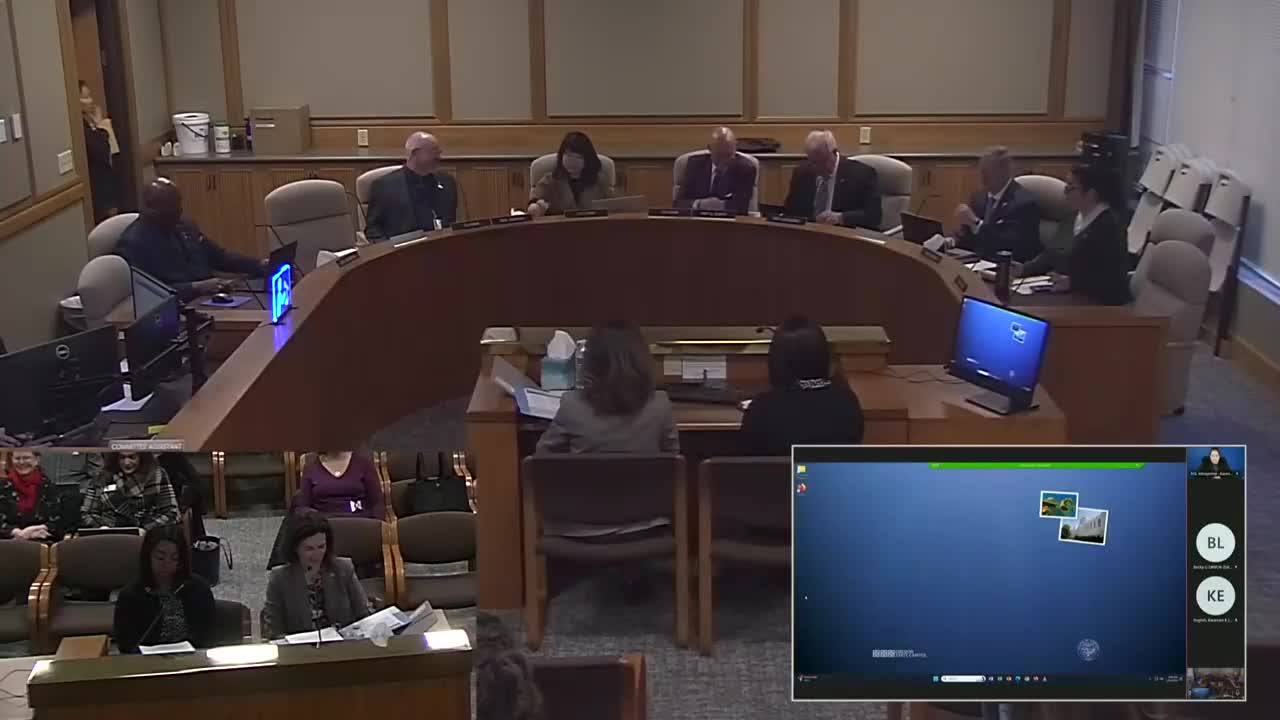
The Joint Committee on Ways and Means Subcommittee on General Government held a public hearing Feb. 11 on House Bill 5017, the State Library of Oregon's 2025–27 budget request. Courtney Rogers of the Department of Administrative Services presented the governor's recommended budget, and Wendy Cornelison, state librarian and director, described agency programs, priorities and a requested position to address a backlog of federal publications.
The governor's recommended budget for the State Library of Oregon is roughly $21.8 million for the 2025–27 biennium, Courtney Rogers, DAS chief financial officer, told the committee. Rogers said the budget reflects “a steady increase in total expenditures” driven by higher general-fund and other-fund allocations while federal funding has remained relatively stable following COVID-era changes.
The request includes core funding split across personnel, services and supplies, and special payments. Cornelison said personnel account for roughly half of the agency's budget, with library support and development receiving the largest program share. The State Library receives funds from several sources: general fund, other funds (primarily assessments charged to state agencies), and federal funds through the Library Services and Technology Act (LSTA) grants.
Why it matters: the agency supports public libraries statewide, provides research and government information services to state employees and legislators, operates the Talking Book and Braille Library for Oregonians with print disabilities, and distributes Ready to Read grants that local libraries use for early-literacy and summer programming.
Cataloging and federal documents backlog
Cornelison told the committee the governor's package includes a targeted investment: a 0.8 FTE government documents librarian to coordinate cataloging and acquisitions for federal and Oregon state documents. “The addition of a government documents librarian will allow for the professional coordination of cataloging and acquisitions processes both for federal documents and for the Oregon documents process,” Cornelison said. She said roughly half of the physical materials in the State Library building are not currently in the online catalog and that the new position would help prioritize and preserve older materials.
Cornelison described ongoing changes at the Federal Depository Library Program (FDLP), which is moving from a one-copy-per-state model toward regional shared-print arrangements; she said the State Library and three Oregon universities currently share hosting duties and that a dedicated staff position would help the agency engage in new shared-print agreements.
Programs that rely on state and federal funds
Cornelison and Rogers explained how different funding streams support programs the committee pressed on during questioning:
- Ready to Read grants: state-funded, noncompetitive grants distributed annually to eligible public libraries. Cornelison said the grant formula is 80% based on the number of youth ages 0–14 served and 20% on geographical service area; libraries receive a minimum of $1,000. In the most recent reporting year the State Library reported $801,340 in Ready to Read grants reached 228,785 youth across 140 public libraries.
- LSTA (federal): the State Library receives multi-year LSTA funding from the Institute of Museum and Library Services. Cornelison said the agency currently spends an allotment of about $2.5 million in the 2025 fiscal year and that LSTA funds are distributed both competitively and for statewide services (examples cited: Sage courier, Oregon Battle of the Books, Answerland, Northwest Digital Heritage).
- Talking Book and Braille Library: serves roughly 5,000 Oregonians with print disabilities. Cornelison described free downloadable access through the National Library Service (BARD) and a State Library recording studio that has added roughly 30 titles since 2020 that have circulated more than 4,000 times.
Agency operations and assessments
Cornelison described the State Library's government information and library services division, which provides research and reference assistance to state employees and is funded by other-fund assessments. She explained the assessment formula includes agency FTE and measured use factors (reference interactions, interlibrary loan/document delivery, patron registration and instruction) and that each factor is weighted to reflect cost and effort.
Cost pressures and contingency
The agency identified personnel costs and technology shifts as main budget drivers. Cornelison told the committee that a 10% reduction (roughly $2.0 million) would require eliminating about six of the agency's roughly 40 positions and would “alter many of our programs.” The State Library said it is working to control costs through usage tracking, subscription adjustments and remote service models where possible.
Public testimony
Public commenters from urban and rural libraries urged support for the governor's recommended budget and emphasized the local impact of state funding: Carrie May, library director for Jackson County Library District, described Ready to Read-funded initiatives for early literacy, including a locally produced baby book distributed through hospitals; Annie Lewis, director of libraries for Multnomah County Library, described large-scale summer reading reach and summer programming supported by Ready to Read and LSTA funds; Haley Legasse, director of library services at North Bend Public Library, described the role of Ready to Read in sustaining rural programs such as infant storytimes and meeting-space upgrades. Rebecca Gladstone, representing the League of Women Voters of Oregon, and Anne Reyes Frazee, president of the Oregon Library Association and a high-school librarian, also spoke in support of HB 5017 and highlighted the State Library's role in democratic access to information, literacy and educator resources.
No final action recorded
The Feb. 11 hearing was informational; the transcript records questions and testimony but no committee vote or final disposition of HB 5017 during this session.
What to watch next
Committee members asked the agency to provide additional details in advance of a work session: a more specific timeline/plan for the government documents backlog and clarification on Northwest Digital Heritage partnerships and matching requirements for competitive LSTA subgrants. The Subcommittee will consider HB 5017 in a future work session where members may take formal action.