Get Full Government Meeting Transcripts, Videos, & Alerts Forever!
Get email alerts on the Criminal Justice topic
No spam. Unsubscribe anytime.
JFAC approves multiple supplementals and a large enhancement package for State Public Defender office
Summary
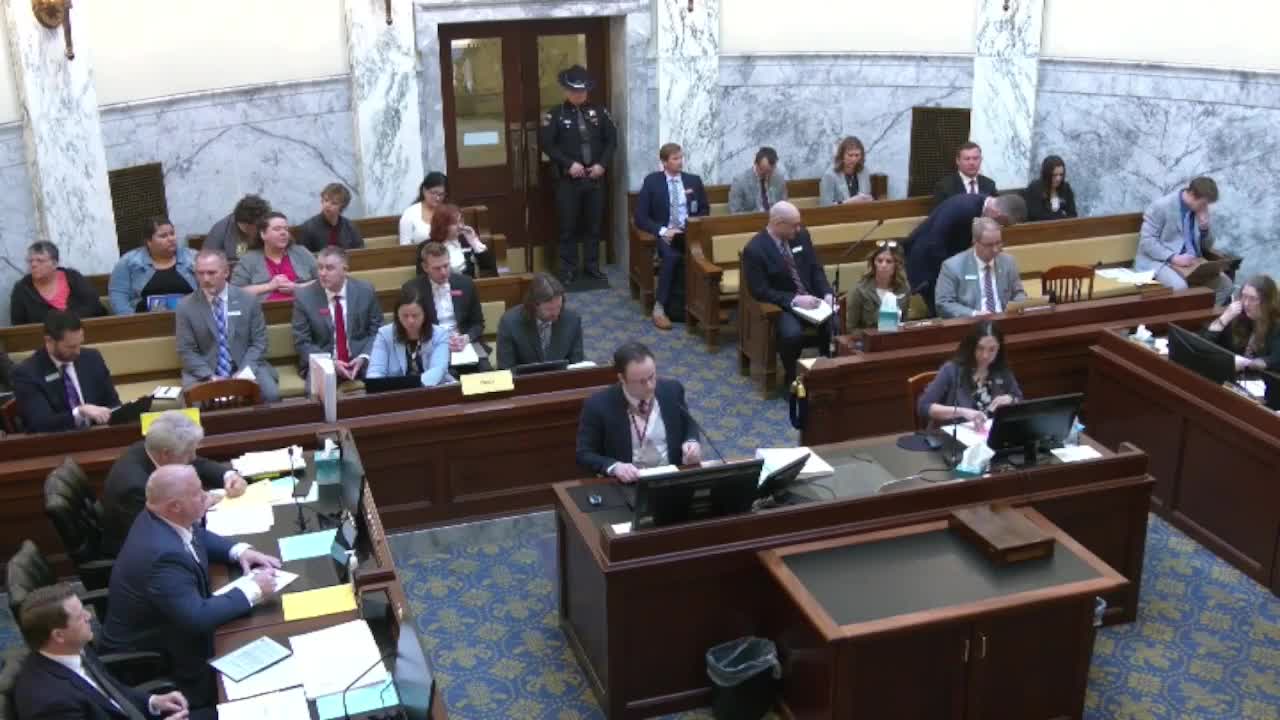
The Joint Finance-Appropriations Committee on March 24 approved several one-time supplementals and a sizable FY26 enhancement package for the Office of the State Public Defender, funding transcript costs, raising contract rates and adding personnel.
The Joint Finance-Appropriations Committee on March 24 approved multiple supplemental appropriations and a wide-ranging enhancement package for the newly created Office of the State Public Defender, funding immediate transcript and contracting costs and establishing an ongoing budget posture that increases contract attorney rates and adds staff and operating support.
Key actions: the committee approved a one-time $2,500,000 dedicated-fund supplemental to align Child Protective Act (CPA) appropriation authority with statutory cash transfers from the public defense fund (motion passed, total 15 ayes, 5 nays). It also approved a one-time $390,200 general-fund supplemental to cover court-ordered transcript costs after the Idaho Supreme Court’s State v. Blasek decision (motion passed unanimously). A third supplemental—$3,799,900 general-fund one-time—was approved to cover additional personnel and increased contract rates for contracted attorneys in the current fiscal year; that motion passed with a committee total of 13 ayes, 7 nays.
Legislative Services analysts explained that the $3.8 million supplemental reflects a change in the contracted attorney rate for the remainder of the fiscal year to $125 per hour (the agency had requested $150). Representative Manwaring, who moved and defended several of the public-defender motions, said the increase is intended to attract contracted attorneys back to public-defense work: “The request was for $150 an hour and this brings that down to $125 an hour.” Manwaring and others also referenced pending policy legislation (recorded as Senate Bill 1181 in committee remarks) that would require reporting and analysis about whether some contracted services should transition to state employment.
The committee also approved a broad FY26 enhancement package that totals $32,382,100 (including $31,082,100 general-fund and $1,300,000 dedicated funds) and 17.96 FTEs. Enhancements include alignment for CPA funding (ongoing), a larger operating budget for contracted work and capital litigation costs, new institutional office costs and associated staffing, increased ongoing transcript funding, ongoing personnel costs for state employees, and an ongoing $125-per-hour standard rate for contracted attorneys. The motion maker and staff emphasized the enhancement negotiated a middle ground between the agency’s request (~$19.1M enhancements) and the governor’s recommendation (~$37.2M), landing at roughly $32.4M.
Committee debate included concerns from some members about the transition from county-provided public defense to the state system, communication with counties on facilities and MOUs, and whether money alone would fix administrative and operational problems. Representative Miller and others raised concerns about county coordination, facility leases, and centralized management during the transition; those concerns were recorded in discussion but did not prevent passage of the motions. The final enhancement motion passed with a committee total of 12 ayes, 8 nays; the chair recorded the motion as carrying a due-pass recommendation.
Implementation notes recorded in committee remarks include: the State Public Defender must provide oversight, establish uniform contract rates, and work with district public defenders and county officials on phased transitions for facilities (committee discussion referenced a planned 2027–2029 phase-in for facility transitions). The committee also added intent language and requested reporting tied to the pending policy bill to analyze cost-effectiveness of contracting versus state employment for some services.