Get Full Government Meeting Transcripts, Videos, & Alerts Forever!
Get email alerts on the Eastern Snake Plain Aquifer topic
No spam. Unsubscribe anytime.
Idaho water director outlines heavy adjudication workload, details Eastern Snake Plain settlement and FY26 budget requests
Summary
Idaho Department of Water Resources Director Matthew Weaver told the House Resources Committee that the agency faces a heavy adjudication workload, cited a recent federal court ruling that largely allowed Idaho’s forfeiture show‑cause statutes to be applied to the United States, described recovery from a catastrophic document‑management failure, and requested new positions and systems to support water administration.
Idaho Department of Water Resources Director Matthew Weaver told the House Resources Committee that the agency is preparing for a large increase in adjudication work, described the department’s recovery from a catastrophic records‑system failure, and outlined fiscal 2026 budget requests tied to aquifer monitoring, communications, software licensing and a proposed water administration bureau.
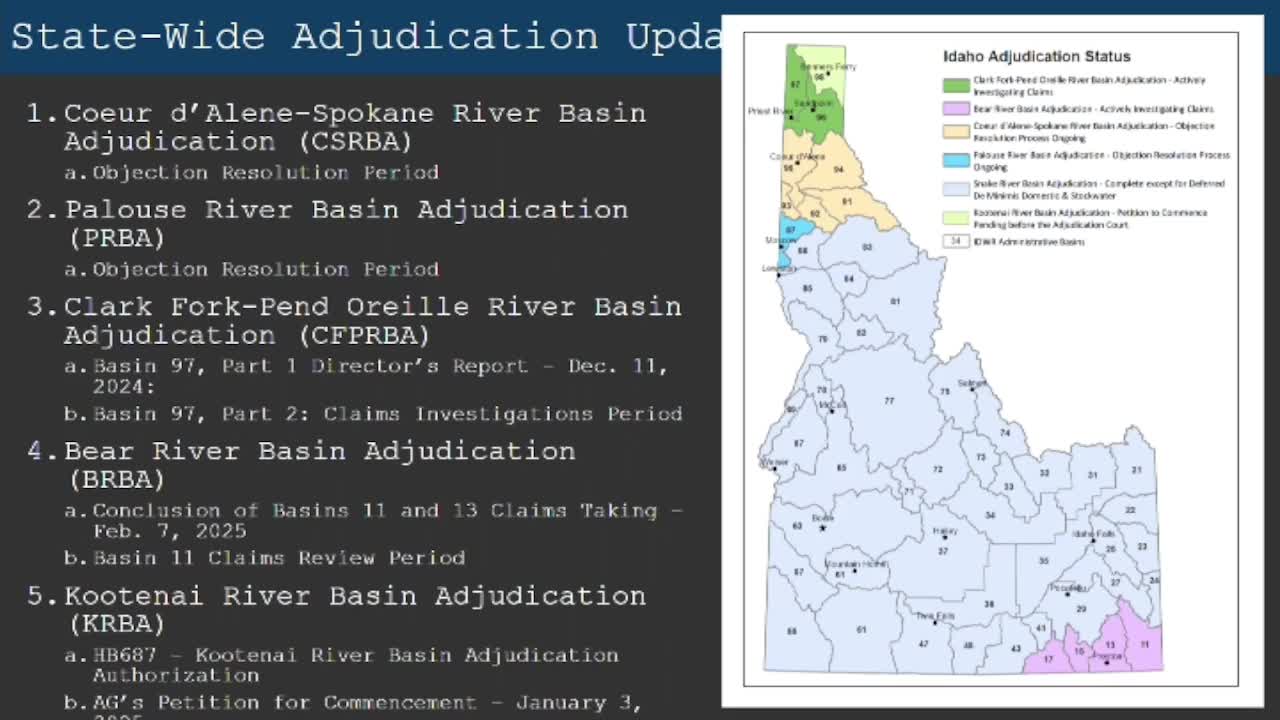
Weaver said the Attorney General’s Office submitted a petition on Jan. 3 to begin adjudication of the Kootenai River Basin, the last unadjudicated basin in Idaho, and the court set an April hearing on commencement. He said a formal commencement order is likely within months after the hearing.
The director summarized a recently concluded federal court decision tied to the Snake River Basin Adjudication litigation. Weaver said the court held that Idaho Code provisions allowing the director to issue show‑cause orders related to forfeiture — described in the hearing as Idaho Code sections governing show‑cause and forfeiture procedures — may be applied to the United States, while other statutory provisions were found to conflict with the Supremacy Clause and were enjoined as to federal parties. Weaver said, contingent on appeals, the department will proceed with four show‑cause cases and expects to issue decisions in the coming year or two.
Weaver also warned the committee that state SRBA court activity may force the department to process deferred domestic and stock water claims left out of earlier work. He described the possible scale of that workload as “tens of thousands, if not in excess of a hundred thousand” additional claims and said the adjudication section currently lacks staff dedicated to that volume of work.
On information technology, Weaver said the department lost its newly migrated online water‑rights document management system in October 2023. The agency moved more than one million records into a Laserfiche instance and then experienced a server failure; he said the department worked with the Office of Information Technology Services and contractors over nine months to rebuild servers and repopulate lost data, and expects to finish filling a remaining “gap period” by the end of the year. The director said the restored system is held with triple redundancy by ITS.
Weaver outlined five department requested budget enhancements for FY26: (1) transfer and staffing for aquifer monitoring and measuring (10 positions funded by loan‑repayment receipts from the Pristine Springs settlement, which repays roughly $716,000 per year and ends in FY2028); (2) a permanent public information officer; (3) ongoing GIS licensing support; (4) a one‑time build of an online beneficial‑use submittal application; and (5) five new positions to create a water administration bureau to support water districts and administration under Idaho Code chapter 6. He said the proposed water‑administration bureau would add five positions to an existing staff of about 11–12 and would speed the department’s objective to create or modify two water districts per year.
Weaver spent substantial time on the Eastern Snake Plain Aquifer (ESPA). He described the effect of Senate Bill 1341, which took effect July 1 and expanded the administrative boundary for the “area of common groundwater supply,” bringing roughly 1,500 additional irrigation rights within delivery‑call proceedings. He said the department issued an order allowing affected users until Nov. 1, 2025, to submit mitigation plans to avoid curtailment.
The director reviewed last year’s delivery‑call chronology: an injury determination in April 2024, an issued curtailment order in late May after the department concluded some groundwater users would only conditionally comply with mitigation plans, and a temporary settlement that paused curtailment for the remainder of the irrigation season. Parties then negotiated a final settlement in November 2024. Weaver said he issued an order on Jan. 3 adopting that settlement as an approved mitigation plan and stated, “I am in full support of it,” while noting a single procedural reconsideration remains (a reporting period question: calendar year vs. water year).
Weaver described features of the mitigation plan he supported: required physical pumping reductions and recharge activities, a four‑year averaging allotment for junior groundwater users, in‑season measurement and reporting of groundwater diversions, and a mechanism allowing tributary basin groundwater users to join the plan by accepting a proportional mitigation obligation. He said the plan narrows curtailment to noncompliant individual users rather than automatically curtailing entire groundwater districts when some members fail to meet obligations.
Weaver summarized department modeling of the ESPA that estimated statewide and private actions since 2016 averaged about 268,000 acre‑feet per year of state‑sponsored managed recharge and about 341,000 acre‑feet per year of private pumping reductions and private recharge — a combined average near 600,000 acre‑feet. Modeling presented to the committee showed that without those combined activities the aquifer’s declining trend would likely have continued; with them, the trend has at least been altered. Weaver cautioned, however, that continued incidental recharge reductions tied to efficiency projects (canal lining, sprinklers) are a concern for long‑term aquifer balance.
He told the committee the department is pausing formal work to finalize a standalone groundwater management plan for the ESPA to allow full implementation and evaluation of the November mitigation plan, but the department will take supporting actions: issuing water‑master instructions, publishing a groundwater‑management water budget and an index value, working in tributary basins to create water districts, and expediting project reviews that support administration on the ESPA.
Committee members asked about chart interpretation, whether the department could serve as both issuer and hearing officer in contested cases (Weaver said he has relied on independent hearing officers and prefers that approach even though the director could serve in that role), the scope of incidental recharge loss from canal lining, and whether the mitigation plan gives growers business‑planning certainty. Weaver repeatedly said the mitigation plan provides protection from curtailment for participating users and that more permanent recovery would require larger, sustained reductions and additional recharge infrastructure.
Weaver closed by asking for questions; committee members indicated interest in receiving his slide deck and the mitigation agreement. He said the department will provide the materials to the committee.