Get Full Government Meeting Transcripts, Videos, & Alerts Forever!
Get email alerts on the Walk Bike Plan topic
No spam. Unsubscribe anytime.
Clackamas County releases draft Walk Bike Plan after broad public outreach
Summary
Clackamas County transportation staff presented a draft update to the county's pedestrian and bicycle master plan, summarizing public engagement, a 236-project list across five planning areas, a new "shared streets" concept and next steps including Planning Commission and Board public hearings.
Clackamas County transportation staff on a planning commission work session presented a draft update to the county's pedestrian and bicycle master plan, highlighting extensive public outreach, a prioritized project list and a new "shared streets" pilot concept aimed at slowing neighborhood traffic.
Scott Holster, a transportation planner for Clackamas County, told the commission the draft "Walk Bike" plan is a 30-year update to the county's 1996 pedestrian-bicycle master plan and is intended as a roadmap for future investments rather than a funded capital improvement program. "This is kind of a line on the map type of project," Holster said, adding the plan does not provide construction funding or detailed design for projects.
The draft identifies 236 projects across five planning areas that together cover the county's urban and rural geographies. Those projects are grouped as linear improvements (sidewalks, multiuse trails, bike lanes) and point improvements (crosswalks, bike signals, bike boxes). Staff said the plan includes a scoring process that assigns projects into three priority tiers (high, medium, low) within each planning area, but that the plan is not fiscally constrained.
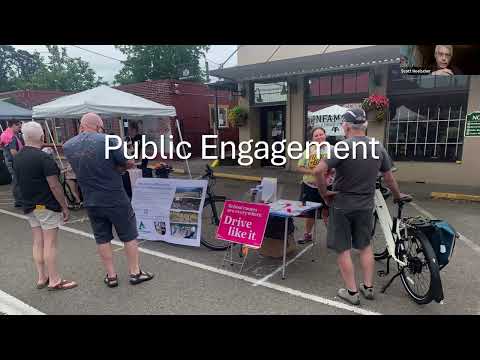
The commission was briefed on the public-engagement program staff used to shape goals and priorities. Holster said the county began outreach before the project team was hired: staff solicited input at the Clackamas County Fair using a "dot game" exercise and later used five community conversations, an interactive online map (Wiki-mapping), an online MetroQuest survey and in-person open houses, among other activities. According to staff, those efforts produced nearly 300 comments at the fair, about 800 written comments through the virtual open house and 270 map submissions. Holster said supportive-program exercises included an interactive coin-allocation exercise to identify public priorities for non-capital programs.
One outcome presented as new to Clackamas County is a candidate shared-streets program. Holster described shared streets as neighborhood local streets where posted speeds would be reduced (for candidate streets currently posted at 25 mph the concept would reduce speeds to 20 mph), combined with signage and pavement markings to improve safety and connectivity where traditional bike lanes or sidewalks are not feasible. Staff described minimum candidate criteria: local street classification, no transit service, and average daily traffic below 2,000 vehicles. Holster said the public response to the shared-streets idea was strongly favorable in outreach, reporting about a 90% favorable response during the mapping exercises.
Staff summarized technical analyses used to develop the project list, including a five-year bicycle and pedestrian crash review (2016'2020), an equity analysis, mapping of destinations and an inventory of existing facilities. The team used a standard level-of-traffic-stress framework (LTS) for bicyclists to classify facilities from low stress (LTS 1) to high stress or gaps (LTS 4), and mapped sidewalks, on-street bike facilities and multiuse paths across the five planning areas.
Commissioners pressed staff on implementation and funding. Commissioner Brian (first name used in the meeting) asked why the draft did not include project-level cost estimates or a capital improvement program (CIP) approach. Karen Burig, the county's long-range planning manager, explained the project budget was limited and that the Walk Bike plan was intended to identify needed projects; staff plan to incorporate costs and integrate projects into the county's upcoming Transportation System Plan (TSP), which will assemble and cost projects across transportation modes. Burig said planners rely on separate implementation memoranda and grant strategies; the commission asked staff to add a referenced April 8, 2024 memo ("Funding and implementation strategy, Task 7.3," prepared by the project consultant) to the plan materials.
Commissioners and members of the public raised local examples of safety risks and coordination needs, including the Highway 26 (Rhododendron) crossing and a Barlow Trail segment. Holster said the county had previously worked with ODOT on a small-area study in Rhododendron and acknowledged the crossing and Highway 26 frontage improvements remain priorities for future coordination. Commissioners also pressed staff about how planned projects would interact with already programmed, funded projects; Holster and Burig said projects already in design or with secured funding generally were excluded from the unfunded project list, though some projects with partial funding remain included.
Staff emphasized supportive programming as a third outcome area: existing programs such as Safe Routes to School and a traffic safety coordinator were listed alongside six proposed outreach and education programs (campaigns to reduce parking in bike lanes, bicycle-friendly driver education, school-zone safety campaigns and events). Burig and Holster said the new programs would require additional funding and grant applications.
Next steps: Holster told the commission the draft plan will go to public hearings, with a Planning Commission public hearing scheduled for April 14 and a Board of County Commissioners public hearing scheduled for May 13. Staff said the Walk Bike plan will then feed into a broader Transportation System Plan update, which will include financial constraints and project costing.
Holster and Burig identified some outstanding topics staff will continue to refine before adoption: project-level cost estimates (to be developed as part of the TSP), implementation details and technical implementation steps for a pilot shared-streets program. The presentation packet and technical memoranda (including the April 8, 2024 funding memo) were identified by staff as available background materials.