Get Full Government Meeting Transcripts, Videos, & Alerts Forever!
Get email alerts on the Water Rights Beneficial Use topic
No spam. Unsubscribe anytime.
Committee approves rules for beneficial-use examinations and examiner certification
Summary
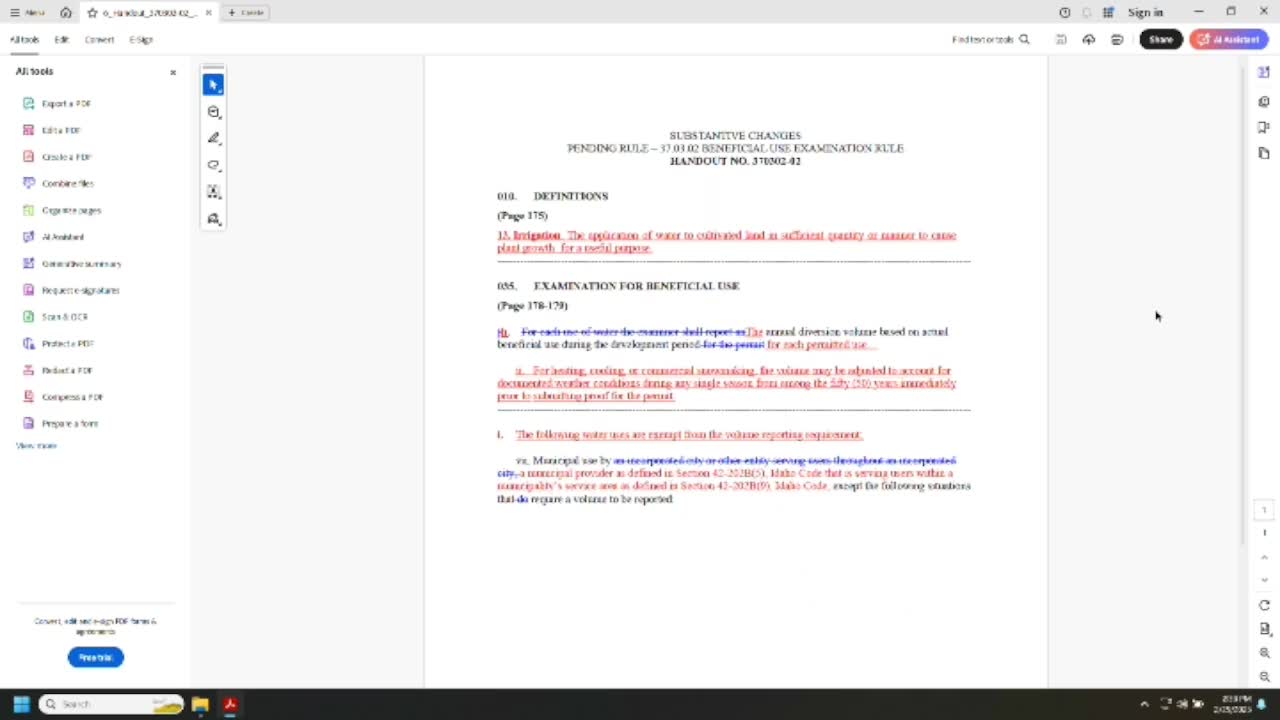
The committee approved rules that set standards for beneficial-use examinations, add a definition of 'irrigation,' allow certain commercial snowmaking uses to rely on 50-year climate data for reporting, and remove an unenforced late-payment penalty for license examination fees.
The House Resources and Conservation Committee approved a revised rule set establishing procedures and standards for beneficial-use examinations and certification of licensed examiners.
Phil Hummer, section manager for water rights at the Idaho Department of Water Resources, said the rulemaking implements Idaho Code 42-217 by setting procedures for licensed geologists and engineers to become certified water-right examiners and for submission of standardized examination reports. Hummer said most edits reorganize and simplify wording; substantive changes were concentrated in definitions (including a new definition of “irrigation”) and in the standards for reporting measured volumes for some uses.
Hummer told the committee that the rule adds commercial snowmaking as a use that may rely on 50 years of climate data when reporting volume, and that the definition of municipal use was updated to reference Idaho Code 40-2-202B to reflect current statutory terminology. He also said IDWR removed a late-payment penalty provision for license examination fees because the department adjusted its intake and review process and has not enforced that penalty.
Representative Raybould and other legislators asked clarifying questions about how ‘‘sufficient quantity’’ is applied in irrigation contexts; Hummer and members noted that sufficiency depends on crop type and use—examples such as alfalfa (3.5–4.5 acre-feet per acre per year) were discussed in committee colloquy as context for how examiners assess irrigation needs.
Representative Raybould moved approval. The committee voted by voice and accepted the docket.