Get Full Government Meeting Transcripts, Videos, & Alerts Forever!
Get email alerts on the Ems Transfer topic
No spam. Unsubscribe anytime.
Committee moves to restructure EMS; several transfer motions sent to Senate after split votes
Summary
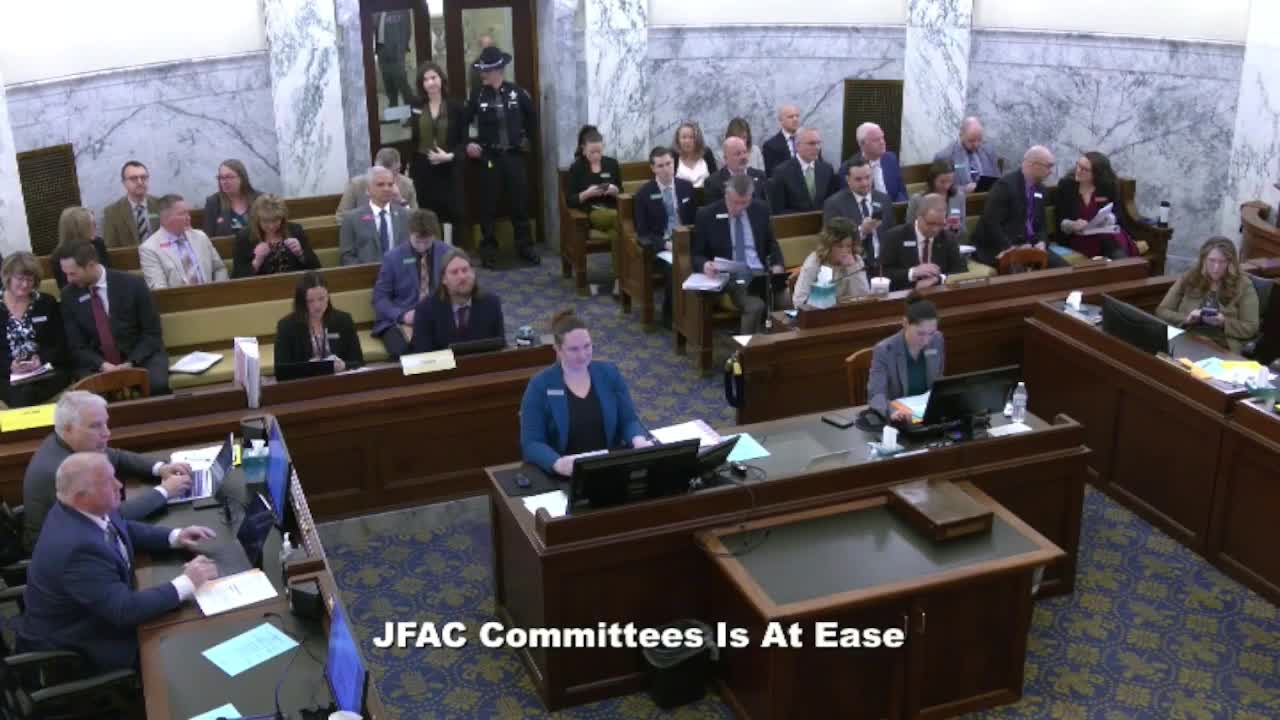
JFAC debated and approved motions on March 12 to move Idaho’s Emergency Medical Services program from the Department of Health and Welfare to the Military Division, directing several budget and transition items that were transmitted for further Senate consideration after split committee votes.
Lawmakers on March 12 took steps to restructure Idaho’s emergency medical services (EMS) by approving language and budgetary motions tied to House Bill 206 that would transfer the EMS program from the Department of Health and Welfare to the Military Division.
What the committee considered: analysts told members the Military Division — led by the adjutant general and housing the Office of Emergency Management — already operates related emergency functions (backup dispatch, hazardous‑materials response, rural EMS) and that moving EMS could give the program a more operational, mission‑oriented structure. Frances Lippitt, budget and policy analyst with Legislative Services, said the transfer would create a new EMS budgeted program within the Military Division and requested funding for transition costs and a part‑time medical director.
Budget motions and votes: the committee considered multiple motions: reducing the public‑health base appropriation and transferring position authority and funds out of the Department of Health and Welfare (a motion to reduce approximately $7.46 million and move FTP and federal dollars was recorded and will be transmitted to the Senate after the Senate committee did not register an affirmative majority); a corresponding motion to add roughly $7.20 million and 30.84 FTP to the Military Division’s new EMS program was also transmitted to the Senate after a split committee vote; and a separate motion to provide $60,000 ongoing General Fund and $150,000 one‑time from dedicated funds for a part‑time medical director was considered and similarly transmitted for Senate action. Several votes recorded a House‑Senate split in committee and the chair noted procedural differences in how failed motions are handled on each side.
Rationale and debate: supporters said the Military Division’s Office of Emergency Management is a logical home for EMS operational functions and that aligning EMS with the Adjutant General’s office would support dispatch and HazMat coordination and could update licensing rules to be more consistent with neighboring states. Opponents asked procedural questions about double funding if the bill failed; committee leadership replied that the legislature would address such contingencies as they occur.
Next steps: because some motions did not secure a Senate‑committee affirmative majority, the items were noted as sent to the Senate under committee procedure. The committee will await further Senate action and any adjustments required by the outcome of House Bill 206.
Ending: the committee’s actions are part of a multi‑step statutory and budgetary restructuring for EMS; implementation will depend on final legislative approval and subsequent administrative transition planning.