Get Full Government Meeting Transcripts, Videos, & Alerts Forever!
Get email alerts on the Prisons Security Enhancements topic
No spam. Unsubscribe anytime.
After ambush that injured staff, Idaho DOC seeks mail‑scanning, drone detection, phone transcription and transport expansion
Summary
In response to a spring ambush that left three DOC staff shot, the Idaho Department of Correction requested one‑time and ongoing funding for advanced surveillance technology, an expanded transport bureau, and a federal body‑worn camera pilot to reduce contraband and increase safety.
Following a violent attack last spring that injured three Idaho Department of Correction employees, agency leaders told the Joint Finance Preparatory Committee they have identified security weaknesses and proposed technology and staffing changes aimed at reducing similar risks.
Noah Peterson, budget analyst with the Legislative Services Office, said the agency’s supplemental requests stem from an incident in which an inmate being transported was ambushed; the transcript states the suspect and the inmate were later suspected of carrying out two murders before their apprehension. The department proposed a suite of measures it says would reduce vulnerabilities exposed by that event.
Key elements proposed by the department: - Digital mail scanning and diversion (proposal: ongoing cost listed as part of an advanced surveillance technology package). The department said digital scanning would reroute incoming mail to an off‑site facility, where it is opened, scanned, digitized and delivered to residents electronically; DOC officials said that would eliminate one of the most porous points of entry for contraband. - Drone detection systems to identify attempts to deliver contraband by unmanned aircraft. - LEO intelligence software for phone‑call transcription and analysis to surface illicit coordination; the department reported about 4,000,000 phone calls totaling roughly 49,000,000 minutes in 2023 and said transcription tools would help surface high‑priority leads for investigation. - An immediate expansion of the transport bureau: a one‑time supplemental was requested to add 12 positions, supply seven fully equipped transport vehicles and fund training and tactical medical proficiency for staff who will handle high‑risk emergency transports. - A federal body‑worn camera pilot to equip three IDOC units, with most up‑front costs proposed to come from federal grants and a small general‑fund share for licensing.
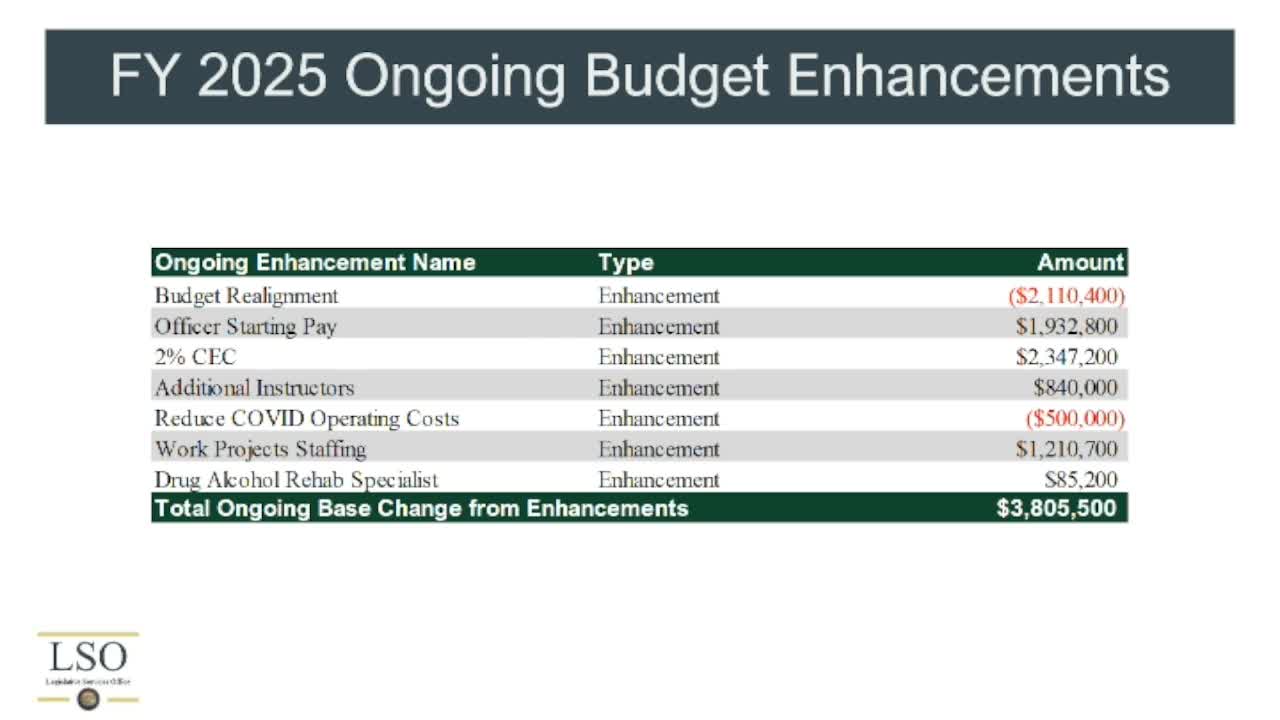
The funding asks listed in committee materials included a $795,000 one‑time cost in FY2025 for initial advanced surveillance technology implementation and a total ongoing price tag for the full surveillance package of about $2,397,000 per year (breakouts in the slides show roughly $1,011,000 for digital mail scanning, $385,500 for drone detection, and $1,000,000 for the phone transcription/analysis software). The transport bureau supplemental request for FY2025 was $1,148,000 one‑time (12 positions with $455,000 in personnel costs and $693,000 for vehicles and equipment); the ongoing cost was projected at roughly $965,500 and included the 12 FTP.
Agency leaders argued the measures are necessary because contraband delivery methods are growing more sophisticated. “The level of sophistication that is being deployed today to introduce contraband into correctional facilities is unlike anything any of us in the field have ever seen,” Director Josh Tewalt told the committee; he described drugs embedded into ink and said mail scanning “completely eliminates our most porous point of entry for contraband.” He also said being able to identify drones would allow the agency to interface with law enforcement to hold drone operators accountable.
On transport bureau staffing, lawmakers asked why 12 new FTPs were requested rather than reallocating officers. Tewalt explained that emergency transports historically have been handled as an “other duty as assigned” by facility staff; creating a trained, statewide transport resource requires relief‑factor considerations (vacation, training, overtime, leave) that make backfilling facility posts expensive. He said the agency had generated tens of thousands of overtime hours at some facilities tied to transport and emergency responses, and that the proposed 12‑person expansion was the most operationally practical way the department identified to provide trained high‑risk transport teams without creating much larger permanent staffing increases at each facility.
A pilot for body‑worn cameras was proposed using federal funds for initial purchase and storage costs; the agency noted the state would be responsible for a match and for ongoing licensing costs in FY2026 and FY2027 if federal grants required state matching funds.
Why this matters: DOC officials said the changes respond to a concrete security failure that placed staff at risk and introduced contraband into facilities. Committee members asked for details about costs, sourcing of ongoing funds, and whether alternatives had been considered.
What’s next: The department will respond to follow‑up questions from committee members on implementation timelines, vendor selection, and the potential to reassign versus add staff for the transport function. Funding decisions will be taken with the broader budget and cabinet recommendations into account.