Get Full Government Meeting Transcripts, Videos, & Alerts Forever!
Get email alerts on the Recidiviz Case Management topic
No spam. Unsubscribe anytime.
Idaho DOC asks for ongoing funding for Recidiviz tools; lawmakers request outcome data
Summary
Department of Correction officials asked the Joint Finance Preparatory Committee to approve ongoing general‑fund support for Recidiviz, a nonprofit case‑management platform the agency says helps automate classification and case‑triage tasks. Legislators pressed for hard ROI and data‑control assurances before committing to continuing costs.
The Idaho Department of Correction on Feb. 4 asked the Joint Finance Preparatory Committee to approve ongoing funding to continue work with Recidiviz, a nonprofit “case‑management” partner the agency says has helped automate classification and case‑triage tasks for probation, parole and prison case managers.
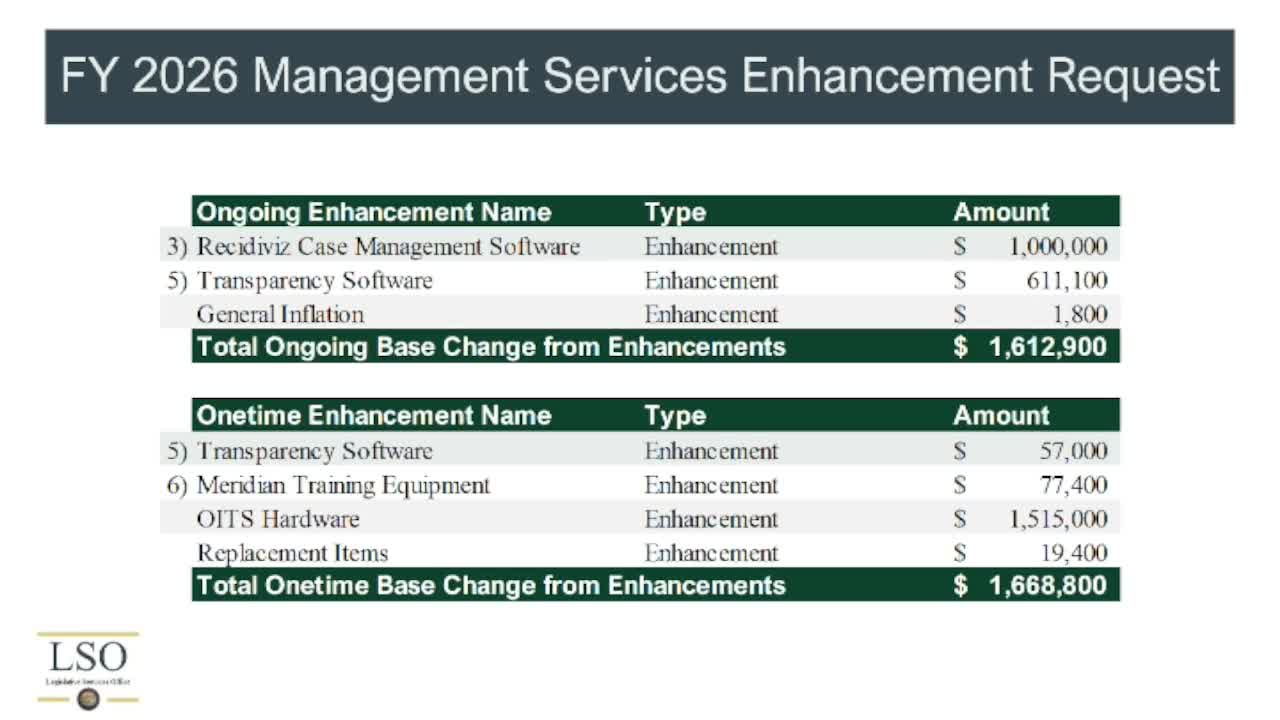
Department budget analyst Noah Peterson told the committee management services had received an appropriation for recidiviz-related work and that previous one‑time federal appropriations had paid for initial tools. Director Josh Tewalt described the partnership as a longstanding, transformative effort to aggregate data across outdated systems and surface actionable dashboards for staff.
Committee members sought evidence the investment reduces recidivism or generates other measurable returns. “As far as hard data, that’s not something I have with me,” Peterson said, adding he could work with the agency to provide committee members with outcome metrics. “I would let the director speak to the effectiveness,” he said.
Tewalt told lawmakers Recidiviz is not a conventional off‑the‑shelf product. “It’s probably the most transformative partnership we’ve entered into as an agency in my entire tenure,” he said, describing Recidiviz as a nonprofit that “finds data across different, outdated systems and brings them together” and then builds overlays and tools to help staff prioritize caseloads and compare outcomes across officers and facilities.
Tewalt said the platform has enabled “case triage tools” for probation and parole officers and that the department wants to transition similar functionality into prisons so case managers can track progress and have classification tools informed by near‑real‑time activity. He also said every dollar the state spends with Recidiviz is leveraged with private philanthropic matches, which the director described as increasing the impact of state dollars.
Lawmakers pressed two recurring concerns: whether the department controls the data pushed into Recidiviz and whether the state would be saddled with ongoing general‑fund obligations after initial federal grants expire. Representative Tanner requested dashboards and sample outputs for committee review. Tewalt said the department controls its data through data‑sharing agreements and that Recidiviz pulls data from state systems rather than re‑creating it. He added the nonprofit also facilitates confidential comparative benchmarking with other jurisdictions that participate in the platform.
On the funding side, Peterson said prior Recidiviz work in 2021 and 2023 amounted to about $1.5 million in mostly federal funds. The management services slides presented to the committee indicate the division received an appropriation to support ongoing Recidiviz work (the slide text identifies the appropriation in the management services column), and staff said they would provide the committee with more details on annual costs, the prior federal funding, and any proposed continuing general‑fund commitment.
Why this matters: Committee members said they want to see tangible results before committing ongoing general fund dollars. Tewalt and Peterson agreed to provide usage dashboards, outcome data and more precise fiscal breakout so the committee can evaluate cost‑benefit and data control protections before making a funding decision.
Looking ahead: The department offered to follow up with the committee on Recidiviz dashboards, philanthropy partners, and available outcomes data to support the request for ongoing funding.