Get Full Government Meeting Transcripts, Videos, & Alerts Forever!
Get email alerts on the Parking Enforcement topic
No spam. Unsubscribe anytime.
Committee advances bill tightening towing, notice rules for vehicles on private property
Summary
The Government Operations Committee passed House Bill 972, which clarifies last year’s parking/motion law by allowing certain postal notice, shortening some towing windows on private property and preserving a ban on booting except as municipalities choose. An amendment to allow booting on residential multi‑unit property failed.
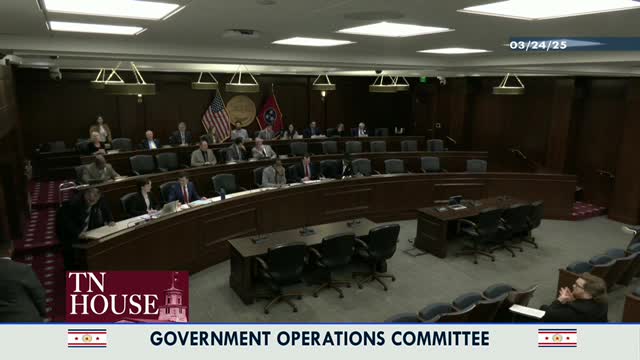
House Bill 972, sponsored by Representative McCallum, cleared the Tennessee House Government Operations Committee after debate over towing windows, notice methods and a failed amendment to permit booting on certain residential properties.
The measure clarifies language in last year’s “motion act,” including an explicit allowance to use the U.S. Postal Service for notice (with a three‑day or sooner requirement), adjustments to signage rules and a change to towing-response timing on private property. Representative McCallum said the bill makes clear that "if you have a car that's illegally parked in private property, the language specifies that you could have that vehicle towed immediately at the owner's expense." Representative McCallum framed the changes as cleanup to last year’s statute.
Why it matters: The bill affects private property owners, parking operators and residents who may find their vehicle subject to quicker towing if it is parked illegally on private property. The committee also debated whether property owners should be allowed to use wheel‑locking (“booting”) as an enforcement tool.
Members questioned the scope of the 12‑hour towing window on private property. Representative McKenzie said he was concerned that a 12‑hour window might be too short in cases where drivers are temporarily delayed. Representative McCallum responded that the 12‑hour window applies to nonhazardous, nonblocking situations and that if a vehicle “creates a hazard, blocks access to public or private property, or is parked illegally, that the 12 hours is moot” and towing may be immediate.
Chairman Clemens offered amendment 6,105 to exempt private residential property owners and owners of multi‑unit residential buildings from a ban on booting; Clemens argued property managers had reported problems with tourist parking and that booting was an effective deterrent. Representative Hardaway voiced support for the amendment as a compromise, saying a boot can let property owners immobilize a vehicle on site while the owner resolves payment or residency questions. Representative McCallum opposed broadening booting authority, arguing towing better removes blocked access and noted municipalities previously declined to adopt booting ordinances.
The committee voted on amendment 6,105 by voice; the amendment failed. The bill then advanced on a roll call vote. The clerk reported 9 ayes and 4 nays; the committee approved the measure and sent it to Finance, Ways and Means.
Details and clarifications from the hearing: - The change applies to private property only; public‑street rules are not altered. Representative McCallum emphasized the bill targets private property enforcement. - Postal notice language was restored with a three‑day or sooner standard. - The transcript records a procedural change increasing the portal reporting window from 15 minutes to one hour (sponsor attributed the change to feasibility with the Department of Revenue). - The bill references a 72‑hour rule in parking garages for unpaid fees; members raised concerns about interactions with prior law cited as TCA 47‑50‑120 (a prior bill by Representative Kumar) and about holiday weekends and malfunctioning pay machines.
Votes at the committee: amendment 6,105 (Clemens) — failed (voice vote; exact tally not recorded). House Bill 972 — passed committee, 9 ayes, 4 nays.