Get Full Government Meeting Transcripts, Videos, & Alerts Forever!
Get email alerts on the Energy Policy topic
No spam. Unsubscribe anytime.
Office of Energy and Mineral Resources seeks federal funds for home energy rebates and proposes Speed Council to streamline permitting
Summary
The Governor’s Office of Energy and Mineral Resources asked JFAC for federal funds to run a Home Energy Rebates program and presented a governor’s Speed Council initiative to coordinate permitting and reduce delays for large energy and infrastructure projects.
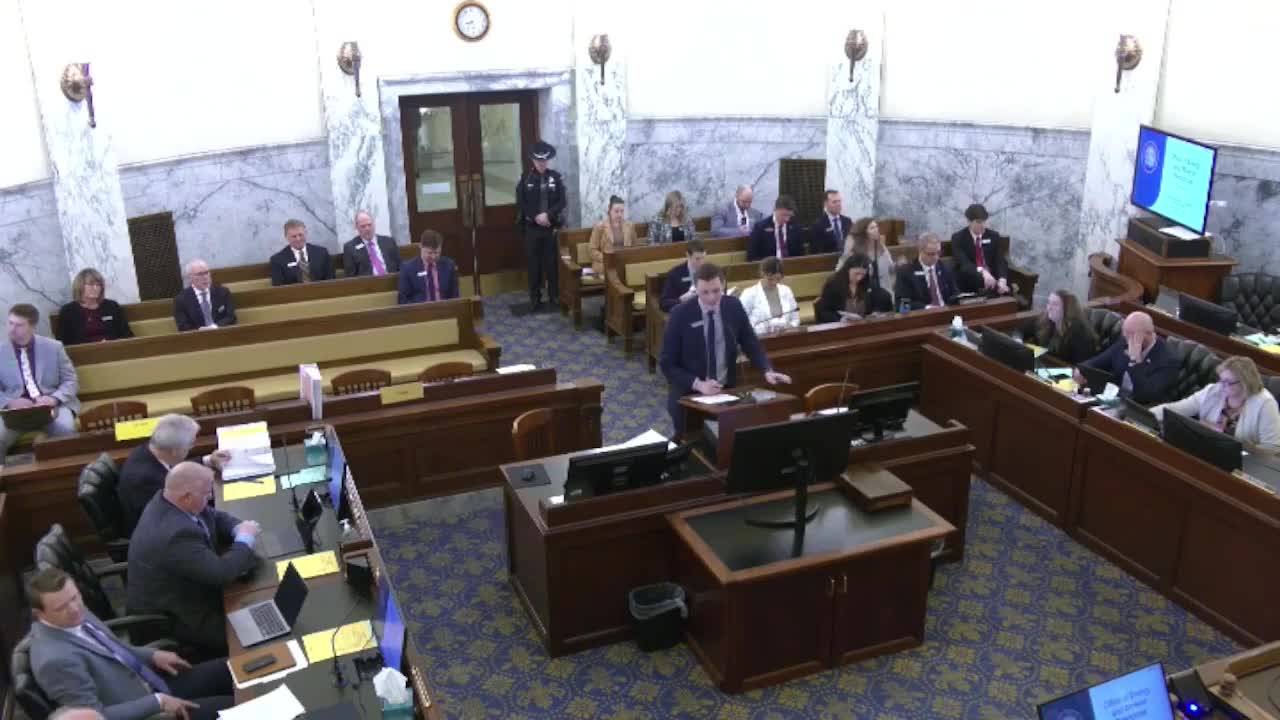
Kellen McGurkin, budget analyst with the Legislative Services Office, briefed the Joint Finance-Appropriations Committee on the Office of Energy and Mineral Resources’ (OEMR/OER) recent federal-grant activity and FY2026 requests.
McGurkin said the office’s appropriations have risen as it has taken on federal grant administration, citing a one-time $15,000,000 state match transfer in FY2022 for the grid resilience (POREG) program and larger federal fund increases in FY2024–25. He summarized FY2026 requests before the governor’s recommendation, including an ongoing federal appropriation request of $24,500,000 to administer the Home Energy Rebates program created under the Inflation Reduction Act of 2022.
The $24.5 million request would break down as about $20,000,000 in trustee and benefit payments (rebates to households), $4,000,000 for operational costs (a third‑party implementer and associated software/verification), and roughly $502,000 for personnel to add four limited-service FTPs to run the program through 2031. McGurkin noted there is no state match required for these federal funds.
The governor’s recommendation included that home-rebates request and added a proposed Speed Council initiative (a governor’s priority outlined in an executive order) to coordinate permitting for major projects. The Speed Council proposal would add $311,000 ongoing from the general fund — including $164,000 for personnel costs (88,000 for a new full‑time management assistant) and $97,000 in operating costs — plus roughly $170,000 one-time for initial dashboard development and start-up costs. The council would be led by OEMR’s administrator and include representatives from the Office of Emergency Management, DEQ, Water Resources, Agriculture and others; it would develop a public dashboard to track project timelines and would have contracting authority for staff and consultant reimbursements.
Administrator Richard Stover testified the Home Energy Rebates implementation budget assumes a federal administrative cap of 20%, and that the office expects to use much of that 20% initially for procurement of a third‑party implementer. "While we're requesting the 20% because of the administrative cap allowance, that may not all be drawn," Stover said.
Stover defended the Speed Council concept as a response to rapidly rising project activity and growing energy demand. He said Idaho’s energy need is expected to increase about 30–50% over the next 10–20 years and described the council’s goals as transparency, accountability, predictability and permitting reform. "The primary tenants of the council are number 1, transparency. Number 2, accountability and predictability," Stover said.
Committee members asked how the office will staff limited-service positions when federal funds expire; McGurkin and Stover said the hires are expected to be limited‑service tied to grant periods. Members also questioned the share of funds budgeted for administration; analysts and the administrator said federal rules allow up to 20% administrative costs and the requested $4,000,000 is sized to procure a third‑party implementer and associated systems.
Stover also described work on nuclear energy strategy through the Idaho Strategic Energy Alliance and coordination with Idaho National Laboratory, and he outlined examples of short-term grant impacts — wildfire mitigation, energy-efficiency projects — which he said produced measurable savings and resilience benefits for utilities and local governments.
No formal appropriation votes were taken during the hearing; the presentation and questions were for committee consideration during the FY2026 budget process.