Get Full Government Meeting Transcripts, Videos, & Alerts Forever!
Get email alerts on the Title Insurance Regulation topic
No spam. Unsubscribe anytime.
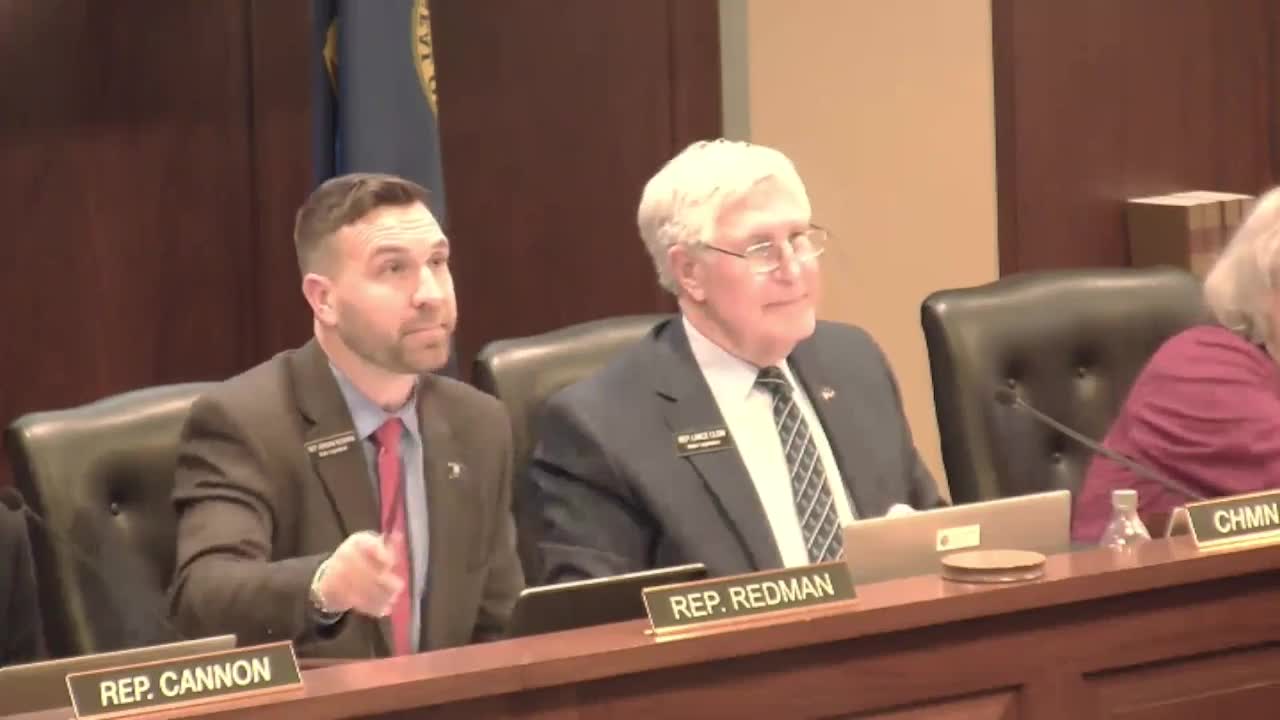
House Business Committee narrows rewrite of title insurance rules after lawmakers press on 'will' vs. 'may' wording
Summary
Lawmakers approved updates to Idaho's title insurance rules (IDAPA 18.05.01) but removed multiple permissive wording changes after members raised consumer-protection concerns about replacing declarative 'will' language with the softer 'may.'
Members of the Idaho House Business Committee on Monday approved an updated set of title insurance rules but carved out multiple sections after extended debate over whether the rule language was being made too permissive.
The committee approved IDAPA 18.05.01, the Department of Insurance’s proposed rewrite of title insurance regulation, after Representative Neil Ehlers moved to retain the stronger prohibitory language in several subsections that the department had changed from "will" to "may."
The rewrite, presented by Shannon Hull, Market Oversight Bureau chief for the Idaho Department of Insurance, was described as primarily editorial: “The changes were primarily to simplify, clarify and reduce duplicative language with statute,” Hull said, adding the department reduced the rule's word count by roughly 7%.
Why it matters: Several lawmakers said the proposed edits softened mandatory language in ways that could reduce protections or enforcement clarity for consumers, particularly where the rule said title insurers "will not" engage in acts constituting the practice of law.
Representative Brent Crane (R-Nampa) pressed the department on that exact alteration. Crane asked whether changing the phrase from "will not" to "may not" could allow title insurers or agents to perform work that amounts to the practice of law. "Could I, if I'm a title insurance agent or a title insurer, do a practice of law?" Crane asked. Director Dean Cameron of the Department of Insurance responded that the department did not see a substantive difference and said the change was intended to harmonize phrasing across the rules. "We don't believe that it gives them permission to continue or to act in any sort of legal capacity beyond the scope of their license," Cameron said.
Representative Lance Birch and others said that consumers had not engaged in the negotiated-rulemaking process and that softening prohibitory language without visible consumer input was concerning. "We've seen that 1-word change in 1 bill and it has huge impact," Birch said.
Representative Ehlers offered a motion listing a set of rule subsections to retain the original prohibitory language (he identified the sections in the motion on the record). The committee voted to approve the docket with those exceptions and moved on to other items on the agenda.
Committee discussion also included technical questions about modernization changes in the docket. Representative Ehlers asked whether definitions would accommodate newer payment types; he specifically raised whether the drafting accounted for digital currency when addressing "collected funds." Hull said the rewrite was meant to align Idaho with federal and neighboring states’ approaches and to ensure escrowed funds are secure.
Ending: The committee approved the rule package with the specified exceptions after the motion; the department said it is willing to revert or further edit language if the committee directs it. The committee then proceeded to other rule dockets on its agenda.