Get Full Government Meeting Transcripts, Videos, & Alerts Forever!
Get email alerts on the Hospital Assessment topic
No spam. Unsubscribe anytime.
Hospital assessment supplemental draws scrutiny; lawmakers ask whether funds flow to hospitals or offset Medicaid costs
Summary
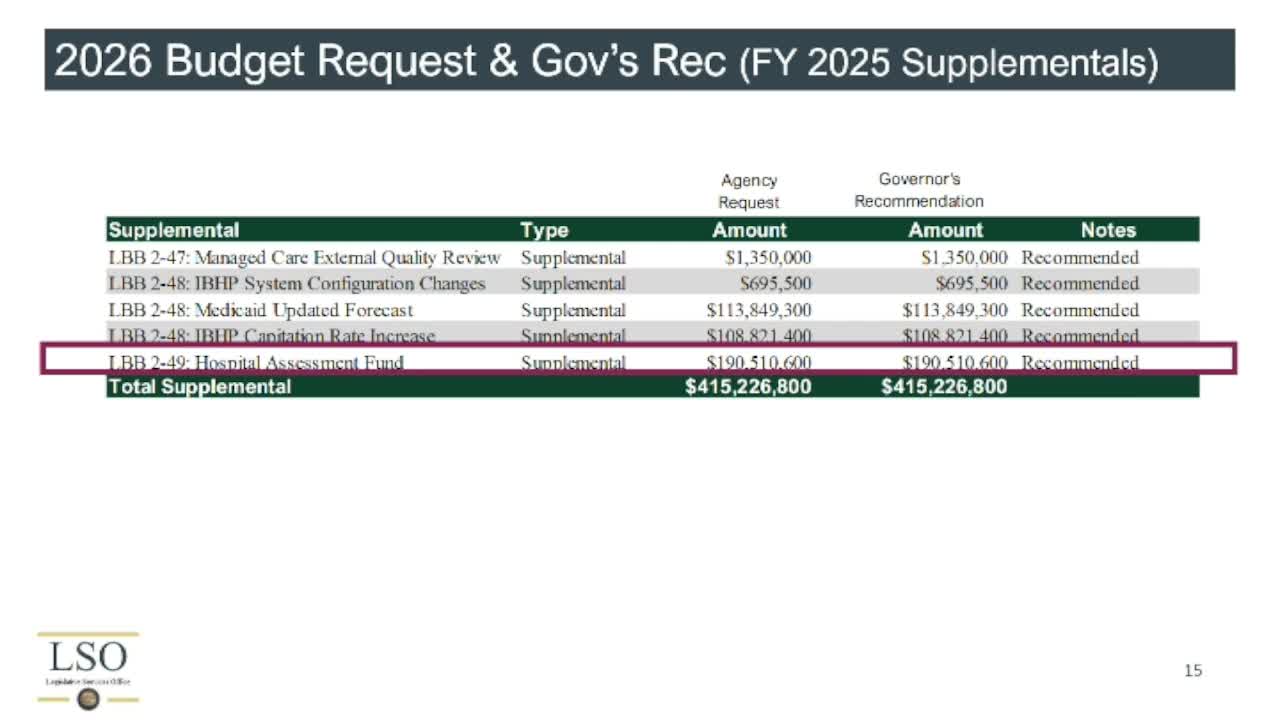
A $190 million supplemental tied to changes in the hospital assessment and the upper payment limit (UPL) drew questions on Feb. 26 about how much of the assessment remains with state government versus being passed through to hospitals and whether policy changes could redirect funds to offset Medicaid expansion costs.
BOISE — Committee members on Feb. 26 pressed Medicaid analysts and department officials about a $190 million supplemental request related to the hospital assessment fund and changes to upper payment limit (UPL) calculations enacted in 2022.
Alex Williamson told JFAC the $190 million request is coded as entrusted benefit payments; about $77 million would come from dedicated funds (the hospital assessment fund) and roughly $113 million from federal funds. She tied the request to Senate Bill 1350 (2022), which altered how the UPL for hospitals and skilled nursing facilities is calculated, and said a similar supplemental had been required in fiscal 2024 after hospitals identified larger than expected assessments needed to access additional federal dollars.
Representative Tanner characterized the request as “more like a blank check to the hospitals,” asking whether Idaho could instead structure assessments or legislation so more money offset state Medicaid costs directly. Williamson replied that “the full amount is not going back to the hospitals. A portion of that does stay with the state. I think it would require some policy changes if you wanted that to go in a different direction.”
Director Alex Adams and Ms. Williamson told lawmakers that changing how funds are used would likely require a policy bill and legislative action; the department described the present request as responding to the revised methodology and its cash‑flow implications.
Ending — Lawmakers asked for more detail on how the hospital assessment is calculated, what portion is retained by the state and what statutory changes (if any) would be required to redirect revenues; analysts agreed to follow up with documentation and background materials.