Get Full Government Meeting Transcripts, Videos, & Alerts Forever!
Get email alerts on the Education School Choice topic
No spam. Unsubscribe anytime.
Senate committee advances parental tax-credit bill for private-school expenses after hours of testimony
Summary
The Idaho Senate Local Government and Taxation Committee voted 6-3 to send House Bill 93 — a capped refundable tax-credit program to help parents pay private-school, tutoring and related K–12 costs — to the full Senate after extensive testimony for and against the proposal.
The Senate Local Government and Taxation Committee voted 6-3 to send House Bill 93, the "Idaho Parental Choice Tax Credit," to the full Senate with a due-pass recommendation after more than three hours of testimony and questions.
Sponsor Senator Lori Den Hartog, R-22, told the committee HB 93 would expand school-choice options for Idaho families and is ‘‘about kids and families, and it's not about the type of school or the type of system.’’ The bill would create a refundable tax credit, based on actual expenses, of up to $5,000 per student and up to $7,500 for a student with a qualifying disability. The program would be capped at $50 million in total credits for the state, with an application window opening Jan. 15, 2026 for expenses incurred in the 2025 tax year and a 60-day application period; families at or below 300% of the federal poverty level would receive priority and could elect a one-time advance payment subject to recapture rules.
The bill places primary administrative responsibility with the Idaho State Tax Commission, which Den Hartog said would create a new fund and publish cumulative amounts claimed and remaining for transparency. The sponsor also described a revised fiscal note showing three full-time employees (two funded within existing vacancies), five part-time seasonal workers, and a $125,000 software/data-processing cost; those implementation costs, she said, were intended to be paid from the $50 million cap rather than on top of it.
Opponents raised concerns about accountability, discrimination by private schools, rural impacts and fiscal drift. Sylvia Cheriton of the American Association of University Women urged a no vote, saying Idaho should invest in ‘‘public schools that serve all students’’ and recounting facilities problems she has seen in public schools. Chuck Winder of Idaho Business for Education told the committee the Tax Commission lacks expertise to evaluate special-education eligibility or private-school outcomes and described ‘‘three fatal flaws’’ in the measure.
Quinn Perry, deputy director of the Idaho School Boards Association, said the bill provides no baseline protections for students denied admission by private schools and questioned whether private schools receiving public dollars should be subject to background checks or other minimum safeguards. Perry said private schools can and do exclude students with learning disabilities or on religious grounds and asked why taxpayers should subsidize institutions that may select students.
Supporters included parents and students who described private or alternative programs meeting individual needs. Jeff Himas, vice principal at Legacy Academy in Nampa, said competition ‘‘can improve outcomes’’ and argued the flow of funds to families, not schools, returns some public funding to families who already pay taxes. Testimony from families and providers emphasized special-needs students, bullying, or other circumstances where parents sought alternatives to their assigned public school.
Committee members questioned enforcement capacity, auditing practices and whether the tax-credit structure could lead to tuition inflation. Senator Ravi (questioner) asked how the Tax Commission would ensure accountability given its current audit rate; Den Hartog replied the commission could determine the types of staff it hires and that audit/compliance functions could be part of the new positions. Several senators said they supported a full Senate debate so the measure could be vetted further.
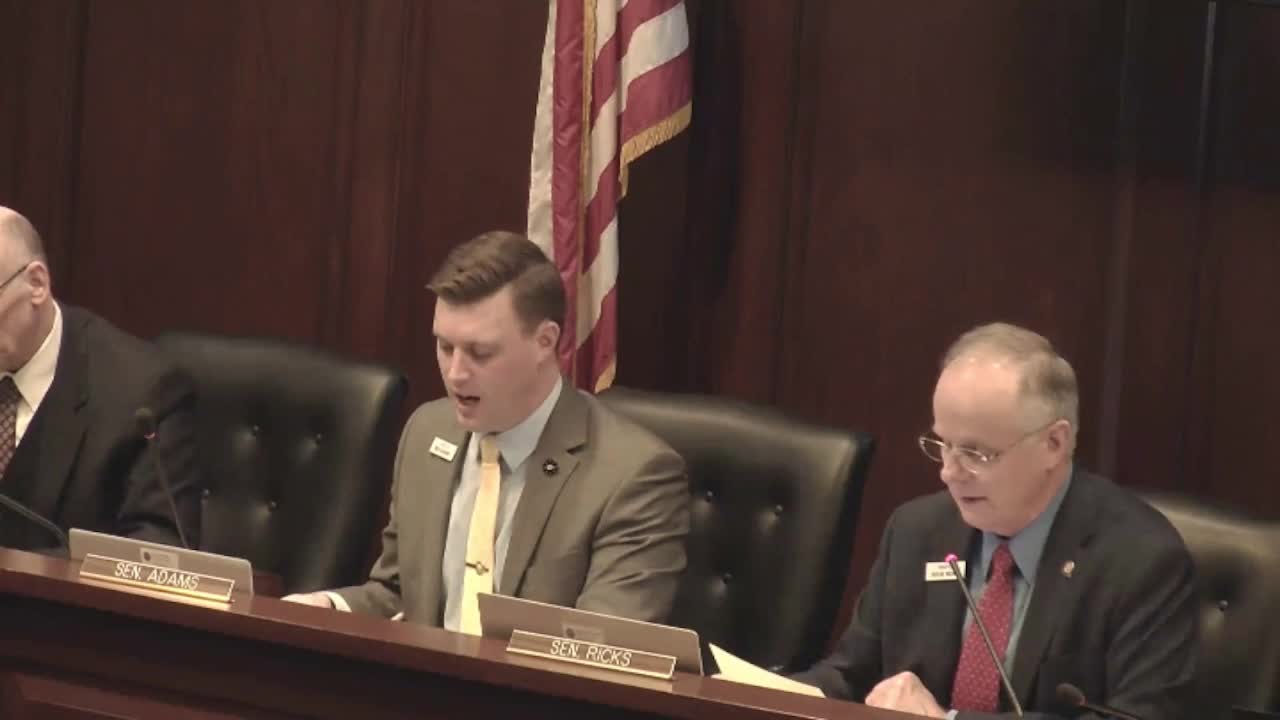
Votes at a glance: the committee approved earlier minutes for Jan. 30 and Feb. 4 by voice vote and approved the motion to send HB 93 to the Senate floor with a due-pass recommendation by a roll-call vote of 6–3 (ayes recorded for Senators Ricks, Adams, Grohl, Anthon, Den Hartog and Toews; nays recorded for Senators Burnt, Robby and Taylor).
The committee record shows the bill will move next to consideration by the full Senate. Supporters say the measure offers targeted help for families and built-in transparency and a cap; opponents say it risks diverting public resources, lacks sufficient oversight of private providers, and will unevenly benefit urban and wealthier districts. The Tax Commission and legislative staff will be central to implementation if the Senate approves the bill.
The hearing included more than an hour of public testimony, with dozens of in-person and virtual speakers for and against the proposal. The Committee debated implementation details, rural equity and constitutional concerns before taking final action to advance the bill.