Get Full Government Meeting Transcripts, Videos, & Alerts Forever!
Get email alerts on the Cybersecurity It topic
No spam. Unsubscribe anytime.
Idaho ITS seeks $10 million cyber-resilience fund amid agency consolidation and rising attack volumes
Summary
Office of Information Technology Services requested a newly created cybersecurity and IT resilience fund with a $10 million initial transfer in the governor's recommendation, and outlined consolidation phases that will move additional agency IT staff into ITS. Administrator Alberto Gonzales warned of millions of automated attacks and said legacy
Christopher LaHosa, a Legislative Services Office budget analyst, opened the Office of Information Technology Services presentation and summarized recent years of agency consolidation and growth in ITS full-time positions. He said the agency now centralizes IT for most executive-branch agencies and that projected cash balances for ITS’s primary fund could be exhausted within the next fiscal year without structural changes.
Why it matters: ITS manages enterprise IT, cyber security and shared services used across dozens of state agencies; decisions on a cyber-resilience fund, consolidation and ongoing replacement budgets affect statewide continuity, data security and agency operations.
Alberto Gonzales, ITS administrator, outlined the cybersecurity case the agency made to JFAC: "Number 1 is the humans by far the biggest threat" and he urged ongoing investment in hardware replacement and security services to reduce risk from legacy equipment and applications. Gonzales said ITS recorded millions of malicious events in the last year: "our firewall had over a 6,000,000 attacks. Our users... were attacked over 14,000,000 times... our endpoints... we had over 20,000 attacks on those things... our security team has fought back 15,000 incidents, ... 900 are very serious."
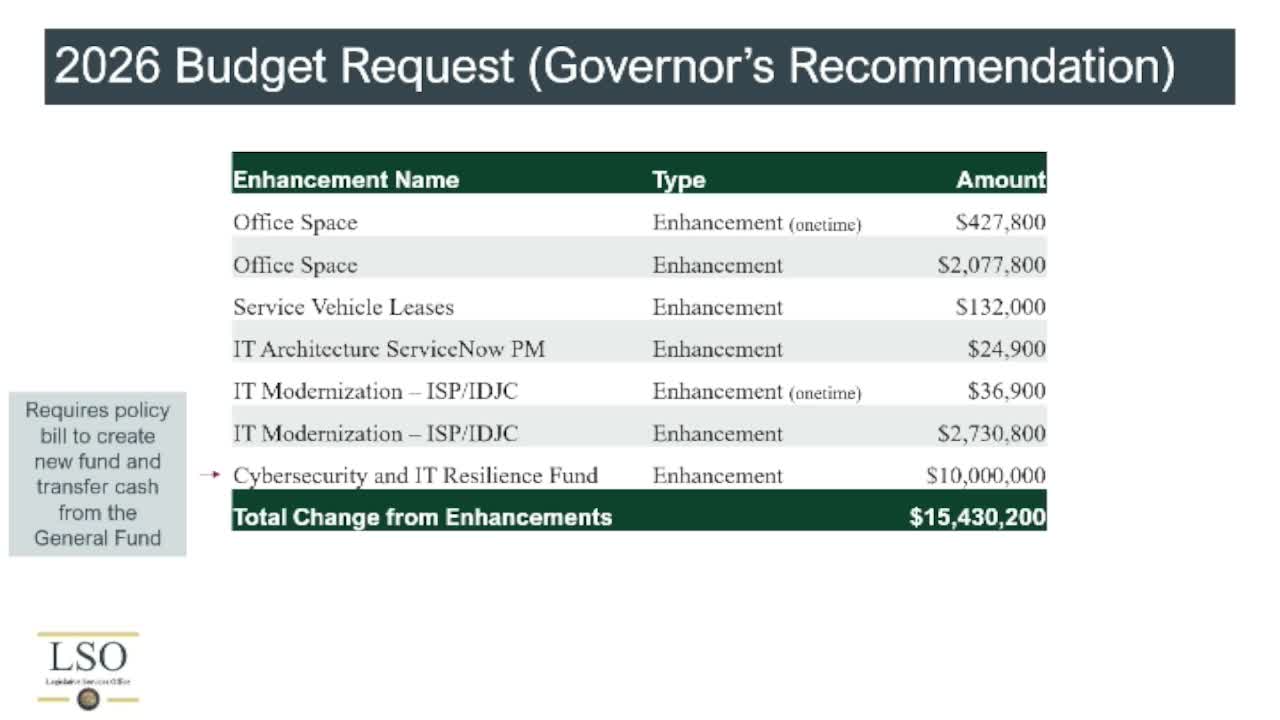
Governor's recommendation and fund proposal: LaHosa summarized the governor’s recommendation to create a new cybersecurity and IT resilience fund with an initial $10,000,000 cash transfer from the general fund and continuous appropriation authority for ITS. The package would permit ITS to purchase enterprise security improvements, emergency connectivity services, IT infrastructure investments and additional hardware replacement items that did not fit into individual agency requests.
Consolidation timeline and staffing: LSO and ITS detailed earlier consolidation phases, noting ITS absorption of IT personnel from multiple agencies over several years (including Department of Corrections, Fish and Game, the Department of Labor and others). Phase 5 would add 22 positions as ITS continues onboarding agencies such as Idaho State Police and Juvenile Corrections; Health and Welfare was discussed as a larger future consolidation requiring earlier preparatory work.
Financial position and request details: ITS asked for multiple line items, including building relocation costs, service vehicles, ServiceNow ticketing implementation, and phase‑5 ongoing costs. LSO warned that ITS’s primary administration fund projected exhaustion and that a centralized fund could provide a planned vehicle for multiyear enterprise-level purchases.
Committee questions focused on whether the $10 million would be one-time or ongoing, how ITS would prioritize hardware replacements across agencies and the agency’s approach to bringing large agencies on line without disrupting services. Gonzales said the fund’s design aims to prevent agencies from deferring critical defensive hardware because of individual operating budgets and to let ITS coordinate replacements and security upgrades statewide.
Gonzales emphasized the programmatic goal: to centralize and manage hardware on the state's network so the state can ensure patching and defensible configurations rather than leaving varied, unsecured devices on agency networks. He also described steps ITS is taking to prepare for larger consolidations, including embedding ITS staff with Health and Welfare leadership 18 months before that scheduled transition.
No appropriation votes occurred during the hearing; the committee asked for more detail, vendor quotes and fiscal notes, which LSO said were posted to SharePoint and DFM materials. ITS and LSO agreed to provide additional clarifications on ongoing versus one-time elements and on the recommended fund’s governance and proposed annual transfers.