Get Full Government Meeting Transcripts, Videos, & Alerts Forever!
Get email alerts on the Water Management topic
No spam. Unsubscribe anytime.
Idaho water officials seek staff, sustained funding to expand recharge and manage Eastern Snake Plain
Summary
Department of Water Resources and Idaho Water Resource Board told a legislative budget panel they need five new water-administration staff and ongoing funding to expand recharge, complete projects and carry out the Eastern Snake Plain Aquifer settlement. Officials said the agency currently has large committed project balances from past appropriati
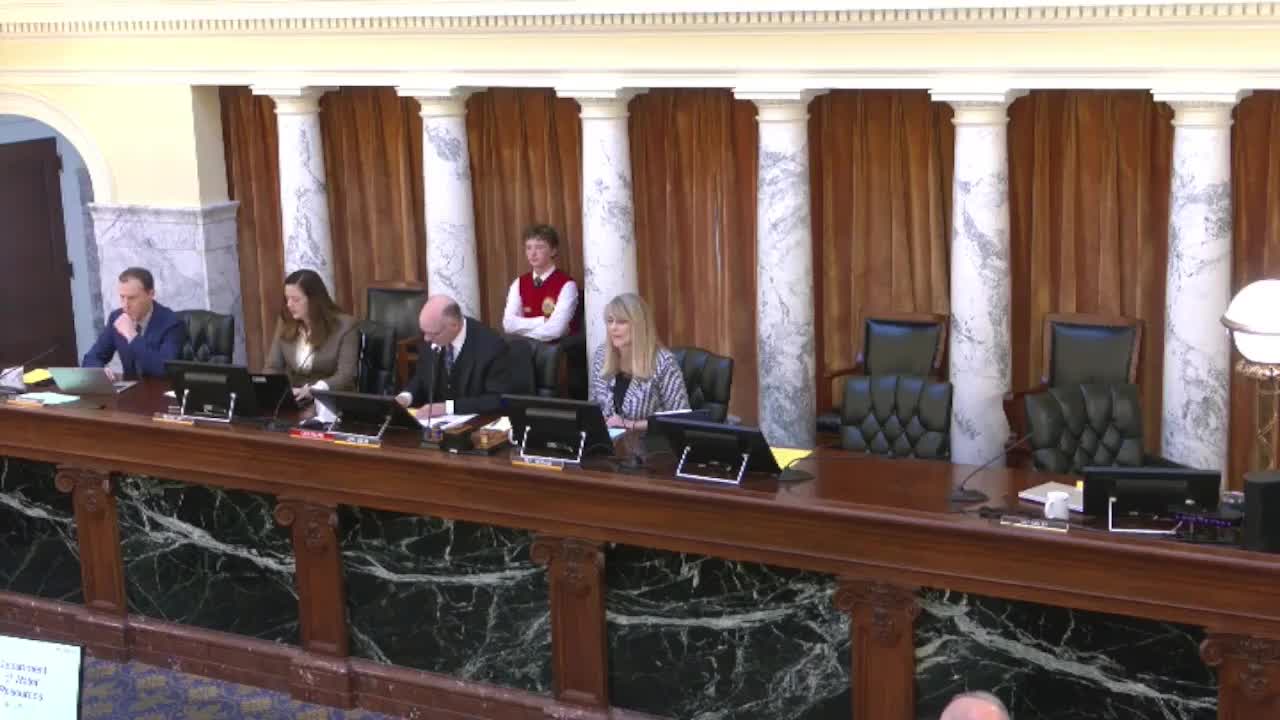
At a March legislative budget hearing, the Idaho Department of Water Resources and the Idaho Water Resource Board told lawmakers they need additional staff and sustained funding to expand managed recharge, support water districts and carry out projects tied to the Eastern Snake Plain Aquifer (ESPA) settlement.
The department requested five new water-administration positions to form a Water Administration Bureau and a public information officer, and noted a governor-recommended $30 million ongoing general-fund transfer to the water management fund to support water projects statewide.
The request responds to rising demand for creating and supporting water districts, ongoing adjudications and an agreement on the Eastern Snake Plain that the department said requires expanded administration and recharge. Budget analyst Janet Jessup told the committee the department received a large infusion of federal American Rescue Plan Act (ARPA) state fiscal recovery funds in recent years — “50,000,000 of this appropriation was 1 time and the other 50,000,000 was made ongoing,” — and that those ARPA dollars account for a marked increase in recent expenditures.
Director Matthew Weaver and Idaho Water Resource Board Chairman Jeff Raybould answered lawmakers’ questions about where money is committed and how recharge and district creation would be expanded. Weaver described the staffing request as a pairing of five new positions with about 11 existing staff now working on water administration: “This proposal would add 5 positions that would get paired, with those 11 existing positions, and we would create a water administration bureau,” Weaver said, adding the five include a bureau chief and a technical records specialist. Weaver said the department is “not meeting the demand to create and support water districts across the state.”
Chairman Raybould gave an overview of projects funded or committed by the water management account, including work at Mountain Home Air Force Base (water-supply pipeline and pumping), Anderson Ranch dam raise planning, a pipeline from Dworsha Dam for hatchery water, Bear Lake storage/carryover work, Priest Lake water management, loans and grants for canal conversions, groundwater-to-surface-water conversion grants and loans, and the Treasure Valley water-supply assessment and potential recharge work. Raybould described loans and grants decisions as case-by-case and said some grant programs will pay up to one-third of project costs, with caps (for example, the aging infrastructure grant pays up to $2,000,000).
On account balances: Weaver summarized a series of fund figures for the water management account as shown to the committee: an ending balance of roughly $293,000,000 at the end of FY2024, revenues since then of about $38,000,000 and expenditures of about $11,200,000, leaving cash of roughly $320,000,000. Of that, board-committed funds totaled about $290,000,000, leaving an uncommitted balance of about $29,000,000. Raybould emphasized that many large projects are paid out over time and that the board disburses funds as project work progresses.
Recharge and ESPA management were central topics. Weaver described the department’s and private actors’ recent recharge and reduced pumping: “Over that period of time, the Idaho Water Resource Board, so state sponsored recharge, was able to average 268,000 acre feet a year of recharge. Private individuals … were able to recharge 116,000 acre feet a year … and they reduced their pumping by 212,000 acre feet.” He summarized those actions as roughly 600,000 acre-feet of aquifer-management activity in recent years and said the board is proposing to raise the average annual recharge target in its aquifer management plan from “250,000 acre feet a year to 350,000 acre feet.”
Lawmakers pressed on pace and delivery: committee members repeatedly noted large committed balances and asked why projects were not already under construction. Raybould and Weaver described typical timelines for major projects (engineering, stakeholder coalitions, environmental and permitting work) and said money is released incrementally as projects reach milestones. Raybould said some projects remain in engineering and have not yet been formally presented to the board for funding draws.
Weaver and Raybould outlined a mix of funding tools the board uses — outright grants, loans with water-right collateral, and regional sustainability grants — and gave examples of projects funded with a mix of ARPA, state water management funds and federal partners (for example, Bureau of Reclamation participation on some irrigation modernization projects). Weaver said the department’s long-term obligations under the ESPA settlement will require continuing resources and administrative capacity, and he noted the department estimated a much larger staffing need to implement full real-time monitoring: “Our back of the envelope estimate was to fulfill that obligation under the settlement agreement. It would take 12 to 15 full time positions at the department,” he said, while noting that water users and districts will share some of that burden.
Committee members asked whether the ongoing $30 million recommendation should be one-time or ongoing and sought clearer project lists before committing additional base funding. Several lawmakers urged caution about rapidly increasing permanent staff and ongoing base funding without project-level detail. Raybould and Weaver said they would provide the committee with the board’s statewide project list and other supporting documents the department maintains.
The hearing included multiple technical and policy clarifications: Jessup explained that consolidated fund sheets in members’ SharePoint show ending cash balances while separate PDFs show money already committed to projects; ArcGIS license changes drove a requested $58,500 ongoing increase for software licensing; the department requested a one‑time laserfiche conversion to streamline about 75 forms; and ARPA appropriations have been used heavily for operating and trustee/benefit payments in the last two fiscal years.
The department concluded by reiterating priorities identified by water users — water administration, water-supply enhancements including recharge, and water projects — and by asking the committee for thoughtful review of the staffing and funding requests.
Ending
Department officials and the board said they will provide the committee with the statewide project list and additional fund‑detail PDFs in SharePoint, and emphasized that large projects are typically released in stages as engineering and agreements are completed.